

Mass balances for biofilters
5.6.
The filter is loaded with 1 rnlh corresponding to 24 rnld and a concentration of 500 g
COD/m 3 , or 500 · 24 = 12,000 g COD/(m 2 ·d). The filter removes 2400 g COD/(m 3 ·
d) over 4 m, that is, 9600 g COD/(m 2 · d). Residue: 2400 g COD/(m 2 · d), corresponding to an effluent concentration of 2400/24 = 100 g COD/m 3 . Hence a COD-limited removal (1 00 g COD/m 3 > 14 g COD/m 3 ) does not occur.
Mass balances for biofilters
Normally it is not necessary to recycle sludge over a biofilter plant, as the sludge
concentration becomes sufficiently large by means of the biofilm and a sufficiently
large specific solid surface (the carrier). As recycle of sludge is not necessary, we can,
in certain cases, leave out a secondary settling tank- see Section 6 about nitrification.
Normally, however, the sludge present in the water which has passed the biofilter
needs a subsequent settling. The sludge comes from sloughed off biofilm and from
the content of suspended solids in the influent water.
5.6.1 Biofilters without recycle
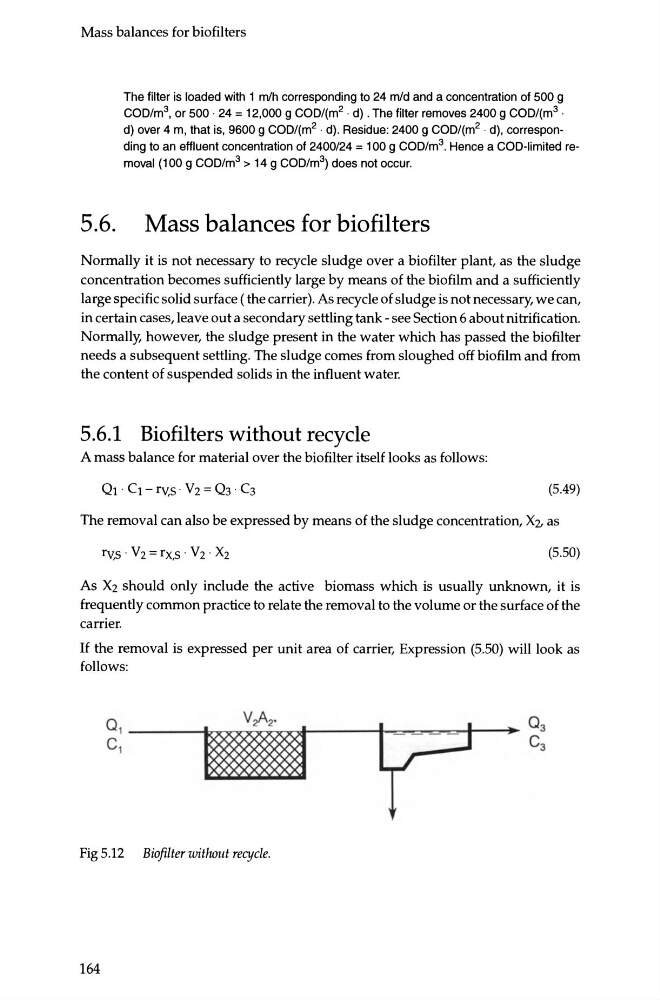
A mass balance for material over the biofilter itself looks as follows:
(5.49)
The removal can also be expressed by means of the sludge concentration, X:u as
(5.50)
As X2 should only include the active biomass which is usually unknown, it is
frequently common practice to relate the removal to the volume or the surface of the
carrier.
If the removal is expressed per unit area of carrier, Expression (5.50) will look as
follows:
Fig 5.12 Biofilter without recycle.
164
5.6.
The filter is loaded with 1 rnlh corresponding to 24 rnld and a concentration of 500 g
COD/m 3 , or 500 · 24 = 12,000 g COD/(m 2 ·d). The filter removes 2400 g COD/(m 3 ·
d) over 4 m, that is, 9600 g COD/(m 2 · d). Residue: 2400 g COD/(m 2 · d), corresponding to an effluent concentration of 2400/24 = 100 g COD/m 3 . Hence a COD-limited removal (1 00 g COD/m 3 > 14 g COD/m 3 ) does not occur.
Mass balances for biofilters
Normally it is not necessary to recycle sludge over a biofilter plant, as the sludge
concentration becomes sufficiently large by means of the biofilm and a sufficiently
large specific solid surface (the carrier). As recycle of sludge is not necessary, we can,
in certain cases, leave out a secondary settling tank- see Section 6 about nitrification.
Normally, however, the sludge present in the water which has passed the biofilter
needs a subsequent settling. The sludge comes from sloughed off biofilm and from
the content of suspended solids in the influent water.
5.6.1 Biofilters without recycle
A mass balance for material over the biofilter itself looks as follows:
(5.49)
The removal can also be expressed by means of the sludge concentration, X:u as
(5.50)
As X2 should only include the active biomass which is usually unknown, it is
frequently common practice to relate the removal to the volume or the surface of the
carrier.
If the removal is expressed per unit area of carrier, Expression (5.50) will look as
follows:
Fig 5.12 Biofilter without recycle.
164