

Filter kinetics
I.
It is determined whether oxygen or organic matter is the potentially limiting
factor and hence controls the removal rate and the kinetics.
II.
It is determined whether the whole biofilm is active (that is, whether the
potentially limiting matter is found throughout the biofilm, or whether only
the outer part of the biofilm removes substances). This is important for the order
of reaction.
The calculation path is shown in Fig 5.9.
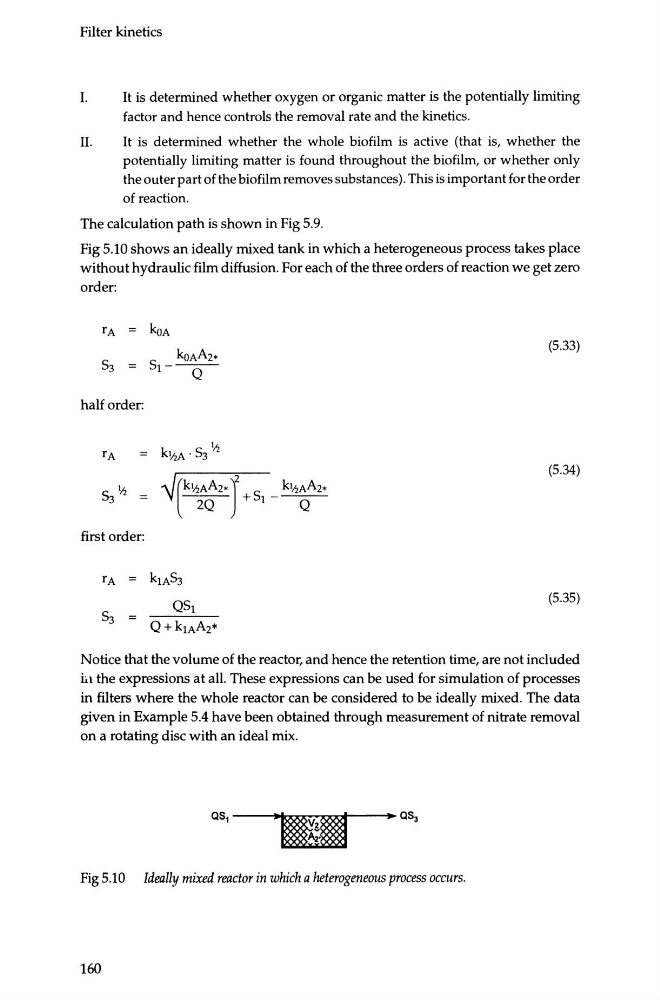
Fig 5.10 shows an ideally mixed tank in which a heterogeneous process takes place
without hydraulic film diffusion. For each of the three orders of reaction we get zero
order:
fA
koA
s3
koAA2•
St---Q
(5.33)
half order:
fA
kt~zA. s 3
l!z
S3 liz = ~ (ki!zAA2• J kt~zAA2•
20
+StQ
(5.34)
first order:
fA
ktAS3
s3
OSt
= Q+ktAA2*
(5.35)
Notice that the volume of the reactor, and hence the retention time, are not included
itt the expressions at all. These expressions can be used for simulation of processes
in filters where the whole reactor can be considered to be ideally mixed. The data
given in Example 5.4 have been obtained through measurement of nitrate removal
on a rotating disc with an ideal mix.
Fig 5.10 Ideally mixed reactor in which a heterogeneous process occurs.
160
I.
It is determined whether oxygen or organic matter is the potentially limiting
factor and hence controls the removal rate and the kinetics.
II.
It is determined whether the whole biofilm is active (that is, whether the
potentially limiting matter is found throughout the biofilm, or whether only
the outer part of the biofilm removes substances). This is important for the order
of reaction.
The calculation path is shown in Fig 5.9.
Fig 5.10 shows an ideally mixed tank in which a heterogeneous process takes place
without hydraulic film diffusion. For each of the three orders of reaction we get zero
order:
fA
koA
s3
koAA2•
St---Q
(5.33)
half order:
fA
kt~zA. s 3
l!z
S3 liz = ~ (ki!zAA2• J kt~zAA2•
20
+StQ
(5.34)
first order:
fA
ktAS3
s3
OSt
= Q+ktAA2*
(5.35)
Notice that the volume of the reactor, and hence the retention time, are not included
itt the expressions at all. These expressions can be used for simulation of processes
in filters where the whole reactor can be considered to be ideally mixed. The data
given in Example 5.4 have been obtained through measurement of nitrate removal
on a rotating disc with an ideal mix.
Fig 5.10 Ideally mixed reactor in which a heterogeneous process occurs.
160