

Two-component diffusion
L
L
s ••
s •• - ~
__ _.. __ .,,
•5vf.ox= 0
.......
X= 0
x1
X= L
X = 0
X = L
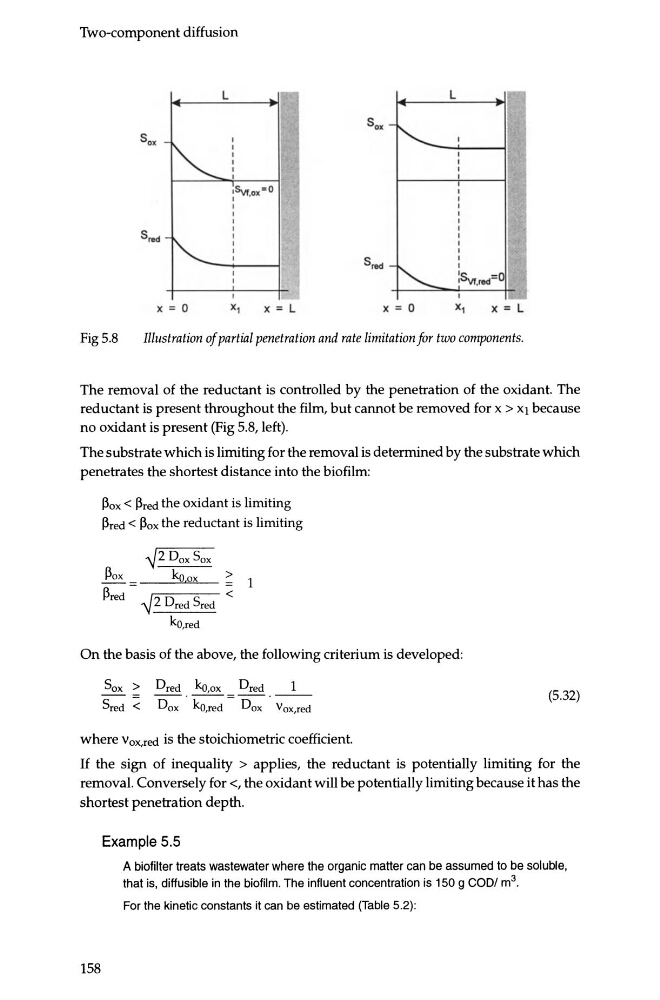
Fig5.8
Illustration of partial penetration and rate limitation for two components.
The removal of the reductant is controlled by the penetration of the oxidant. The
reductant is present throughout the film, but cannot be removed for x > XI because
no oxidant is present (Fig 5.8, left).
The substrate which is limiting for the removal is determined by the substrate which
penetrates the shortest distance into the biofilm:
~ox < ~red the oxidant is limiting
~red< ~ox the reductant is limiting
~ox
~red
~2 Dox Sox
koox
>
~2 Dred Sred <
ko,red
1
On the basis of the above, the following criterium is developed:
Sox > Dred . ko,ox = Dred . 1
Sred < Dox ko,red Dox Yox,red
where Vox,red is the stoichiometric coefficient.
(5.32)
If the sign of inequality > applies, the reductant is potentially limiting for the
removal. Conversely for<, the oxidant will be potentially limiting because it has the
shortest penetration depth.
158
Example 5.5
A biofilter treats wastewater where the organic matter can be assumed to be soluble,
that is, diffusible in the biofilm. The influent concentration is 150 g COD/ m 3 .
For the kinetic constants it can be estimated (Table 5.2):
L
L
s ••
s •• - ~
__ _.. __ .,,
•5vf.ox= 0
.......
X= 0
x1
X= L
X = 0
X = L
Fig5.8
Illustration of partial penetration and rate limitation for two components.
The removal of the reductant is controlled by the penetration of the oxidant. The
reductant is present throughout the film, but cannot be removed for x > XI because
no oxidant is present (Fig 5.8, left).
The substrate which is limiting for the removal is determined by the substrate which
penetrates the shortest distance into the biofilm:
~ox < ~red the oxidant is limiting
~red< ~ox the reductant is limiting
~ox
~red
~2 Dox Sox
koox
>
~2 Dred Sred <
ko,red
1
On the basis of the above, the following criterium is developed:
Sox > Dred . ko,ox = Dred . 1
Sred < Dox ko,red Dox Yox,red
where Vox,red is the stoichiometric coefficient.
(5.32)
If the sign of inequality > applies, the reductant is potentially limiting for the
removal. Conversely for<, the oxidant will be potentially limiting because it has the
shortest penetration depth.
158
Example 5.5
A biofilter treats wastewater where the organic matter can be assumed to be soluble,
that is, diffusible in the biofilm. The influent concentration is 150 g COD/ m 3 .
For the kinetic constants it can be estimated (Table 5.2):