

Hydraulic film diffusion
N = h(S- Sg)
(5.26)
where h is the transfer coefficient (m/ d). The phenomenon is an analogue for the
transport of impulse, heat and substance. Much literature is available on tubes,
plane surfaces, etc.; but it may be difficult to transfer the information to a biofilm
whose surface structure is often badly defined in respect of hydrodynamics. Very
few figures from experience are available for biofilms.
In the case where there is a diffusional limitation in the hydraulic film and in the
biofilm, the result for a zero order reaction in the biofilm is:
( dSvfl
N = h(S - Sg) = - D dx = 0
(5.27)
because the flux across the interface must be the same, both in relation to the
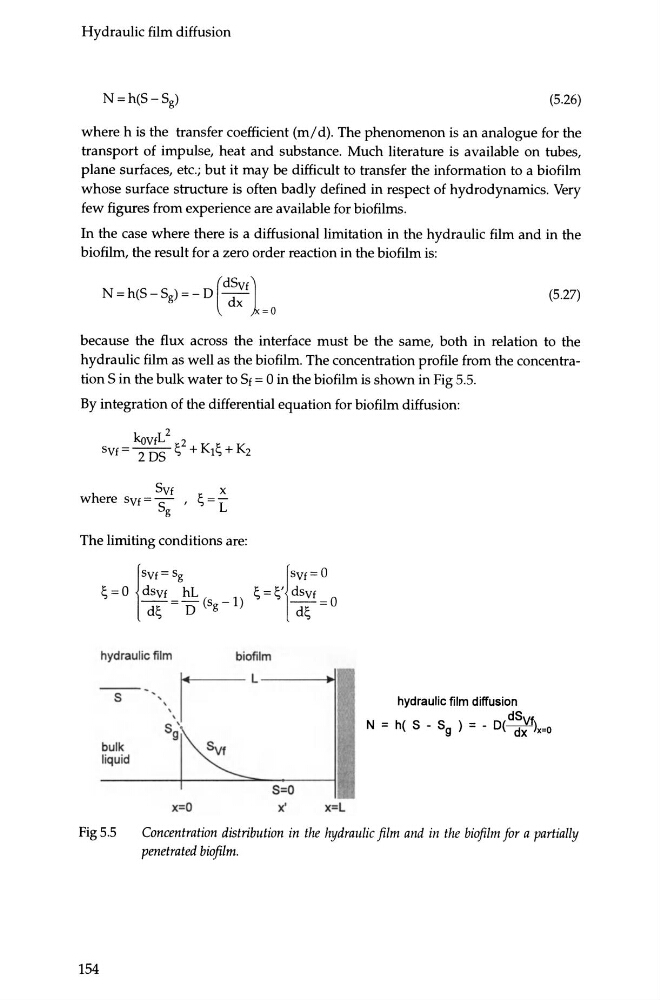
hydraulic film as well as the biofilm. The concentration profile from the concentrationS in the bulk water to St = 0 in the biofilm is shown in Fig 5.5.
By integration of the differential equation for biofilm diffusion:
kovtL 2 2
Syf = 2 DS ~ + Kl~ + K2
Svt
x
where svt=s , ~ =r:;
g
The limiting conditions are:
l
svf = sg
lsvf = 0
~ = 0 dsvf hL
~ = ~, dsvf
- = - ( s -1)
- = 0
d~
D g
d~
hydraulic film
bulk
liquid
x=O
biofilm
S=O
X:
x=L
hydraulic film diffusion
dSvt
N = h( S - S 9 ) = - D(--aJC)x•O
FigS.S
Concentration distribution in the hydraulic film and in the biofilm for a partially
penetrated biofilm.
154
N = h(S- Sg)
(5.26)
where h is the transfer coefficient (m/ d). The phenomenon is an analogue for the
transport of impulse, heat and substance. Much literature is available on tubes,
plane surfaces, etc.; but it may be difficult to transfer the information to a biofilm
whose surface structure is often badly defined in respect of hydrodynamics. Very
few figures from experience are available for biofilms.
In the case where there is a diffusional limitation in the hydraulic film and in the
biofilm, the result for a zero order reaction in the biofilm is:
( dSvfl
N = h(S - Sg) = - D dx = 0
(5.27)
because the flux across the interface must be the same, both in relation to the
hydraulic film as well as the biofilm. The concentration profile from the concentrationS in the bulk water to St = 0 in the biofilm is shown in Fig 5.5.
By integration of the differential equation for biofilm diffusion:
kovtL 2 2
Syf = 2 DS ~ + Kl~ + K2
Svt
x
where svt=s , ~ =r:;
g
The limiting conditions are:
l
svf = sg
lsvf = 0
~ = 0 dsvf hL
~ = ~, dsvf
- = - ( s -1)
- = 0
d~
D g
d~
hydraulic film
bulk
liquid
x=O
biofilm
S=O
X:
x=L
hydraulic film diffusion
dSvt
N = h( S - S 9 ) = - D(--aJC)x•O
FigS.S
Concentration distribution in the hydraulic film and in the biofilm for a partially
penetrated biofilm.
154