

Biofilm kinetics
where Ks is the concentration at which the two reaction rates would be identical if
there were only first and zero orders, or the saturation constant, if Monod kinetics
were applied. Hence:
first order:
zero order:
fA
klVf L£
S
K=-=---5=£·
koA kovf L
Ks
fA
K=-=1
koA
I
p > 1
P<1
1 12
K=_rA_=_k~ _A_s_ Y 2 = --./2 Dkovt'~ = P= fi(2_J
koA
koA
kovtL
a Ks
(5.21)
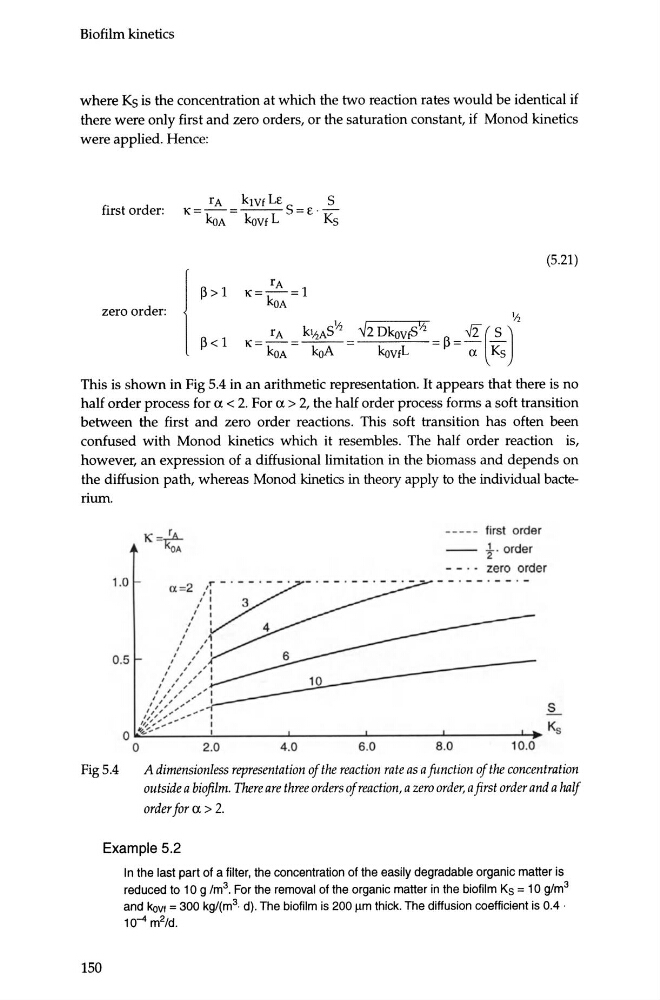
This is shown in Fig 5.4 in an arithmetic representation. It appears that there is no
half order process for a< 2. For a> 2, the half order process forms a soft transition
between the first and zero order reactions. This soft transition has often been
confused with Monod kinetics which it resembles. The half order reaction is,
however, an expression of a diffusional limitation in the biomass and depends on
the diffusion path, whereas Monod kinetics in theory apply to the individual bacterium.
K =~ OA
1.0
0.5
2.0
4.0
6.0
first order
f· order
zero order
8.0
10.0
Fig 5.4
A dimensionless representation of the reaction rate as a function of the concentration
outside a biofilm. There are three orders of reaction, a zero order, a first order and a half
order for a> 2.
150
Example 5.2
In the last part of a filter, the concentration of the easily degradable organic matter is
reduced to 10 g 1m 3 . For the removal of the organic matter in the biofilm Ks = 10 g/m 3
and kovt = 300 kg/(m 3 · d). The biofilm is 200 iJ.m thick. The diffusion coefficient is 0.4 ·
10--<~ m 2 /d.
where Ks is the concentration at which the two reaction rates would be identical if
there were only first and zero orders, or the saturation constant, if Monod kinetics
were applied. Hence:
first order:
zero order:
fA
klVf L£
S
K=-=---5=£·
koA kovf L
Ks
fA
K=-=1
koA
I
p > 1
P<1
1 12
K=_rA_=_k~ _A_s_ Y 2 = --./2 Dkovt'~ = P= fi(2_J
koA
koA
kovtL
a Ks
(5.21)
This is shown in Fig 5.4 in an arithmetic representation. It appears that there is no
half order process for a< 2. For a> 2, the half order process forms a soft transition
between the first and zero order reactions. This soft transition has often been
confused with Monod kinetics which it resembles. The half order reaction is,
however, an expression of a diffusional limitation in the biomass and depends on
the diffusion path, whereas Monod kinetics in theory apply to the individual bacterium.
K =~ OA
1.0
0.5
2.0
4.0
6.0
first order
f· order
zero order
8.0
10.0
Fig 5.4
A dimensionless representation of the reaction rate as a function of the concentration
outside a biofilm. There are three orders of reaction, a zero order, a first order and a half
order for a> 2.
150
Example 5.2
In the last part of a filter, the concentration of the easily degradable organic matter is
reduced to 10 g 1m 3 . For the removal of the organic matter in the biofilm Ks = 10 g/m 3
and kovt = 300 kg/(m 3 · d). The biofilm is 200 iJ.m thick. The diffusion coefficient is 0.4 ·
10--<~ m 2 /d.