

Types of plants, activated sludge plants
a
1 ~ •..
"?
b
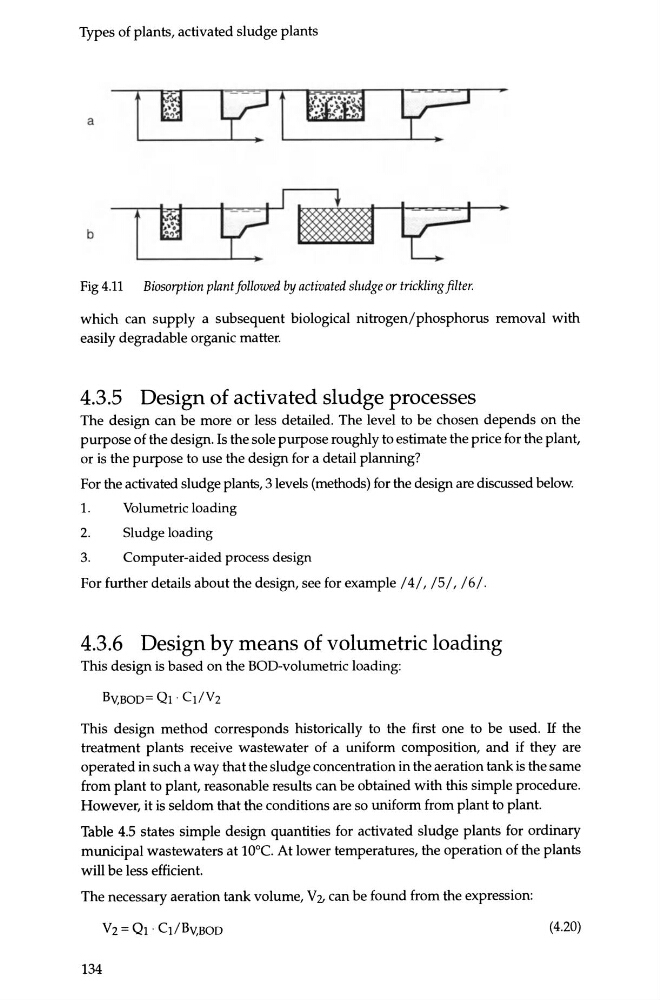
Fig 4.11 Biosorption plant followed by activated sludge or trickling filter.
which can supply a subsequent biological nitrogen/phosphorus removal with
easily degradable organic matter.
4.3.5 Design of activated sludge processes
The design can be more or less detailed. The level to be chosen depends on the
purpose of the design. Is the sole purpose roughly to estimate the price for the plant,
or is the purpose to use the design for a detail planning?
For the activated sludge plants, 3levels (methods) for the design are discussed below.
1.
Volumetric loading
2.
Sludge loading
3.
Computer-aided process design
For further details aboutthe design, see for example /4/ , /5/, /6/ .
4.3.6 Design by means of volumetric loading
This design is based on the BOD-volumetric loading:
This design method corresponds historically to the first one to be used. If the
treatment plants receive wastewater of a uniform composition, and if they are
operated in such a way that the sludge concentration in the aeration tank is the same
from plant to plant, reasonable results can be obtained with this simple procedure.
However, it is seldom that the conditions are so uniform from plant to plant.
Table 4.5 states simple design quantities for activated sludge plants for ordinary
municipal wastewaters at 10°C. At lower temperatures, the operation of the plants
will be less efficient.
The necessary aeration tank volume, V'b can be found from the expression:
(4.20)
134
a
1 ~ •..
"?
b
Fig 4.11 Biosorption plant followed by activated sludge or trickling filter.
which can supply a subsequent biological nitrogen/phosphorus removal with
easily degradable organic matter.
4.3.5 Design of activated sludge processes
The design can be more or less detailed. The level to be chosen depends on the
purpose of the design. Is the sole purpose roughly to estimate the price for the plant,
or is the purpose to use the design for a detail planning?
For the activated sludge plants, 3levels (methods) for the design are discussed below.
1.
Volumetric loading
2.
Sludge loading
3.
Computer-aided process design
For further details aboutthe design, see for example /4/ , /5/, /6/ .
4.3.6 Design by means of volumetric loading
This design is based on the BOD-volumetric loading:
This design method corresponds historically to the first one to be used. If the
treatment plants receive wastewater of a uniform composition, and if they are
operated in such a way that the sludge concentration in the aeration tank is the same
from plant to plant, reasonable results can be obtained with this simple procedure.
However, it is seldom that the conditions are so uniform from plant to plant.
Table 4.5 states simple design quantities for activated sludge plants for ordinary
municipal wastewaters at 10°C. At lower temperatures, the operation of the plants
will be less efficient.
The necessary aeration tank volume, V'b can be found from the expression:
(4.20)
134