

Activated Sludge Treatment Plants
1.0 h withdrawal of settled wastewater
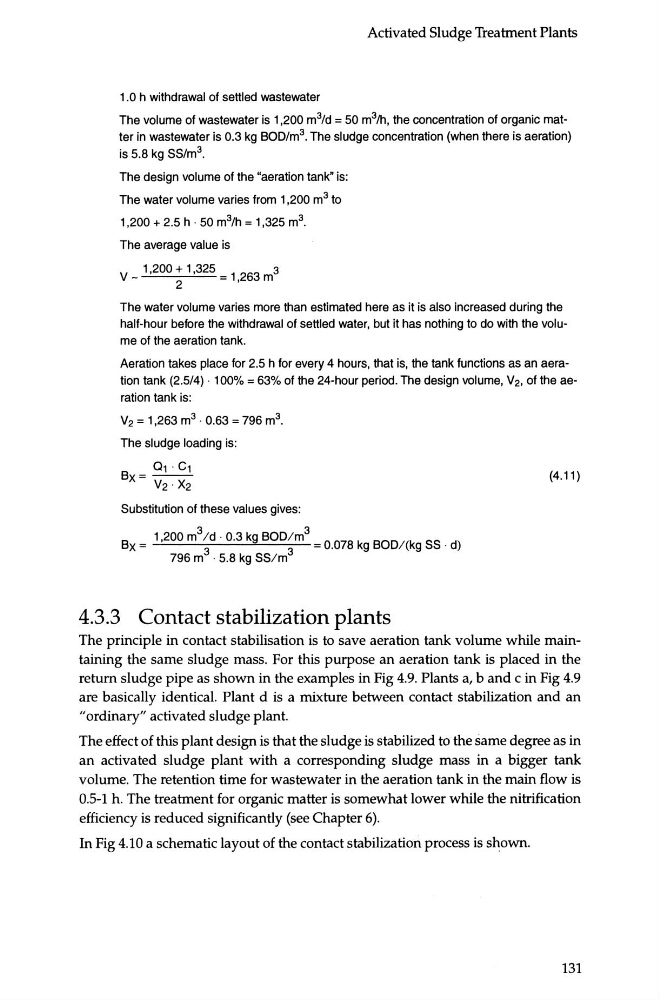
The volume of wastewater is 1 ,200 m 3 /d = 50 m 3 /h, the concentration of organic matter in wastewater is 0.3 kg BOD/m 3 . The sludge concentration (when there is aeration)
is 5.8 kg SS/m 3 •
The design volume of the "aeration tank" is:
The water volume varies from 1 ,200 m 3 to
1,200 + 2.5 h · 50 m 3 /h = 1,325 m 3 .
The average value is
V _ 1 ,200 ; 1 ,325 1 • 263 m3
The water volume varies more than estimated here as it is also increased during the
half-hour before the withdrawal of settled water, but it has nothing to do with the volume of the aeration tank.
Aeration takes place for 2.5 h for every 4 hours, that is, the tank functions as an aeration tank (2.5/4) · 100% = 63% of the 24-hour period. The design volume, V2, of the aeration tank is:
V2 = 1 ,263m 3 . 0.63 =796m 3 .
The sludge loading is:
a1 · c1
Bx= - - -
v2 · x2
Substitution of these values gives:
3
3
Bx = 1 ,200 m /d . 0.3 kg BOD/m = 0.078 kg 800/(kg SS . d)
796m 3 · 5.8 kg SS/m 3
4.3.3 Contact stabilization plants
(4.11)
The principle in contact stabilisation is to save aeration tank volume while maintaining the same sludge mass. For this purpose an aeration tank is placed in the
return sludge pipe as shown in the examples in Fig 4.9. Plants a, b and c in Fig 4.9
are basically identical. Plant d is a mixture between contact stabilization and an
"ordinary" activated sludge plant.
The effect of this plant design is that the sludge is stabilized to the same degree as in
an activated sludge plant with a corresponding sludge mass in a bigger tank
volume. The retention time for wastewater in the aeration tank in the main flow is
0.5-1 h. The treatment for organic matter is somewhat lower while the nitrification
efficiency is reduced significantly (see Chapter 6).
In Fig 4.10 a schematic layout of the contact stabilization process is shown.
131
1.0 h withdrawal of settled wastewater
The volume of wastewater is 1 ,200 m 3 /d = 50 m 3 /h, the concentration of organic matter in wastewater is 0.3 kg BOD/m 3 . The sludge concentration (when there is aeration)
is 5.8 kg SS/m 3 •
The design volume of the "aeration tank" is:
The water volume varies from 1 ,200 m 3 to
1,200 + 2.5 h · 50 m 3 /h = 1,325 m 3 .
The average value is
V _ 1 ,200 ; 1 ,325 1 • 263 m3
The water volume varies more than estimated here as it is also increased during the
half-hour before the withdrawal of settled water, but it has nothing to do with the volume of the aeration tank.
Aeration takes place for 2.5 h for every 4 hours, that is, the tank functions as an aeration tank (2.5/4) · 100% = 63% of the 24-hour period. The design volume, V2, of the aeration tank is:
V2 = 1 ,263m 3 . 0.63 =796m 3 .
The sludge loading is:
a1 · c1
Bx= - - -
v2 · x2
Substitution of these values gives:
3
3
Bx = 1 ,200 m /d . 0.3 kg BOD/m = 0.078 kg 800/(kg SS . d)
796m 3 · 5.8 kg SS/m 3
4.3.3 Contact stabilization plants
(4.11)
The principle in contact stabilisation is to save aeration tank volume while maintaining the same sludge mass. For this purpose an aeration tank is placed in the
return sludge pipe as shown in the examples in Fig 4.9. Plants a, b and c in Fig 4.9
are basically identical. Plant d is a mixture between contact stabilization and an
"ordinary" activated sludge plant.
The effect of this plant design is that the sludge is stabilized to the same degree as in
an activated sludge plant with a corresponding sludge mass in a bigger tank
volume. The retention time for wastewater in the aeration tank in the main flow is
0.5-1 h. The treatment for organic matter is somewhat lower while the nitrification
efficiency is reduced significantly (see Chapter 6).
In Fig 4.10 a schematic layout of the contact stabilization process is shown.
131