

Activated Sludge Treatment Plants
a 4 = 750 m 3 /h
a 5 = 100 m 3 /d
a 6 = 1,000 m 3 /d
X3 = 0.05 kg COD/m 3
Xs = 11.0 kg COD/m 3
Y obs = 0.4 kg COD(B)Ikg COD(S)
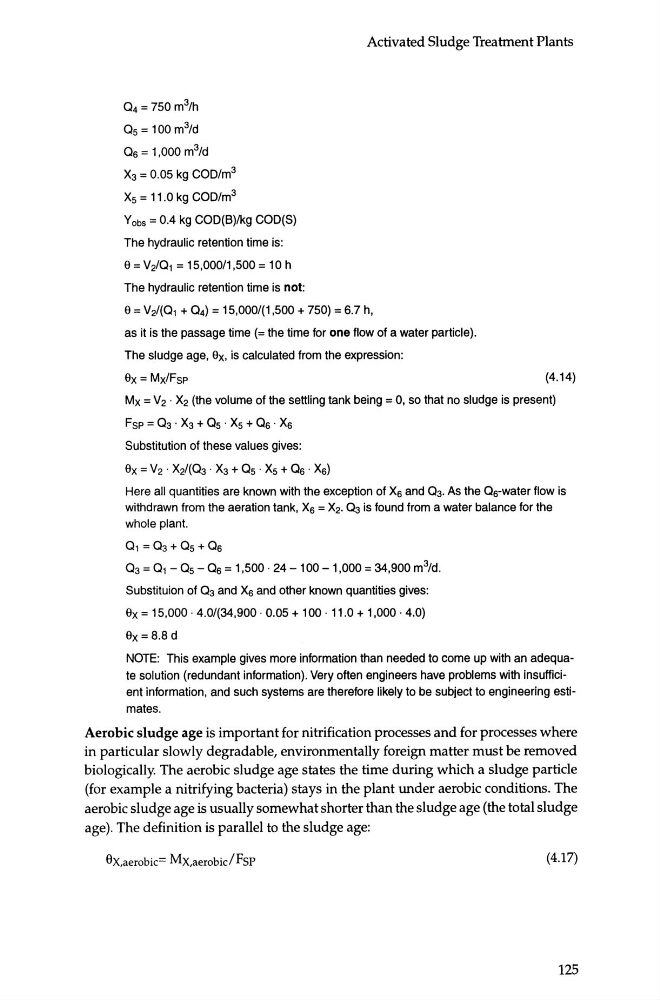
The hydraulic retention time is:
e = V2ta, = 15,ooot1,5oo = 1 o h
The hydraulic retention time is not:
e = V2/(a, + a4) = 15,000/(1,5oo + 750) = 6.7 h,
as it is the passage time(= the time for one flow of a water particle).
The sludge age, ex. is calculated from the expression:
ex= Mx/Fsp
(4.14)
Mx = V2 · X2 (the volume of the settling tank being = 0, so that no sludge is present)
Fsp = a3 · X3 + as · Xs + as · Xs
Substitution of these values gives:
ex= V2 · X2/(a3 · X3 +as · Xs +as· Xe)
Here all quantities are known with the exception of X6 and a 3. As the a 6-water flow is
withdrawn from the aeration tank, X6 = X2. a 3 is found from a water balance for the
whole plant.
a, = a3 + as + as
a3 =a,- a 5 - a 6 = 1,500 · 24- 100- 1,000 = 34,900 m 3 /d.
Substituion of a 3 and X6 and other known quantities gives:
ex= 15,000 · 4.0/(34,900 . 0.05 + 1 oo . 11.0 + 1,ooo . 4.0)
ex= 8.8 d
NOTE: This example gives more information than needed to come up with an adequate solution (redundant information). Very often engineers have problems with insufficient information, and such systems are therefore likely to be subject to engineering estimates.
Aerobic sludge age is important for nitrification processes and for processes where
in particular slowly degradable, environmentally foreign matter must be removed
biologically. The aerobic sludge age states the time during which a sludge particle
(for example a nitrifying bacteria) stays in the plant under aerobic conditions. The
aerobic sludge age is usually somewhat shorter than the sludge age (the total sludge
age). The definition is parallel to the sludge age:
8x,aerobic= Mx,aerobic/Fsp
(4.17)
125
a 4 = 750 m 3 /h
a 5 = 100 m 3 /d
a 6 = 1,000 m 3 /d
X3 = 0.05 kg COD/m 3
Xs = 11.0 kg COD/m 3
Y obs = 0.4 kg COD(B)Ikg COD(S)
The hydraulic retention time is:
e = V2ta, = 15,ooot1,5oo = 1 o h
The hydraulic retention time is not:
e = V2/(a, + a4) = 15,000/(1,5oo + 750) = 6.7 h,
as it is the passage time(= the time for one flow of a water particle).
The sludge age, ex. is calculated from the expression:
ex= Mx/Fsp
(4.14)
Mx = V2 · X2 (the volume of the settling tank being = 0, so that no sludge is present)
Fsp = a3 · X3 + as · Xs + as · Xs
Substitution of these values gives:
ex= V2 · X2/(a3 · X3 +as · Xs +as· Xe)
Here all quantities are known with the exception of X6 and a 3. As the a 6-water flow is
withdrawn from the aeration tank, X6 = X2. a 3 is found from a water balance for the
whole plant.
a, = a3 + as + as
a3 =a,- a 5 - a 6 = 1,500 · 24- 100- 1,000 = 34,900 m 3 /d.
Substituion of a 3 and X6 and other known quantities gives:
ex= 15,000 · 4.0/(34,900 . 0.05 + 1 oo . 11.0 + 1,ooo . 4.0)
ex= 8.8 d
NOTE: This example gives more information than needed to come up with an adequate solution (redundant information). Very often engineers have problems with insufficient information, and such systems are therefore likely to be subject to engineering estimates.
Aerobic sludge age is important for nitrification processes and for processes where
in particular slowly degradable, environmentally foreign matter must be removed
biologically. The aerobic sludge age states the time during which a sludge particle
(for example a nitrifying bacteria) stays in the plant under aerobic conditions. The
aerobic sludge age is usually somewhat shorter than the sludge age (the total sludge
age). The definition is parallel to the sludge age:
8x,aerobic= Mx,aerobic/Fsp
(4.17)
125