

Kutser [52] made a review of passive optical remote sensing methods and
techniques for assessing cyanobacteria and other intense phytoplankton blooms in
coastal and inland waters. Most of the methods used to detect cyanobacteria are
based on the spectral characteristics of their accessory pigments (e.g. phycocyanins,
phycoerythrin) associated with different algal species (e.g. Microcystis spp.,
Planktothrix spp.). According to Kutser [43], MIVIS bands 10 (620 nm) and
11 (640 nm) allow PC absorption feature near 630 nm and a small peak in
reflectance spectra near 650 nm characteristic to cyanobacteria containing PC to
be detected.
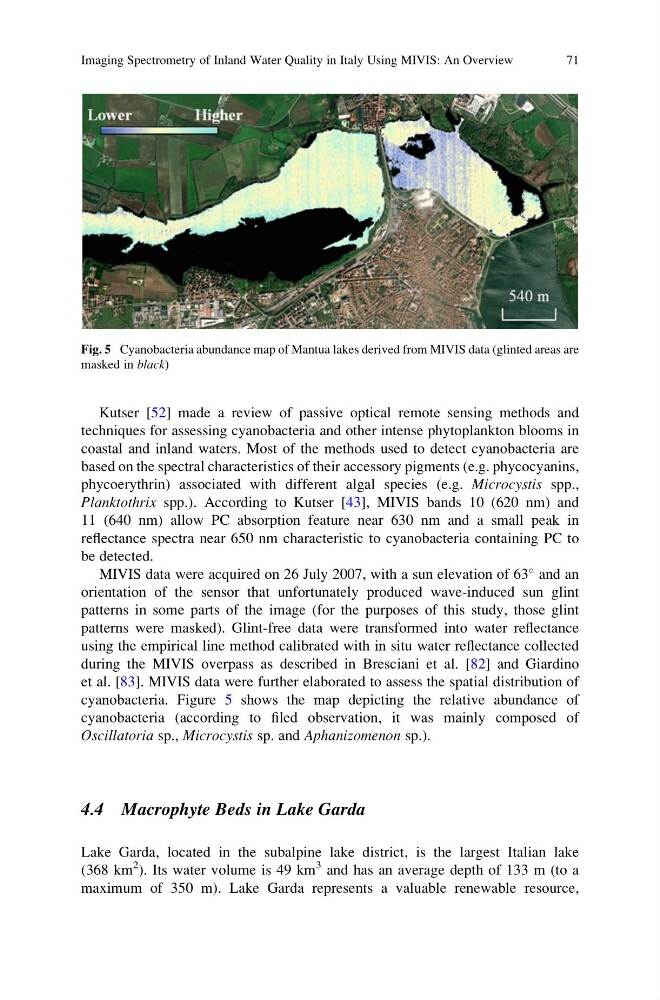
MIVIS data were acquired on 26 July 2007, with a sun elevation of 63
and an
orientation of the sensor that unfortunately produced wave-induced sun glint
patterns in some parts of the image (for the purposes of this study, those glint
patterns were masked). Glint-free data were transformed into water reflectance
using the empirical line method calibrated with in situ water reflectance collected
during the MIVIS overpass as described in Bresciani et al. [82] and Giardino
et al. [83]. MIVIS data were further elaborated to assess the spatial distribution of
cyanobacteria. Figure 5 shows the map depicting the relative abundance of
cyanobacteria (according to filed observation, it was mainly composed of
Oscillatoria sp., Microcystis sp. and Aphanizomenon sp.).
4.4 Macrophyte Beds in Lake Garda
Lake Garda, located in the subalpine lake district, is the largest Italian lake
(368 km
2 ). Its water volume is 49 km
3 and has an average depth of 133 m (to a
maximum of 350 m). Lake Garda represents a valuable renewable resource,
Fig. 5 Cyanobacteria abundance map of Mantua lakes derived from MIVIS data (glinted areas are
masked in black)
Imaging Spectrometry of Inland Water Quality in Italy Using MIVIS: An Overview
71
techniques for assessing cyanobacteria and other intense phytoplankton blooms in
coastal and inland waters. Most of the methods used to detect cyanobacteria are
based on the spectral characteristics of their accessory pigments (e.g. phycocyanins,
phycoerythrin) associated with different algal species (e.g. Microcystis spp.,
Planktothrix spp.). According to Kutser [43], MIVIS bands 10 (620 nm) and
11 (640 nm) allow PC absorption feature near 630 nm and a small peak in
reflectance spectra near 650 nm characteristic to cyanobacteria containing PC to
be detected.
MIVIS data were acquired on 26 July 2007, with a sun elevation of 63
and an
orientation of the sensor that unfortunately produced wave-induced sun glint
patterns in some parts of the image (for the purposes of this study, those glint
patterns were masked). Glint-free data were transformed into water reflectance
using the empirical line method calibrated with in situ water reflectance collected
during the MIVIS overpass as described in Bresciani et al. [82] and Giardino
et al. [83]. MIVIS data were further elaborated to assess the spatial distribution of
cyanobacteria. Figure 5 shows the map depicting the relative abundance of
cyanobacteria (according to filed observation, it was mainly composed of
Oscillatoria sp., Microcystis sp. and Aphanizomenon sp.).
4.4 Macrophyte Beds in Lake Garda
Lake Garda, located in the subalpine lake district, is the largest Italian lake
(368 km
2 ). Its water volume is 49 km
3 and has an average depth of 133 m (to a
maximum of 350 m). Lake Garda represents a valuable renewable resource,
Fig. 5 Cyanobacteria abundance map of Mantua lakes derived from MIVIS data (glinted areas are
masked in black)
Imaging Spectrometry of Inland Water Quality in Italy Using MIVIS: An Overview
71