

multiple scattering of light on water surface, might need to be accomplished. As
inland waters are typically delimited by land, the contribution of reflections from
the surrounding environment on the water surface might interfere with the estimations of signals coming from water. The remotely sensed signals coming from
water might be finally affected by the illumination and acquisition geometries. The
effect of wave-induced sun glint may happen and obscure the radiance originating
from the water. Such glint, which is particularly noticeable with high spatial
resolution sensors, hence hindering the mapping of water quality and benthic
features, can be corrected according to published procedures [46–49].
3 Imaging Spectrometry
Algorithms for assessing water quality in optically complex waters perform best if
they can make use of hyperspectral data. Hyperspectral remote sensing, or imaging
spectroscopy, provides measurements across numerous discrete narrow bands,
forming a contiguous spectrum that enables detection and identification of key
biophysical properties of water column and bottom. For example, in case the chl-a
concentration is estimated according to band ratio which makes use of red (680 nm)
to near-infrared (700 nm) bands, the advantage of having a signal on a contiguous
spectrum relies on the ability to define the algorithm according to the shift of the
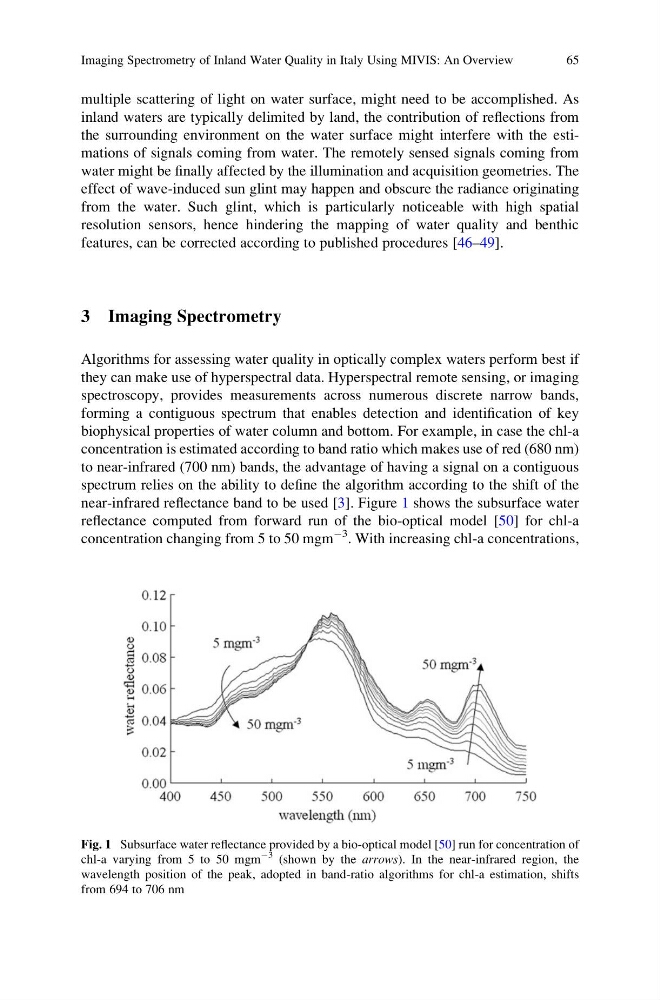
near-infrared reflectance band to be used [3]. Figure 1 shows the subsurface water
reflectance computed from forward run of the bio-optical model [50] for chl-a
concentration changing from 5 to 50 mgm
À3
. With increasing chl-a concentrations,
Fig. 1 Subsurface water reflectance provided by a bio-optical model [50] run for concentration of
chl-a varying from 5 to 50 mgm
À3 (shown by the arrows). In the near-infrared region, the
wavelength position of the peak, adopted in band-ratio algorithms for chl-a estimation, shifts
from 694 to 706 nm
Imaging Spectrometry of Inland Water Quality in Italy Using MIVIS: An Overview
65
inland waters are typically delimited by land, the contribution of reflections from
the surrounding environment on the water surface might interfere with the estimations of signals coming from water. The remotely sensed signals coming from
water might be finally affected by the illumination and acquisition geometries. The
effect of wave-induced sun glint may happen and obscure the radiance originating
from the water. Such glint, which is particularly noticeable with high spatial
resolution sensors, hence hindering the mapping of water quality and benthic
features, can be corrected according to published procedures [46–49].
3 Imaging Spectrometry
Algorithms for assessing water quality in optically complex waters perform best if
they can make use of hyperspectral data. Hyperspectral remote sensing, or imaging
spectroscopy, provides measurements across numerous discrete narrow bands,
forming a contiguous spectrum that enables detection and identification of key
biophysical properties of water column and bottom. For example, in case the chl-a
concentration is estimated according to band ratio which makes use of red (680 nm)
to near-infrared (700 nm) bands, the advantage of having a signal on a contiguous
spectrum relies on the ability to define the algorithm according to the shift of the
near-infrared reflectance band to be used [3]. Figure 1 shows the subsurface water
reflectance computed from forward run of the bio-optical model [50] for chl-a
concentration changing from 5 to 50 mgm
À3
. With increasing chl-a concentrations,
Fig. 1 Subsurface water reflectance provided by a bio-optical model [50] run for concentration of
chl-a varying from 5 to 50 mgm
À3 (shown by the arrows). In the near-infrared region, the
wavelength position of the peak, adopted in band-ratio algorithms for chl-a estimation, shifts
from 694 to 706 nm
Imaging Spectrometry of Inland Water Quality in Italy Using MIVIS: An Overview
65