

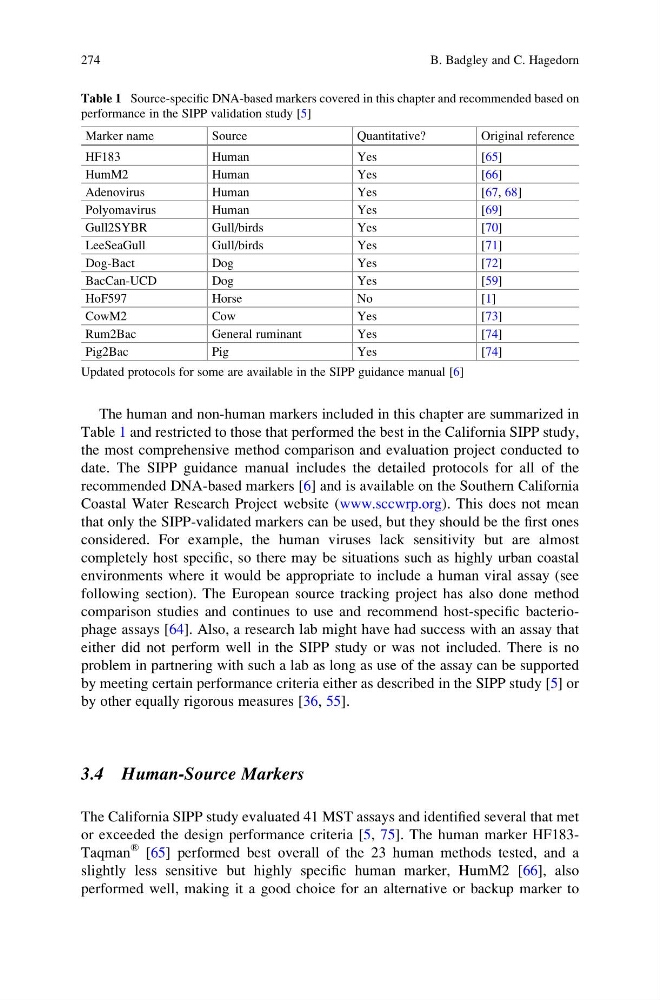
The human and non-human markers included in this chapter are summarized in
Table 1 and restricted to those that performed the best in the California SIPP study,
the most comprehensive method comparison and evaluation project conducted to
date. The SIPP guidance manual includes the detailed protocols for all of the
recommended DNA-based markers [6] and is available on the Southern California
Coastal Water Research Project website (www.sccwrp.org). This does not mean
that only the SIPP-validated markers can be used, but they should be the first ones
considered. For example, the human viruses lack sensitivity but are almost
completely host specific, so there may be situations such as highly urban coastal
environments where it would be appropriate to include a human viral assay (see
following section). The European source tracking project has also done method
comparison studies and continues to use and recommend host-specific bacteriophage assays [64]. Also, a research lab might have had success with an assay that
either did not perform well in the SIPP study or was not included. There is no
problem in partnering with such a lab as long as use of the assay can be supported
by meeting certain performance criteria either as described in the SIPP study [5] or
by other equally rigorous measures [36, 55].
3.4 Human-Source Markers
The California SIPP study evaluated 41 MST assays and identified several that met
or exceeded the design performance criteria [5, 75]. The human marker HF183Taqman
® [65] performed best overall of the 23 human methods tested, and a
slightly less sensitive but highly specific human marker, HumM2 [66], also
performed well, making it a good choice for an alternative or backup marker to
Table 1 Source-specific DNA-based markers covered in this chapter and recommended based on
performance in the SIPP validation study [5]
Marker name
Source
Quantitative?
Original reference
HF183
Human
Yes
[65]
HumM2
Human
Yes
[66]
Adenovirus
Human
Yes
[67, 68]
Polyomavirus
Human
Yes
[69]
Gull2SYBR
Gull/birds
Yes
[70]
LeeSeaGull
Gull/birds
Yes
[71]
Dog-Bact
Dog
Yes
[72]
BacCan-UCD
Dog
Yes
[59]
HoF597
Horse
No
[1]
CowM2
Cow
Yes
[73]
Rum2Bac
General ruminant
Yes
[74]
Pig2Bac
Pig
Yes
[74]
Updated protocols for some are available in the SIPP guidance manual [6]
274
B. Badgley and C. Hagedorn
Table 1 and restricted to those that performed the best in the California SIPP study,
the most comprehensive method comparison and evaluation project conducted to
date. The SIPP guidance manual includes the detailed protocols for all of the
recommended DNA-based markers [6] and is available on the Southern California
Coastal Water Research Project website (www.sccwrp.org). This does not mean
that only the SIPP-validated markers can be used, but they should be the first ones
considered. For example, the human viruses lack sensitivity but are almost
completely host specific, so there may be situations such as highly urban coastal
environments where it would be appropriate to include a human viral assay (see
following section). The European source tracking project has also done method
comparison studies and continues to use and recommend host-specific bacteriophage assays [64]. Also, a research lab might have had success with an assay that
either did not perform well in the SIPP study or was not included. There is no
problem in partnering with such a lab as long as use of the assay can be supported
by meeting certain performance criteria either as described in the SIPP study [5] or
by other equally rigorous measures [36, 55].
3.4 Human-Source Markers
The California SIPP study evaluated 41 MST assays and identified several that met
or exceeded the design performance criteria [5, 75]. The human marker HF183Taqman
® [65] performed best overall of the 23 human methods tested, and a
slightly less sensitive but highly specific human marker, HumM2 [66], also
performed well, making it a good choice for an alternative or backup marker to
Table 1 Source-specific DNA-based markers covered in this chapter and recommended based on
performance in the SIPP validation study [5]
Marker name
Source
Quantitative?
Original reference
HF183
Human
Yes
[65]
HumM2
Human
Yes
[66]
Adenovirus
Human
Yes
[67, 68]
Polyomavirus
Human
Yes
[69]
Gull2SYBR
Gull/birds
Yes
[70]
LeeSeaGull
Gull/birds
Yes
[71]
Dog-Bact
Dog
Yes
[72]
BacCan-UCD
Dog
Yes
[59]
HoF597
Horse
No
[1]
CowM2
Cow
Yes
[73]
Rum2Bac
General ruminant
Yes
[74]
Pig2Bac
Pig
Yes
[74]
Updated protocols for some are available in the SIPP guidance manual [6]
274
B. Badgley and C. Hagedorn