

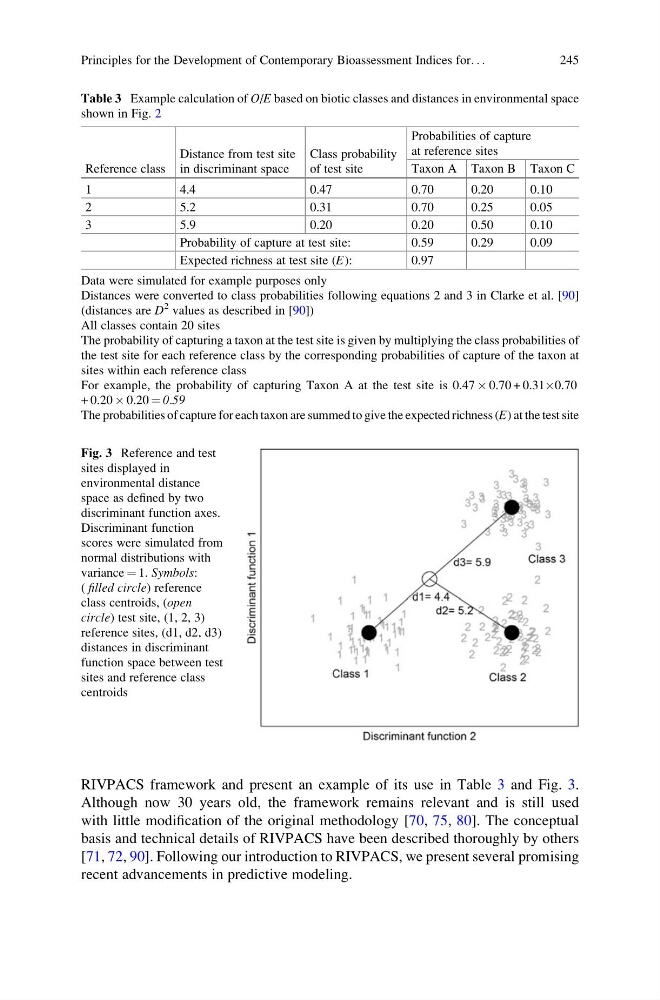
RIVPACS framework and present an example of its use in Table 3 and Fig. 3.
Although now 30 years old, the framework remains relevant and is still used
with little modification of the original methodology [70, 75, 80]. The conceptual
basis and technical details of RIVPACS have been described thoroughly by others
[71, 72, 90]. Following our introduction to RIVPACS, we present several promising
recent advancements in predictive modeling.
Table 3 Example calculation of O/E based on biotic classes and distances in environmental space
shown in Fig. 2
Reference class
Distance from test site
in discriminant space
Class probability
of test site
Probabilities of capture
at reference sites
Taxon A Taxon B Taxon C
1
4.4
0.47
0.70
0.20
0.10
2
5.2
0.31
0.70
0.25
0.05
3
5.9
0.20
0.20
0.50
0.10
Probability of capture at test site:
0.59
0.29
0.09
Expected richness at test site (E):
0.97
Data were simulated for example purposes only
Distances were converted to class probabilities following equations 2 and 3 in Clarke et al. [90]
(distances are D
2 values as described in [90])
All classes contain 20 sites
The probability of capturing a taxon at the test site is given by multiplying the class probabilities of
the test site for each reference class by the corresponding probabilities of capture of the taxon at
sites within each reference class
For example, the probability of capturing Taxon A at the test site is 0.47 Â 0.70 + 0.31Â0.70
+ 0.20 Â 0.20 ¼ 0.59
The probabilities of capture for each taxon are summed to give the expected richness (E) at the test site
Fig. 3 Reference and test
sites displayed in
environmental distance
space as defined by two
discriminant function axes.
Discriminant function
scores were simulated from
normal distributions with
variance ¼ 1. Symbols:
( filled circle) reference
class centroids, (open
circle) test site, (1, 2, 3)
reference sites, (d1, d2, d3)
distances in discriminant
function space between test
sites and reference class
centroids
Principles for the Development of Contemporary Bioassessment Indices for. . .
245
Although now 30 years old, the framework remains relevant and is still used
with little modification of the original methodology [70, 75, 80]. The conceptual
basis and technical details of RIVPACS have been described thoroughly by others
[71, 72, 90]. Following our introduction to RIVPACS, we present several promising
recent advancements in predictive modeling.
Table 3 Example calculation of O/E based on biotic classes and distances in environmental space
shown in Fig. 2
Reference class
Distance from test site
in discriminant space
Class probability
of test site
Probabilities of capture
at reference sites
Taxon A Taxon B Taxon C
1
4.4
0.47
0.70
0.20
0.10
2
5.2
0.31
0.70
0.25
0.05
3
5.9
0.20
0.20
0.50
0.10
Probability of capture at test site:
0.59
0.29
0.09
Expected richness at test site (E):
0.97
Data were simulated for example purposes only
Distances were converted to class probabilities following equations 2 and 3 in Clarke et al. [90]
(distances are D
2 values as described in [90])
All classes contain 20 sites
The probability of capturing a taxon at the test site is given by multiplying the class probabilities of
the test site for each reference class by the corresponding probabilities of capture of the taxon at
sites within each reference class
For example, the probability of capturing Taxon A at the test site is 0.47 Â 0.70 + 0.31Â0.70
+ 0.20 Â 0.20 ¼ 0.59
The probabilities of capture for each taxon are summed to give the expected richness (E) at the test site
Fig. 3 Reference and test
sites displayed in
environmental distance
space as defined by two
discriminant function axes.
Discriminant function
scores were simulated from
normal distributions with
variance ¼ 1. Symbols:
( filled circle) reference
class centroids, (open
circle) test site, (1, 2, 3)
reference sites, (d1, d2, d3)
distances in discriminant
function space between test
sites and reference class
centroids
Principles for the Development of Contemporary Bioassessment Indices for. . .
245