

often reference sites are chosen based on the best available conditions (LDC sites;
e.g., [50, 51]).
The reliability of bioassessments depends largely on the existence of a sufficient
number of reference sites to encompass the range of natural variability in the study
region. Given the pervasiveness of human impacts on aquatic ecosystems, achieving a sufficient number of reference sites is often difficult, and may be impossible
if standards regarding the acceptable level of impairment are unrealistically high
[50, 51]. Impairment is highly variable among geographic regions because development pressure is nonuniform. Recognizing this, Yates and Bailey [50] developed
a novel strategy for selecting reference sites that allowed for flexibility in the
standards used for screening to select LDC sites within study regions exposed to
different impairment regimes. This is a pragmatic strategy, as flexibility in the level
of impairment allowed is unavoidable in areas where impairment is pervasive;
however, clear comparisons of bioassessment results among studies are hindered
when the standards used to select reference sites vary.
2.3 Reference Site Classification
Reference sites that successfully pass the screening process are used to predict
assemblage conditions under minimal impairment. Classification of reference sites
is intended to increase the precision and accuracy of these predictions by grouping
sites inhabited by similar ecological assemblages. Broadly, there are two major
types of classification systems: (1) typologies, wherein sites are grouped based on
spatial proximity and/or similarity in their natural environmental variation, and
(2) biotic classifications, which employ statistical analyses on assemblage data to
group sites. We begin by discussing the two as distinct approaches, although
bioassessment programs often use elements of both to develop the best site classifications. Throughout this section, we discuss analytical techniques that are
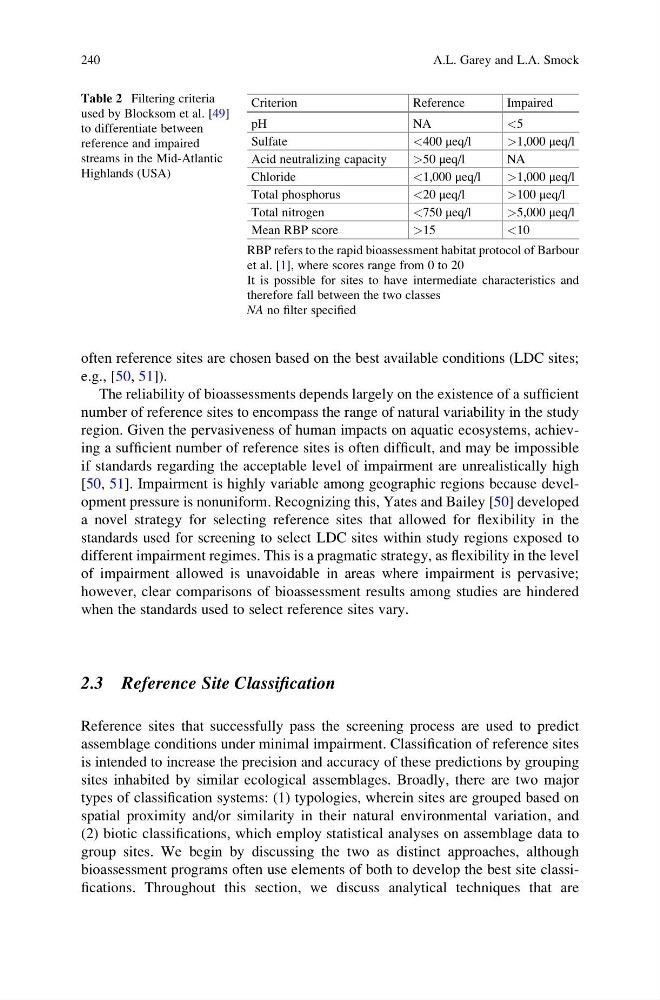
Table 2 Filtering criteria
used by Blocksom et al. [49]
to differentiate between
reference and impaired
streams in the Mid-Atlantic
Highlands (USA)
Criterion
Reference
Impaired
pH
NA
<5
Sulfate
<400 μeq/l
>1,000 μeq/l
Acid neutralizing capacity
>50 μeq/l
NA
Chloride
<1,000 μeq/l
>1,000 μeq/l
Total phosphorus
<20 μeq/l
>100 μeq/l
Total nitrogen
<750 μeq/l
>5,000 μeq/l
Mean RBP score
>15
<10
RBP refers to the rapid bioassessment habitat protocol of Barbour
et al. [1], where scores range from 0 to 20
It is possible for sites to have intermediate characteristics and
therefore fall between the two classes
NA no filter specified
240
A.L. Garey and L.A. Smock
e.g., [50, 51]).
The reliability of bioassessments depends largely on the existence of a sufficient
number of reference sites to encompass the range of natural variability in the study
region. Given the pervasiveness of human impacts on aquatic ecosystems, achieving a sufficient number of reference sites is often difficult, and may be impossible
if standards regarding the acceptable level of impairment are unrealistically high
[50, 51]. Impairment is highly variable among geographic regions because development pressure is nonuniform. Recognizing this, Yates and Bailey [50] developed
a novel strategy for selecting reference sites that allowed for flexibility in the
standards used for screening to select LDC sites within study regions exposed to
different impairment regimes. This is a pragmatic strategy, as flexibility in the level
of impairment allowed is unavoidable in areas where impairment is pervasive;
however, clear comparisons of bioassessment results among studies are hindered
when the standards used to select reference sites vary.
2.3 Reference Site Classification
Reference sites that successfully pass the screening process are used to predict
assemblage conditions under minimal impairment. Classification of reference sites
is intended to increase the precision and accuracy of these predictions by grouping
sites inhabited by similar ecological assemblages. Broadly, there are two major
types of classification systems: (1) typologies, wherein sites are grouped based on
spatial proximity and/or similarity in their natural environmental variation, and
(2) biotic classifications, which employ statistical analyses on assemblage data to
group sites. We begin by discussing the two as distinct approaches, although
bioassessment programs often use elements of both to develop the best site classifications. Throughout this section, we discuss analytical techniques that are
Table 2 Filtering criteria
used by Blocksom et al. [49]
to differentiate between
reference and impaired
streams in the Mid-Atlantic
Highlands (USA)
Criterion
Reference
Impaired
pH
NA
<5
Sulfate
<400 μeq/l
>1,000 μeq/l
Acid neutralizing capacity
>50 μeq/l
NA
Chloride
<1,000 μeq/l
>1,000 μeq/l
Total phosphorus
<20 μeq/l
>100 μeq/l
Total nitrogen
<750 μeq/l
>5,000 μeq/l
Mean RBP score
>15
<10
RBP refers to the rapid bioassessment habitat protocol of Barbour
et al. [1], where scores range from 0 to 20
It is possible for sites to have intermediate characteristics and
therefore fall between the two classes
NA no filter specified
240
A.L. Garey and L.A. Smock