

critical parameters to measure, there are newer technologies, such as rapid pulse
and optical DO sensors, which may be more practical for long-term deployment.
Another challenge with the sonde was the battery power requirements (four 6 V
lead acid batteries for each sonde), which required monthly replacement after
charging.
In 2011, the sondes were replaced with a specific conductance/temperature (SCT)
logger. The SCT logger contains a long-lasting internal battery (3 years with 1 min
logging), avoiding the problem of monthly replacement of heavy batteries. In
addition, the SCT logger contains a sensor with a titanium oxide coating, which
prevents direct contact with water, thus preventing corrosion and fouling.
Also in 2011, at the same time the sondes were replaced with the SCT loggers,
the design of the drip collection system was also modified to funnel dripwaters from
the tarps into a reservoir containing the SCT logger before overflowing into the rain
gauge. The rain gauge drains to a composite sample bottle outfitted with an airlock
and overflow (Fig. 7). The time period integrated by the composite sample varies
significantly over time, but can range from several days during the dry period to less
than 2 min during large recharge events. The purpose of changing the design was to
create a singular collection system for dripwater from multiple stalactites for
measurement of both dripwater rate and chemistry. This works well for the James
Cave project, where the focus is on recharge quantity and quality, but for cave
monitoring projects with a focus on geochemical controls on speleothem growth
and especially in caves where drip rates are slow, collection of dripwater on a tarp
Pressure transducer location
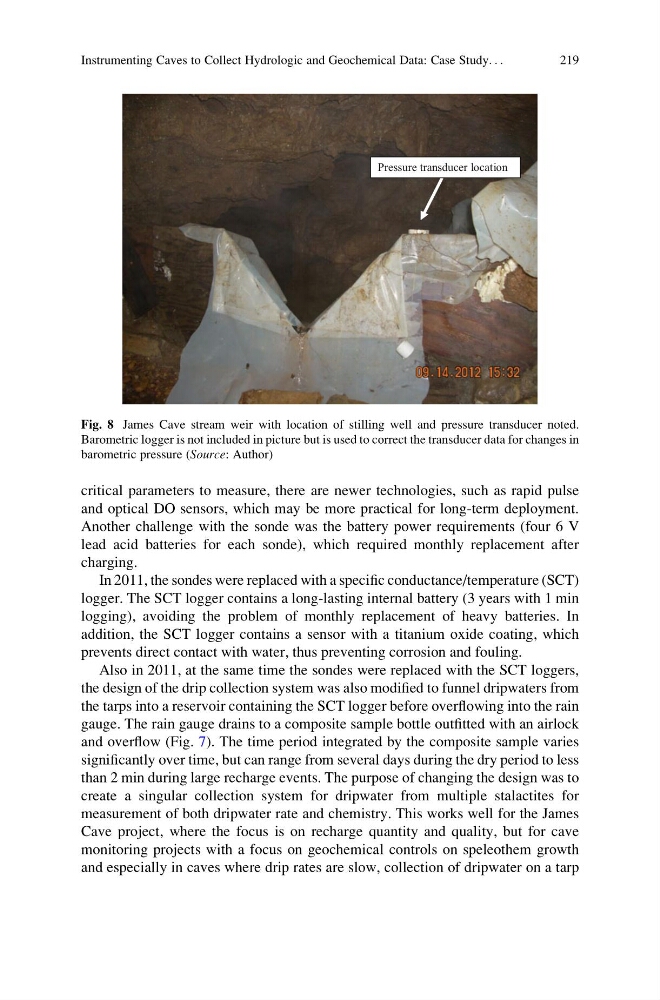
Fig. 8 James Cave stream weir with location of stilling well and pressure transducer noted.
Barometric logger is not included in picture but is used to correct the transducer data for changes in
barometric pressure (Source: Author)
Instrumenting Caves to Collect Hydrologic and Geochemical Data: Case Study. . .
219
and optical DO sensors, which may be more practical for long-term deployment.
Another challenge with the sonde was the battery power requirements (four 6 V
lead acid batteries for each sonde), which required monthly replacement after
charging.
In 2011, the sondes were replaced with a specific conductance/temperature (SCT)
logger. The SCT logger contains a long-lasting internal battery (3 years with 1 min
logging), avoiding the problem of monthly replacement of heavy batteries. In
addition, the SCT logger contains a sensor with a titanium oxide coating, which
prevents direct contact with water, thus preventing corrosion and fouling.
Also in 2011, at the same time the sondes were replaced with the SCT loggers,
the design of the drip collection system was also modified to funnel dripwaters from
the tarps into a reservoir containing the SCT logger before overflowing into the rain
gauge. The rain gauge drains to a composite sample bottle outfitted with an airlock
and overflow (Fig. 7). The time period integrated by the composite sample varies
significantly over time, but can range from several days during the dry period to less
than 2 min during large recharge events. The purpose of changing the design was to
create a singular collection system for dripwater from multiple stalactites for
measurement of both dripwater rate and chemistry. This works well for the James
Cave project, where the focus is on recharge quantity and quality, but for cave
monitoring projects with a focus on geochemical controls on speleothem growth
and especially in caves where drip rates are slow, collection of dripwater on a tarp
Pressure transducer location
Fig. 8 James Cave stream weir with location of stilling well and pressure transducer noted.
Barometric logger is not included in picture but is used to correct the transducer data for changes in
barometric pressure (Source: Author)
Instrumenting Caves to Collect Hydrologic and Geochemical Data: Case Study. . .
219