

3.4.1 Drip Rate
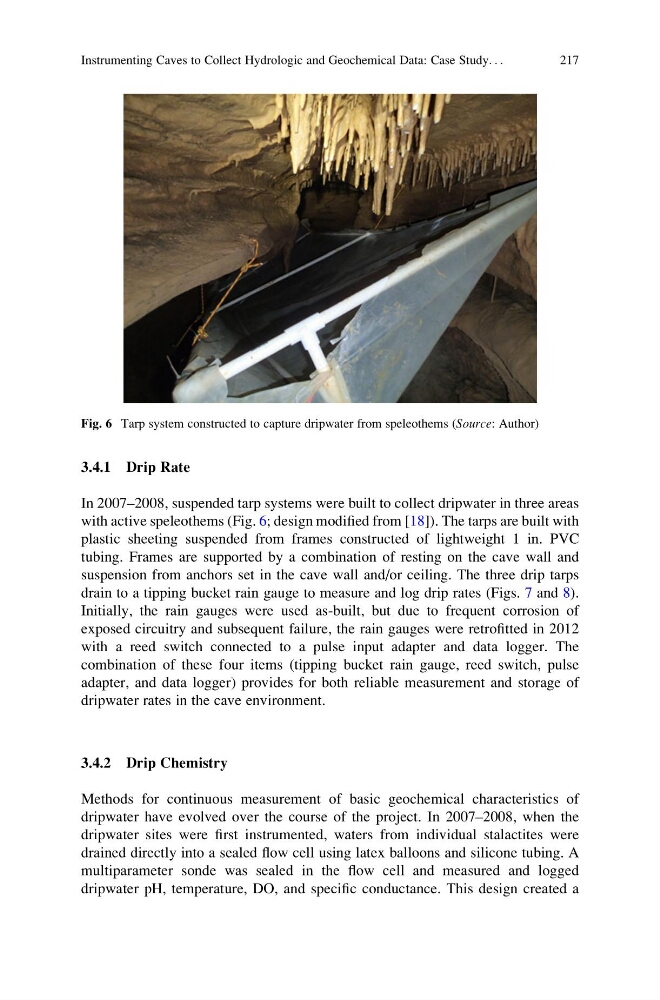
In 2007–2008, suspended tarp systems were built to collect dripwater in three areas
with active speleothems (Fig. 6; design modified from [18]). The tarps are built with
plastic sheeting suspended from frames constructed of lightweight 1 in. PVC
tubing. Frames are supported by a combination of resting on the cave wall and
suspension from anchors set in the cave wall and/or ceiling. The three drip tarps
drain to a tipping bucket rain gauge to measure and log drip rates (Figs. 7 and 8).
Initially, the rain gauges were used as-built, but due to frequent corrosion of
exposed circuitry and subsequent failure, the rain gauges were retrofitted in 2012
with a reed switch connected to a pulse input adapter and data logger. The
combination of these four items (tipping bucket rain gauge, reed switch, pulse
adapter, and data logger) provides for both reliable measurement and storage of
dripwater rates in the cave environment.
3.4.2 Drip Chemistry
Methods for continuous measurement of basic geochemical characteristics of
dripwater have evolved over the course of the project. In 2007–2008, when the
dripwater sites were first instrumented, waters from individual stalactites were
drained directly into a sealed flow cell using latex balloons and silicone tubing. A
multiparameter sonde was sealed in the flow cell and measured and logged
dripwater pH, temperature, DO, and specific conductance. This design created a
Fig. 6 Tarp system constructed to capture dripwater from speleothems (Source: Author)
Instrumenting Caves to Collect Hydrologic and Geochemical Data: Case Study. . .
217
In 2007–2008, suspended tarp systems were built to collect dripwater in three areas
with active speleothems (Fig. 6; design modified from [18]). The tarps are built with
plastic sheeting suspended from frames constructed of lightweight 1 in. PVC
tubing. Frames are supported by a combination of resting on the cave wall and
suspension from anchors set in the cave wall and/or ceiling. The three drip tarps
drain to a tipping bucket rain gauge to measure and log drip rates (Figs. 7 and 8).
Initially, the rain gauges were used as-built, but due to frequent corrosion of
exposed circuitry and subsequent failure, the rain gauges were retrofitted in 2012
with a reed switch connected to a pulse input adapter and data logger. The
combination of these four items (tipping bucket rain gauge, reed switch, pulse
adapter, and data logger) provides for both reliable measurement and storage of
dripwater rates in the cave environment.
3.4.2 Drip Chemistry
Methods for continuous measurement of basic geochemical characteristics of
dripwater have evolved over the course of the project. In 2007–2008, when the
dripwater sites were first instrumented, waters from individual stalactites were
drained directly into a sealed flow cell using latex balloons and silicone tubing. A
multiparameter sonde was sealed in the flow cell and measured and logged
dripwater pH, temperature, DO, and specific conductance. This design created a
Fig. 6 Tarp system constructed to capture dripwater from speleothems (Source: Author)
Instrumenting Caves to Collect Hydrologic and Geochemical Data: Case Study. . .
217