

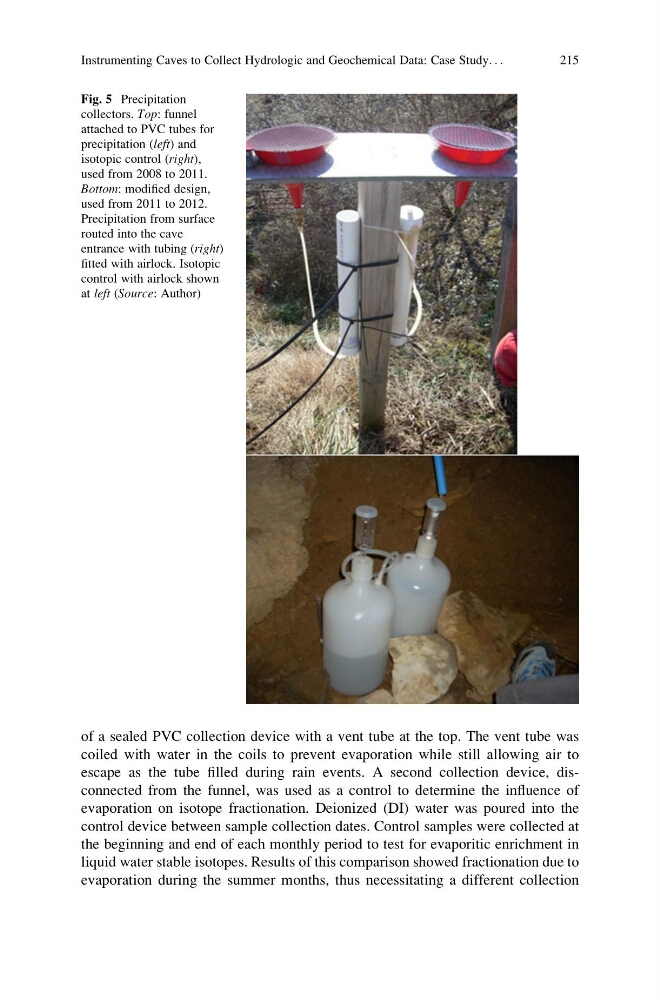
of a sealed PVC collection device with a vent tube at the top. The vent tube was
coiled with water in the coils to prevent evaporation while still allowing air to
escape as the tube filled during rain events. A second collection device, disconnected from the funnel, was used as a control to determine the influence of
evaporation on isotope fractionation. Deionized (DI) water was poured into the
control device between sample collection dates. Control samples were collected at
the beginning and end of each monthly period to test for evaporitic enrichment in
liquid water stable isotopes. Results of this comparison showed fractionation due to
evaporation during the summer months, thus necessitating a different collection
Fig. 5 Precipitation
collectors. Top: funnel
attached to PVC tubes for
precipitation (left) and
isotopic control (right),
used from 2008 to 2011.
Bottom: modified design,
used from 2011 to 2012.
Precipitation from surface
routed into the cave
entrance with tubing (right)
fitted with airlock. Isotopic
control with airlock shown
at left (Source: Author)
Instrumenting Caves to Collect Hydrologic and Geochemical Data: Case Study. . .
215
coiled with water in the coils to prevent evaporation while still allowing air to
escape as the tube filled during rain events. A second collection device, disconnected from the funnel, was used as a control to determine the influence of
evaporation on isotope fractionation. Deionized (DI) water was poured into the
control device between sample collection dates. Control samples were collected at
the beginning and end of each monthly period to test for evaporitic enrichment in
liquid water stable isotopes. Results of this comparison showed fractionation due to
evaporation during the summer months, thus necessitating a different collection
Fig. 5 Precipitation
collectors. Top: funnel
attached to PVC tubes for
precipitation (left) and
isotopic control (right),
used from 2008 to 2011.
Bottom: modified design,
used from 2011 to 2012.
Precipitation from surface
routed into the cave
entrance with tubing (right)
fitted with airlock. Isotopic
control with airlock shown
at left (Source: Author)
Instrumenting Caves to Collect Hydrologic and Geochemical Data: Case Study. . .
215