

3.3 Optical Sensors
Optical sensors, the most advanced technology for water monitoring, are used to
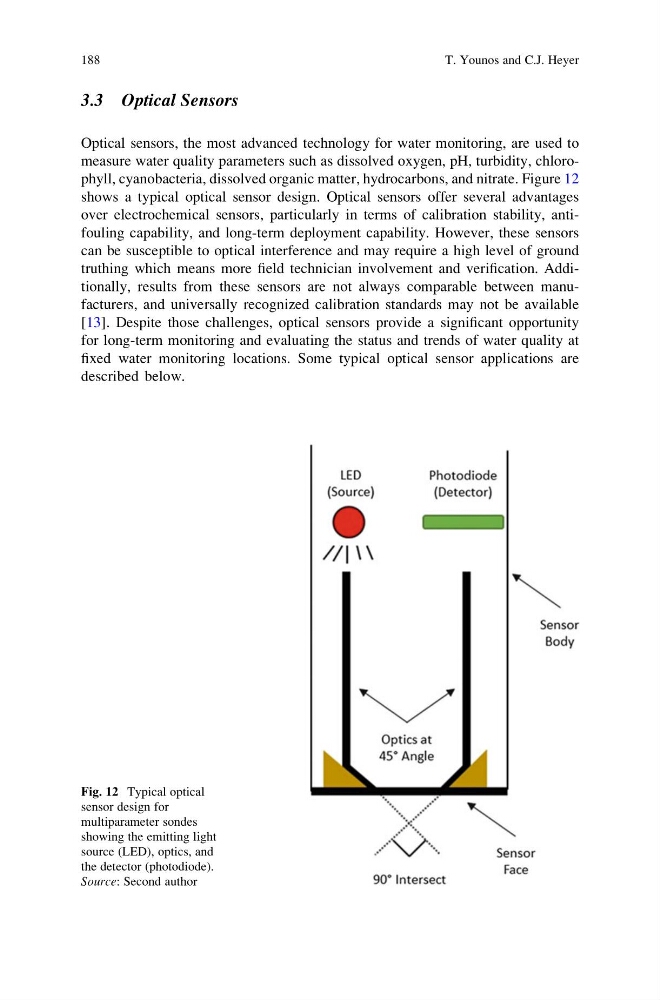
measure water quality parameters such as dissolved oxygen, pH, turbidity, chlorophyll, cyanobacteria, dissolved organic matter, hydrocarbons, and nitrate. Figure 12
shows a typical optical sensor design. Optical sensors offer several advantages
over electrochemical sensors, particularly in terms of calibration stability, antifouling capability, and long-term deployment capability. However, these sensors
can be susceptible to optical interference and may require a high level of ground
truthing which means more field technician involvement and verification. Additionally, results from these sensors are not always comparable between manufacturers, and universally recognized calibration standards may not be available
[13]. Despite those challenges, optical sensors provide a significant opportunity
for long-term monitoring and evaluating the status and trends of water quality at
fixed water monitoring locations. Some typical optical sensor applications are
described below.
Fig. 12 Typical optical
sensor design for
multiparameter sondes
showing the emitting light
source (LED), optics, and
the detector (photodiode).
Source: Second author
188
T. Younos and C.J. Heyer
Optical sensors, the most advanced technology for water monitoring, are used to
measure water quality parameters such as dissolved oxygen, pH, turbidity, chlorophyll, cyanobacteria, dissolved organic matter, hydrocarbons, and nitrate. Figure 12
shows a typical optical sensor design. Optical sensors offer several advantages
over electrochemical sensors, particularly in terms of calibration stability, antifouling capability, and long-term deployment capability. However, these sensors
can be susceptible to optical interference and may require a high level of ground
truthing which means more field technician involvement and verification. Additionally, results from these sensors are not always comparable between manufacturers, and universally recognized calibration standards may not be available
[13]. Despite those challenges, optical sensors provide a significant opportunity
for long-term monitoring and evaluating the status and trends of water quality at
fixed water monitoring locations. Some typical optical sensor applications are
described below.
Fig. 12 Typical optical
sensor design for
multiparameter sondes
showing the emitting light
source (LED), optics, and
the detector (photodiode).
Source: Second author
188
T. Younos and C.J. Heyer