

multiplied together to compute a streamflow. For the index velocity method, V is a
function of such parameters as streamwide velocity, stage, and cross-stream velocity, and A is a function of stage and cross-sectional shape. These measurements are
made over the entire flow regime in order to establish a good relationship between
stage and area and between index velocity and mean velocity.
Technologies discussed in this section include water level sensors for continuous
stage measurements in surface water applications and acoustic Doppler technology
for measuring discrete and continuous water velocity to calculate discharge.
2.1 Water Level Sensors
Major sensor types for continuous water level measurements include submersible
pressure transducers, shaft encoders, bubbler systems, or noncontact RADAR
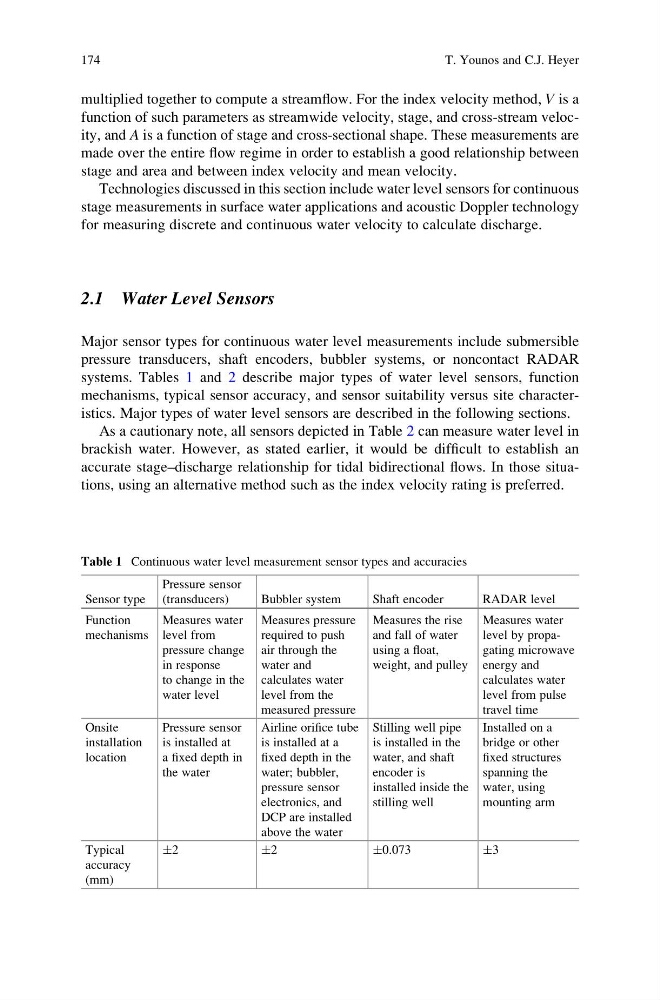
systems. Tables 1 and 2 describe major types of water level sensors, function
mechanisms, typical sensor accuracy, and sensor suitability versus site characteristics. Major types of water level sensors are described in the following sections.
As a cautionary note, all sensors depicted in Table 2 can measure water level in
brackish water. However, as stated earlier, it would be difficult to establish an
accurate stage–discharge relationship for tidal bidirectional flows. In those situations, using an alternative method such as the index velocity rating is preferred.
Table 1 Continuous water level measurement sensor types and accuracies
Sensor type
Pressure sensor
(transducers)
Bubbler system
Shaft encoder
RADAR level
Function
mechanisms
Measures water
level from
pressure change
in response
to change in the
water level
Measures pressure
required to push
air through the
water and
calculates water
level from the
measured pressure
Measures the rise
and fall of water
using a float,
weight, and pulley
Measures water
level by propagating microwave
energy and
calculates water
level from pulse
travel time
Onsite
installation
location
Pressure sensor
is installed at
a fixed depth in
the water
Airline orifice tube
is installed at a
fixed depth in the
water; bubbler,
pressure sensor
electronics, and
DCP are installed
above the water
Stilling well pipe
is installed in the
water, and shaft
encoder is
installed inside the
stilling well
Installed on a
bridge or other
fixed structures
spanning the
water, using
mounting arm
Typical
accuracy
(mm)
Æ2
Æ2
Æ0.073
Æ3
174
T. Younos and C.J. Heyer
function of such parameters as streamwide velocity, stage, and cross-stream velocity, and A is a function of stage and cross-sectional shape. These measurements are
made over the entire flow regime in order to establish a good relationship between
stage and area and between index velocity and mean velocity.
Technologies discussed in this section include water level sensors for continuous
stage measurements in surface water applications and acoustic Doppler technology
for measuring discrete and continuous water velocity to calculate discharge.
2.1 Water Level Sensors
Major sensor types for continuous water level measurements include submersible
pressure transducers, shaft encoders, bubbler systems, or noncontact RADAR
systems. Tables 1 and 2 describe major types of water level sensors, function
mechanisms, typical sensor accuracy, and sensor suitability versus site characteristics. Major types of water level sensors are described in the following sections.
As a cautionary note, all sensors depicted in Table 2 can measure water level in
brackish water. However, as stated earlier, it would be difficult to establish an
accurate stage–discharge relationship for tidal bidirectional flows. In those situations, using an alternative method such as the index velocity rating is preferred.
Table 1 Continuous water level measurement sensor types and accuracies
Sensor type
Pressure sensor
(transducers)
Bubbler system
Shaft encoder
RADAR level
Function
mechanisms
Measures water
level from
pressure change
in response
to change in the
water level
Measures pressure
required to push
air through the
water and
calculates water
level from the
measured pressure
Measures the rise
and fall of water
using a float,
weight, and pulley
Measures water
level by propagating microwave
energy and
calculates water
level from pulse
travel time
Onsite
installation
location
Pressure sensor
is installed at
a fixed depth in
the water
Airline orifice tube
is installed at a
fixed depth in the
water; bubbler,
pressure sensor
electronics, and
DCP are installed
above the water
Stilling well pipe
is installed in the
water, and shaft
encoder is
installed inside the
stilling well
Installed on a
bridge or other
fixed structures
spanning the
water, using
mounting arm
Typical
accuracy
(mm)
Æ2
Æ2
Æ0.073
Æ3
174
T. Younos and C.J. Heyer