

to animals. Thus, there has been much interest by water resource managers in
methods for real- or near real-time assessment of the abundance and spatial
distribution of cyanobacterial blooms. Phycocyanin has a strong absorption peak
near 620 nm, which leads to a characteristic dip in reflectance spectra around 600–
630 nm for water bodies with cyanobacteria blooms (e.g., Fig. 4). Several
researchers have reported empirical algorithms for cyanobacterial abundance
using hyperspectral measurements and reflectance ratios around this wavelength
range [52, 53]. Unfortunately, this wavelength range represents a gap in coverage
by the sensors of the Landsat satellites (for OLI of Landsat 8, band 3 has a range of
530–590 nm and band 4 a range of 640–70 nm). Vincent et al. [54] claimed to be
able to measure phycocyanin and trace cyanobacterial blooms in Lake Erie using
Landsat. They reported an r
2 of 0.77 for the relationship, but this is thought to be an
example of indirect correlation (e.g., [35]). The retrieval equation probably was
responding to chlorophyll signals; cyanobacteria were the dominant algae in the
lake at the time of the measurements, and a high correlation could be expected
between phycocyanin and chlorophyll levels. Several groups (e.g., [55–58]) have
found that the narrower bands of MERIS are suitable for retrieval of phycocyanin
concentrations. In these cases, the fluorescence of phycocyanin at ~681 nm is
detected using a semiempirical second derivative function that also uses reflectance
data for nearby bands at 709 and 665 nm.
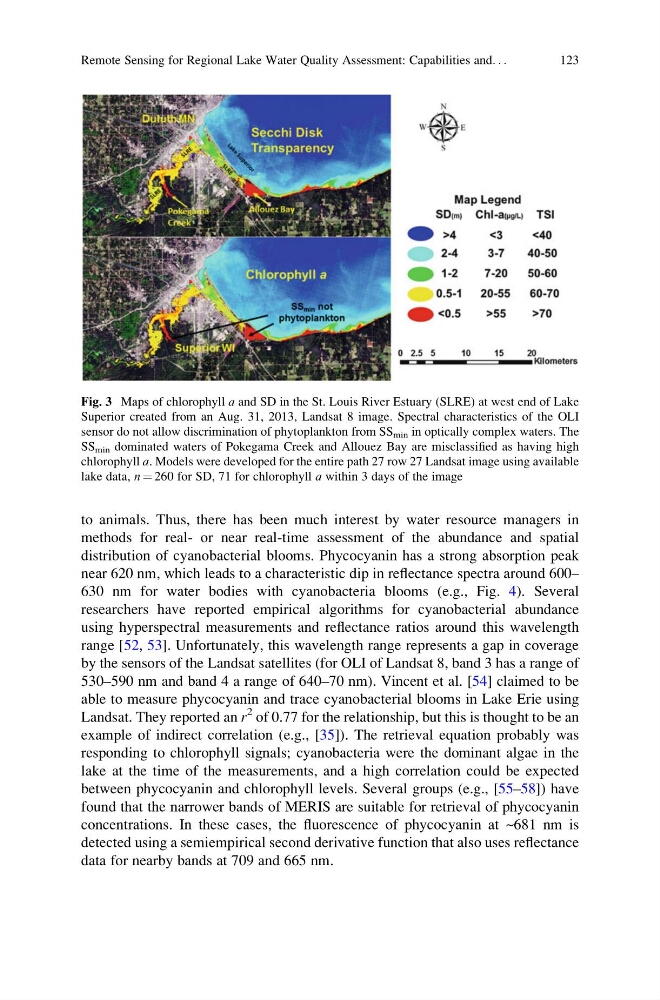
Fig. 3 Maps of chlorophyll a and SD in the St. Louis River Estuary (SLRE) at west end of Lake
Superior created from an Aug. 31, 2013, Landsat 8 image. Spectral characteristics of the OLI
sensor do not allow discrimination of phytoplankton from SS min in optically complex waters. The
SS min dominated waters of Pokegama Creek and Allouez Bay are misclassified as having high
chlorophyll a. Models were developed for the entire path 27 row 27 Landsat image using available
lake data, n ¼ 260 for SD, 71 for chlorophyll a within 3 days of the image
Remote Sensing for Regional Lake Water Quality Assessment: Capabilities and. . .
123
methods for real- or near real-time assessment of the abundance and spatial
distribution of cyanobacterial blooms. Phycocyanin has a strong absorption peak
near 620 nm, which leads to a characteristic dip in reflectance spectra around 600–
630 nm for water bodies with cyanobacteria blooms (e.g., Fig. 4). Several
researchers have reported empirical algorithms for cyanobacterial abundance
using hyperspectral measurements and reflectance ratios around this wavelength
range [52, 53]. Unfortunately, this wavelength range represents a gap in coverage
by the sensors of the Landsat satellites (for OLI of Landsat 8, band 3 has a range of
530–590 nm and band 4 a range of 640–70 nm). Vincent et al. [54] claimed to be
able to measure phycocyanin and trace cyanobacterial blooms in Lake Erie using
Landsat. They reported an r
2 of 0.77 for the relationship, but this is thought to be an
example of indirect correlation (e.g., [35]). The retrieval equation probably was
responding to chlorophyll signals; cyanobacteria were the dominant algae in the
lake at the time of the measurements, and a high correlation could be expected
between phycocyanin and chlorophyll levels. Several groups (e.g., [55–58]) have
found that the narrower bands of MERIS are suitable for retrieval of phycocyanin
concentrations. In these cases, the fluorescence of phycocyanin at ~681 nm is
detected using a semiempirical second derivative function that also uses reflectance
data for nearby bands at 709 and 665 nm.
Fig. 3 Maps of chlorophyll a and SD in the St. Louis River Estuary (SLRE) at west end of Lake
Superior created from an Aug. 31, 2013, Landsat 8 image. Spectral characteristics of the OLI
sensor do not allow discrimination of phytoplankton from SS min in optically complex waters. The
SS min dominated waters of Pokegama Creek and Allouez Bay are misclassified as having high
chlorophyll a. Models were developed for the entire path 27 row 27 Landsat image using available
lake data, n ¼ 260 for SD, 71 for chlorophyll a within 3 days of the image
Remote Sensing for Regional Lake Water Quality Assessment: Capabilities and. . .
123