

The expansion of the three main cities (Changzhou, Wuxi, and Suzhou) in the
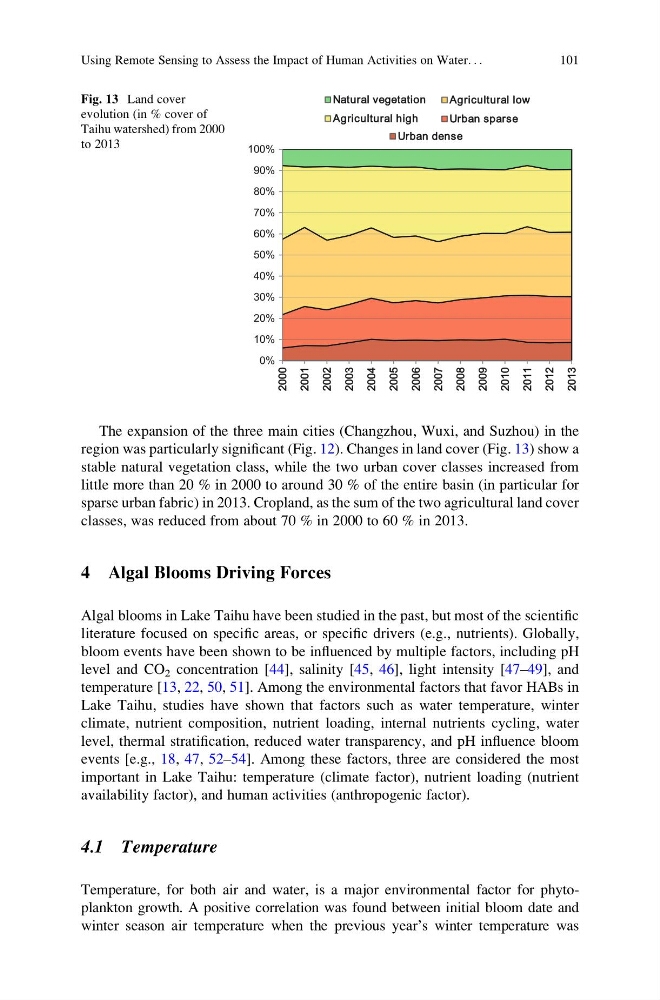
region was particularly significant (Fig. 12). Changes in land cover (Fig. 13) show a
stable natural vegetation class, while the two urban cover classes increased from
little more than 20 % in 2000 to around 30 % of the entire basin (in particular for
sparse urban fabric) in 2013. Cropland, as the sum of the two agricultural land cover
classes, was reduced from about 70 % in 2000 to 60 % in 2013.
4 Algal Blooms Driving Forces
Algal blooms in Lake Taihu have been studied in the past, but most of the scientific
literature focused on specific areas, or specific drivers (e.g., nutrients). Globally,
bloom events have been shown to be influenced by multiple factors, including pH
level and CO 2 concentration [44], salinity [45, 46], light intensity [47–49], and
temperature [13, 22, 50, 51]. Among the environmental factors that favor HABs in
Lake Taihu, studies have shown that factors such as water temperature, winter
climate, nutrient composition, nutrient loading, internal nutrients cycling, water
level, thermal stratification, reduced water transparency, and pH influence bloom
events [e.g., 18, 47, 52–54]. Among these factors, three are considered the most
important in Lake Taihu: temperature (climate factor), nutrient loading (nutrient
availability factor), and human activities (anthropogenic factor).
4.1 Temperature
Temperature, for both air and water, is a major environmental factor for phytoplankton growth. A positive correlation was found between initial bloom date and
winter season air temperature when the previous year’s winter temperature was
0%
10%
20%
30%
40%
50%
60%
70%
80%
90%
100%
2 2000
2001
2002
2003
2004
2005
2006
2007
2008
2009
2010
2011
2012
2013
Natural vegetation
Agricultural high
Agricultural low
Urban sparse
Urban dense
Fig. 13 Land cover
evolution (in % cover of
Taihu watershed) from 2000
to 2013
Using Remote Sensing to Assess the Impact of Human Activities on Water. . .
101
region was particularly significant (Fig. 12). Changes in land cover (Fig. 13) show a
stable natural vegetation class, while the two urban cover classes increased from
little more than 20 % in 2000 to around 30 % of the entire basin (in particular for
sparse urban fabric) in 2013. Cropland, as the sum of the two agricultural land cover
classes, was reduced from about 70 % in 2000 to 60 % in 2013.
4 Algal Blooms Driving Forces
Algal blooms in Lake Taihu have been studied in the past, but most of the scientific
literature focused on specific areas, or specific drivers (e.g., nutrients). Globally,
bloom events have been shown to be influenced by multiple factors, including pH
level and CO 2 concentration [44], salinity [45, 46], light intensity [47–49], and
temperature [13, 22, 50, 51]. Among the environmental factors that favor HABs in
Lake Taihu, studies have shown that factors such as water temperature, winter
climate, nutrient composition, nutrient loading, internal nutrients cycling, water
level, thermal stratification, reduced water transparency, and pH influence bloom
events [e.g., 18, 47, 52–54]. Among these factors, three are considered the most
important in Lake Taihu: temperature (climate factor), nutrient loading (nutrient
availability factor), and human activities (anthropogenic factor).
4.1 Temperature
Temperature, for both air and water, is a major environmental factor for phytoplankton growth. A positive correlation was found between initial bloom date and
winter season air temperature when the previous year’s winter temperature was
0%
10%
20%
30%
40%
50%
60%
70%
80%
90%
100%
2 2000
2001
2002
2003
2004
2005
2006
2007
2008
2009
2010
2011
2012
2013
Natural vegetation
Agricultural high
Agricultural low
Urban sparse
Urban dense
Fig. 13 Land cover
evolution (in % cover of
Taihu watershed) from 2000
to 2013
Using Remote Sensing to Assess the Impact of Human Activities on Water. . .
101