

sediment particle size has become coarser over the last century [14]. The concentration of heavy metals, total organic carbon, and nutrients in the lake has also
increased since 1970s [14]. The largest nutrient inflow into Lake Taihu originates
from the southwestern sub-basin area (40–50 % of incoming TN and 60–70 % of
TP) and the northwestern sub-basin area (15–20 % of incoming TN and 15–20 % of
TP) [15].
The phytoplankton community during spring and summer seasons is dominated
by the presence of Microcystis cyanobacteria. This dominance has been attributed
to nutrient (N/P) ratios, underwater light availability, temperature, and zooplankton
grazing [16]. Cyanobacteria blooms occur on a regular basis with the highest
intensity in the northwestern bays (Meiliang Bay, in particular) where N-limiting
conditions (and excess P) are frequent [16]. Light availability was found to be
important in the deeper and more turbid central part of the lake on phytoplankton
composition and biomass [17].
For Microcystis, the dominant cyanobacterial species in Lake Taihu, Liu
et al. [18] assessed a high correlation between temporal dynamics and total
nitrogen-to-total phosphorus ratio (TN:TP), nitrogen composition, water temperature, and pH. Under such conditions, phytoplankton composition shows signs of
rapid replacement of chlorophyta (mainly Ulothrix) by cyanobacteria (mainly
Microcystis) [19]. These phenomena are more critical in the northern parts of the
lake (e.g., Meiliang Bay, near Wuxi city) than in the central part of the lake, because
of low water level, favorable currents, and boat traffic [17].
The effects of climatic variables and nutrient loading on formation and characteristics of HABs in Lake Taihu have been studied by several research groups.
These researchers assessed the influence of increased temperature and decreased
concentration of nitrogen during the hot season on cyanobacteria biomass [19],
considering the dual control of both climate factors and nutrients on the risk of
bloom events [20]. In an earlier study, Chen et al. [21] identified temperature, wind,
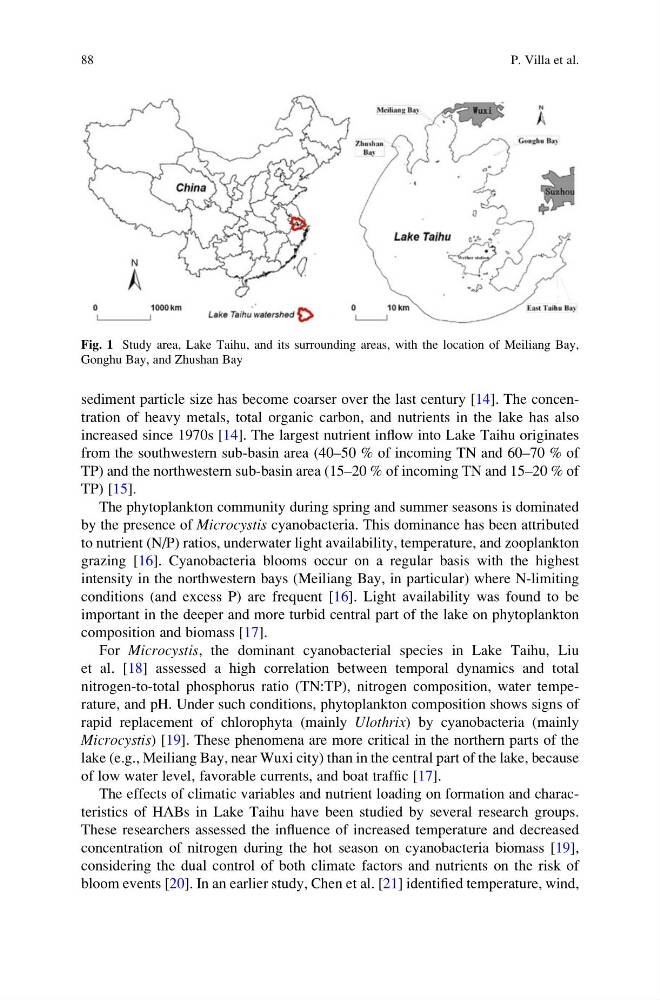
Fig. 1 Study area, Lake Taihu, and its surrounding areas, with the location of Meiliang Bay,
Gonghu Bay, and Zhushan Bay
88
P. Villa et al.
increased since 1970s [14]. The largest nutrient inflow into Lake Taihu originates
from the southwestern sub-basin area (40–50 % of incoming TN and 60–70 % of
TP) and the northwestern sub-basin area (15–20 % of incoming TN and 15–20 % of
TP) [15].
The phytoplankton community during spring and summer seasons is dominated
by the presence of Microcystis cyanobacteria. This dominance has been attributed
to nutrient (N/P) ratios, underwater light availability, temperature, and zooplankton
grazing [16]. Cyanobacteria blooms occur on a regular basis with the highest
intensity in the northwestern bays (Meiliang Bay, in particular) where N-limiting
conditions (and excess P) are frequent [16]. Light availability was found to be
important in the deeper and more turbid central part of the lake on phytoplankton
composition and biomass [17].
For Microcystis, the dominant cyanobacterial species in Lake Taihu, Liu
et al. [18] assessed a high correlation between temporal dynamics and total
nitrogen-to-total phosphorus ratio (TN:TP), nitrogen composition, water temperature, and pH. Under such conditions, phytoplankton composition shows signs of
rapid replacement of chlorophyta (mainly Ulothrix) by cyanobacteria (mainly
Microcystis) [19]. These phenomena are more critical in the northern parts of the
lake (e.g., Meiliang Bay, near Wuxi city) than in the central part of the lake, because
of low water level, favorable currents, and boat traffic [17].
The effects of climatic variables and nutrient loading on formation and characteristics of HABs in Lake Taihu have been studied by several research groups.
These researchers assessed the influence of increased temperature and decreased
concentration of nitrogen during the hot season on cyanobacteria biomass [19],
considering the dual control of both climate factors and nutrients on the risk of
bloom events [20]. In an earlier study, Chen et al. [21] identified temperature, wind,
Fig. 1 Study area, Lake Taihu, and its surrounding areas, with the location of Meiliang Bay,
Gonghu Bay, and Zhushan Bay
88
P. Villa et al.