

64
rise in level, they, perhaps, were amalgamated
in the larger lake. Further, the enormous size,
indented swampy shoreline and extensive littoral zone of the present lake might have also provided numerous divergent habitats and niches
to accommodate the complex biotic community. Thus, it appears that the evolution of the
lake community as well as its shape and productivity are result of its landscape history.
In addition to the above, much of the unique
and fascinating bio-community of Lake Victoria
is now threatened with extinction mainly
because of introduction (around 1967) of the
Nile perch ( Lates niloticus ) which is a carnivorous fi sh. Within this time span, the predator has
possibly intruded into almost every nook and
corner of the lake and has eaten large number of
Haplochromis. However, 13 species in the lake
are considered to be migratory in nature. They
swim up in the infl owing rivers to spawn and the
young return to feed and grow in the lake. All
other fi sh are said to be resident in the lake. It
may be noted here that cichlids, particularly
Haplochromis , are supposed to have evolved the
most since the formation of the lake basin.
These fi shes have switched over and adapted
themselves to consuming wide spectrum of food
items from their basic habit of eating midge larvae. They eat zooplankton, molluscs and other
fi sh and even steal the eggs out of the mouth of
breeding parents. There seems to be niche overlap amongst different species of this genus. The
carnivorous fi sh account for c 40 % of the total
fi sh population of the lake.
6.1.2.1 Fishery of Lake Victoria
Lake Victoria is one of the largest lakes in the
world. It contains a very diverse fi sh community
dominated by many endemic cichlids. The cichlids comprised about half of the total fi sh yield
from the lake since the beginning of the 1970s.
Of these, about 38 % belonged to the genus
Oreochromis.
The fi shery of the lake began to fl ourish after
the arrival of imported gill nets. Increasing
effort was put into fi shery with burgeoning
human population. At one time, about 30,000
fi shermen were involved in the fi shery. By then,
catch per net was very low. Fishing was rapidly
becoming unprofi table. Such a situation was
known as economic overfi shing. As fi shing continued in Lake Victoria beyond the point of biological overfi shing, there was, perhaps, total
decline of the fi shery at some point of time.
Thus, a very valuable resource was, perhaps,
entirely used in less than half of the century
mainly due to reluctance of recognising what
was happening. Other than Oreochromis , many
cichlids of Lake Victoria belonged to the genus
Haplochromis .
New species are still being discovered and the
species folk in Lake Victoria is of exceptional
interest in the study of organic evolution.
6.1.3 Lake Tanganyika
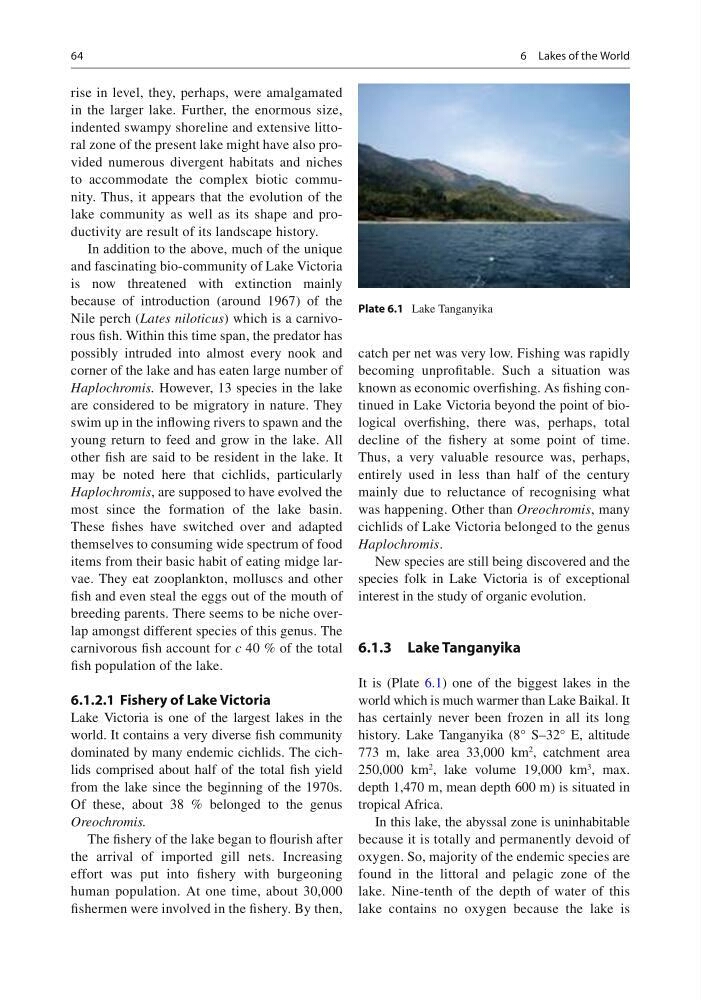
It is (Plate 6.1 ) one of the biggest lakes in the
world which is much warmer than Lake Baikal. It
has certainly never been frozen in all its long
history. Lake Tanganyika (8° S–32° E, altitude
773 m, lake area 33,000 km
2
, catchment area
250,000 km
2
, lake volume 19,000 km
3 , max.
depth 1,470 m, mean depth 600 m) is situated in
tropical Africa.
In this lake, the abyssal zone is uninhabitable
because it is totally and permanently devoid of
oxygen. So, majority of the endemic species are
found in the littoral and pelagic zone of the
lake. Nine-tenth of the depth of water of this
lake contains no oxygen because the lake is
Plate 6.1 Lake Tanganyika
6 Lakes of the World
rise in level, they, perhaps, were amalgamated
in the larger lake. Further, the enormous size,
indented swampy shoreline and extensive littoral zone of the present lake might have also provided numerous divergent habitats and niches
to accommodate the complex biotic community. Thus, it appears that the evolution of the
lake community as well as its shape and productivity are result of its landscape history.
In addition to the above, much of the unique
and fascinating bio-community of Lake Victoria
is now threatened with extinction mainly
because of introduction (around 1967) of the
Nile perch ( Lates niloticus ) which is a carnivorous fi sh. Within this time span, the predator has
possibly intruded into almost every nook and
corner of the lake and has eaten large number of
Haplochromis. However, 13 species in the lake
are considered to be migratory in nature. They
swim up in the infl owing rivers to spawn and the
young return to feed and grow in the lake. All
other fi sh are said to be resident in the lake. It
may be noted here that cichlids, particularly
Haplochromis , are supposed to have evolved the
most since the formation of the lake basin.
These fi shes have switched over and adapted
themselves to consuming wide spectrum of food
items from their basic habit of eating midge larvae. They eat zooplankton, molluscs and other
fi sh and even steal the eggs out of the mouth of
breeding parents. There seems to be niche overlap amongst different species of this genus. The
carnivorous fi sh account for c 40 % of the total
fi sh population of the lake.
6.1.2.1 Fishery of Lake Victoria
Lake Victoria is one of the largest lakes in the
world. It contains a very diverse fi sh community
dominated by many endemic cichlids. The cichlids comprised about half of the total fi sh yield
from the lake since the beginning of the 1970s.
Of these, about 38 % belonged to the genus
Oreochromis.
The fi shery of the lake began to fl ourish after
the arrival of imported gill nets. Increasing
effort was put into fi shery with burgeoning
human population. At one time, about 30,000
fi shermen were involved in the fi shery. By then,
catch per net was very low. Fishing was rapidly
becoming unprofi table. Such a situation was
known as economic overfi shing. As fi shing continued in Lake Victoria beyond the point of biological overfi shing, there was, perhaps, total
decline of the fi shery at some point of time.
Thus, a very valuable resource was, perhaps,
entirely used in less than half of the century
mainly due to reluctance of recognising what
was happening. Other than Oreochromis , many
cichlids of Lake Victoria belonged to the genus
Haplochromis .
New species are still being discovered and the
species folk in Lake Victoria is of exceptional
interest in the study of organic evolution.
6.1.3 Lake Tanganyika
It is (Plate 6.1 ) one of the biggest lakes in the
world which is much warmer than Lake Baikal. It
has certainly never been frozen in all its long
history. Lake Tanganyika (8° S–32° E, altitude
773 m, lake area 33,000 km
2
, catchment area
250,000 km
2
, lake volume 19,000 km
3 , max.
depth 1,470 m, mean depth 600 m) is situated in
tropical Africa.
In this lake, the abyssal zone is uninhabitable
because it is totally and permanently devoid of
oxygen. So, majority of the endemic species are
found in the littoral and pelagic zone of the
lake. Nine-tenth of the depth of water of this
lake contains no oxygen because the lake is
Plate 6.1 Lake Tanganyika
6 Lakes of the World