

52
the top layer and also due to the low organic
matter content. Bulk density of soil is influenced
by density of the mineral particles, quantity of
organic matter, soil compaction and burrowing
activity of the soil animals. In other words, BD
is said to be the specific gravity of the soil with
its pores. BD helps in determining the degree of
compaction of the given soil. BD also indicates
the soil aeration status.
Main materials required: 25 ml volumetric
flask, oven, weighing balance, soil sample.
4.4.5.1 Procedure
It varies according to the nature of the site, disturbed or undisturbed. Procedure for both the
kinds of sites is described below:
For Disturbed Site
Portion of the earth which is regularly ploughed
is called ‘disturbed site’.
1. The soil sample be oven-dried.
2. A 100-ml volumetric flask be weighed (W 1 ).
3. This pre-weighed volumetric flask be filled
with soil sample collected by standard
procedure.
4. The flask be now tapped and tapping is continued till the level of soil poured in reaches the
100 ml mark of the volumetric flask.
Note: It is assumed that by packing the flask
with soil followed by tapping the flask, compactness of soil in the nature is represented.
5. Weight of the volumetric flask with the soil be
noted (W 2 ).
6. Weight of the soil be determined by subtracting W 2 − W 1 .
7. The flask be now emptied and water be poured
in up to the 100 ml mark of the volumetric
flask.
8. The volume of the water (say X ml) be noted
by pouring it out into a measuring cylinder.
Calculation (with a model example)
Weight of the volumetric flask (W 1 ) = say 71.0 g
Weight of the volumetric flask + soil (W 2 ) = say
203.5 g
Volume of water in the volumetric flask
(X) = 100 ml
Weight of the soil (W 2 − W 1 = Y) = say 132.5 g
Now, we know that 1 ml = 1 cc
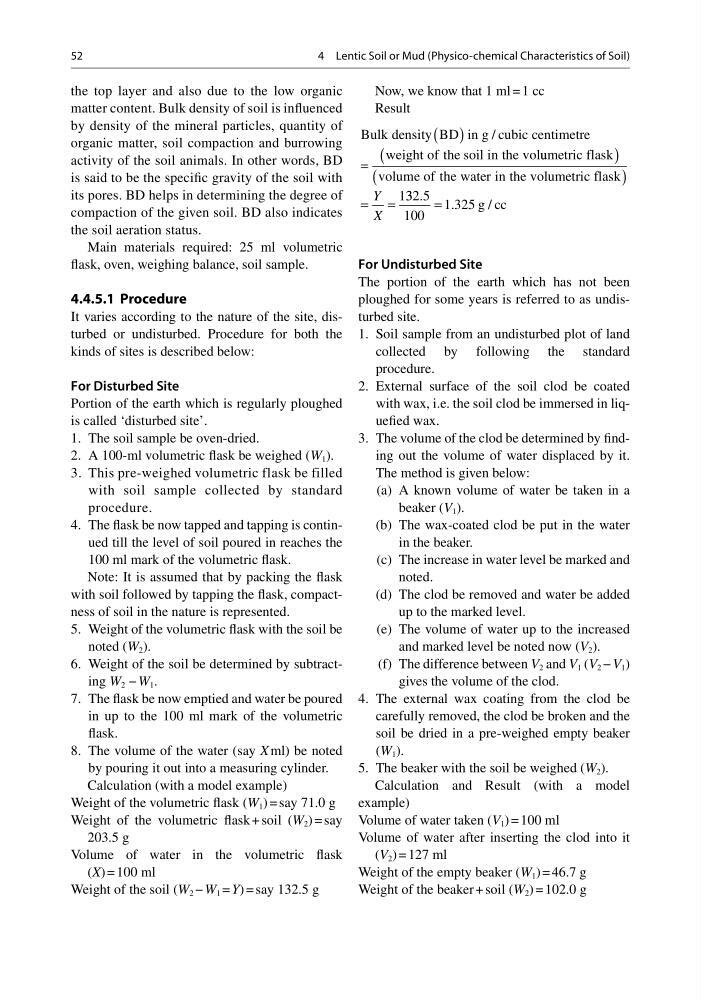
Result
Bulk density BD in g cubic centimetre
weight of the soil in the vol
( )
=
/
u umetric flask
volume of the water in the volumetric flask
(
)
(
)
= =
Y
X
13 32 5
100
1 325
.
.
/
=
g cc
For Undisturbed Site
The portion of the earth which has not been
ploughed for some years is referred to as undisturbed site.
1. Soil sample from an undisturbed plot of land
collected by following the standard
procedure.
2. External surface of the soil clod be coated
with wax, i.e. the soil clod be immersed in liquefied wax.
3. The volume of the clod be determined by finding out the volume of water displaced by it.
The method is given below:
(a) A known volume of water be taken in a
beaker (V 1 ).
(b) The wax-coated clod be put in the water
in the beaker.
(c) The increase in water level be marked and
noted.
(d) The clod be removed and water be added
up to the marked level.
(e) The volume of water up to the increased
and marked level be noted now (V 2 ).
(f) The difference between V 2 and V 1 (V 2 − V 1 )
gives the volume of the clod.
4. The external wax coating from the clod be
carefully removed, the clod be broken and the
soil be dried in a pre-weighed empty beaker
(W 1 ).
5. The beaker with the soil be weighed (W 2 ).
Calculation and Result (with a model
example)
Volume of water taken (V 1 ) = 100 ml
Volume of water after inserting the clod into it
(V 2 ) = 127 ml
Weight of the empty beaker (W 1 ) = 46.7 g
Weight of the beaker + soil (W 2 ) = 102.0 g
4 Lentic Soil or Mud (Physico-chemical Characteristics of Soil)
the top layer and also due to the low organic
matter content. Bulk density of soil is influenced
by density of the mineral particles, quantity of
organic matter, soil compaction and burrowing
activity of the soil animals. In other words, BD
is said to be the specific gravity of the soil with
its pores. BD helps in determining the degree of
compaction of the given soil. BD also indicates
the soil aeration status.
Main materials required: 25 ml volumetric
flask, oven, weighing balance, soil sample.
4.4.5.1 Procedure
It varies according to the nature of the site, disturbed or undisturbed. Procedure for both the
kinds of sites is described below:
For Disturbed Site
Portion of the earth which is regularly ploughed
is called ‘disturbed site’.
1. The soil sample be oven-dried.
2. A 100-ml volumetric flask be weighed (W 1 ).
3. This pre-weighed volumetric flask be filled
with soil sample collected by standard
procedure.
4. The flask be now tapped and tapping is continued till the level of soil poured in reaches the
100 ml mark of the volumetric flask.
Note: It is assumed that by packing the flask
with soil followed by tapping the flask, compactness of soil in the nature is represented.
5. Weight of the volumetric flask with the soil be
noted (W 2 ).
6. Weight of the soil be determined by subtracting W 2 − W 1 .
7. The flask be now emptied and water be poured
in up to the 100 ml mark of the volumetric
flask.
8. The volume of the water (say X ml) be noted
by pouring it out into a measuring cylinder.
Calculation (with a model example)
Weight of the volumetric flask (W 1 ) = say 71.0 g
Weight of the volumetric flask + soil (W 2 ) = say
203.5 g
Volume of water in the volumetric flask
(X) = 100 ml
Weight of the soil (W 2 − W 1 = Y) = say 132.5 g
Now, we know that 1 ml = 1 cc
Result
Bulk density BD in g cubic centimetre
weight of the soil in the vol
( )
=
/
u umetric flask
volume of the water in the volumetric flask
(
)
(
)
= =
Y
X
13 32 5
100
1 325
.
.
/
=
g cc
For Undisturbed Site
The portion of the earth which has not been
ploughed for some years is referred to as undisturbed site.
1. Soil sample from an undisturbed plot of land
collected by following the standard
procedure.
2. External surface of the soil clod be coated
with wax, i.e. the soil clod be immersed in liquefied wax.
3. The volume of the clod be determined by finding out the volume of water displaced by it.
The method is given below:
(a) A known volume of water be taken in a
beaker (V 1 ).
(b) The wax-coated clod be put in the water
in the beaker.
(c) The increase in water level be marked and
noted.
(d) The clod be removed and water be added
up to the marked level.
(e) The volume of water up to the increased
and marked level be noted now (V 2 ).
(f) The difference between V 2 and V 1 (V 2 − V 1 )
gives the volume of the clod.
4. The external wax coating from the clod be
carefully removed, the clod be broken and the
soil be dried in a pre-weighed empty beaker
(W 1 ).
5. The beaker with the soil be weighed (W 2 ).
Calculation and Result (with a model
example)
Volume of water taken (V 1 ) = 100 ml
Volume of water after inserting the clod into it
(V 2 ) = 127 ml
Weight of the empty beaker (W 1 ) = 46.7 g
Weight of the beaker + soil (W 2 ) = 102.0 g
4 Lentic Soil or Mud (Physico-chemical Characteristics of Soil)