

42
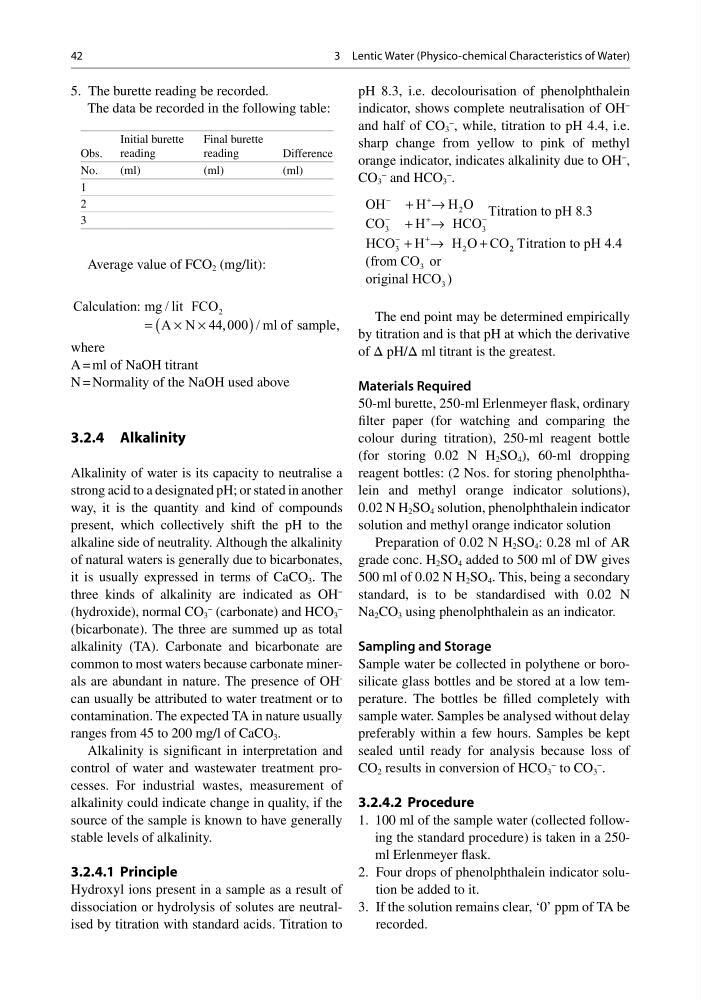
5. The burette reading be recorded.
The data be recorded in the following table:
Obs.
Initial burette
reading
Final burette
reading
Difference
No.
(ml)
(ml)
(ml)
1
2
3
Average value of FCO 2 (mg/lit):
Calculation: mg lit FCO
ml of sample,
/
A N
,
/
2
44 000
=
× ×
(
)
where
A = ml of NaOH titrant
N = Normality of the NaOH used above
3.2.4 Alkalinity
Alkalinity of water is its capacity to neutralise a
strong acid to a designated pH; or stated in another
way, it is the quantity and kind of compounds
present, which collectively shift the pH to the
alkaline side of neutrality. Although the alkalinity
of natural waters is generally due to bicarbonates,
it is usually expressed in terms of CaCO 3 . The
three kinds of alkalinity are indicated as OH
−
(hydroxide), normal CO 3
−
(carbonate) and HCO 3
−
(bicarbonate). The three are summed up as total
alkalinity (TA). Carbonate and bicarbonate are
common to most waters because carbonate minerals are abundant in nature. The presence of OH
-
can usually be attributed to water treatment or to
contamination. The expected TA in nature usually
ranges from 45 to 200 mg/l of CaCO 3 .
Alkalinity is significant in interpretation and
control of water and wastewater treatment processes. For industrial wastes, measurement of
alkalinity could indicate change in quality, if the
source of the sample is known to have generally
stable levels of alkalinity.
3.2.4.1 Principle
Hydroxyl ions present in a sample as a result of
dissociation or hydrolysis of solutes are neutralised by titration with standard acids. Titration to
pH 8.3, i.e. decolourisation of phenolphthalein
indicator, shows complete neutralisation of OH
−
and half of CO 3
−
, while, titration to pH 4.4, i.e.
sharp change from yellow to pink of methyl
orange indicator, indicates alkalinity due to OH
−
,
CO 3
−
and HCO 3
−
.
OH
H
H O Titration to pH
CO
H
HCO
HCO H
H O CO
−
+
−
+
−
−
+
+ →
+ →
+ →
+
2
3
3
3
2
8 3
.
2 2
3
3
4 4
Titration to pH
from CO or
original HCO
.
(
)
The end point may be determined empirically
by titration and is that pH at which the derivative
of Δ pH/Δ ml titrant is the greatest.
Materials Required
50-ml burette, 250-ml Erlenmeyer flask, ordinary
filter paper (for watching and comparing the
colour during titration), 250-ml reagent bottle
(for storing 0.02 N H 2 SO 4 ), 60-ml dropping
reagent bottles: (2 Nos. for storing phenolphthalein and methyl orange indicator solutions),
0.02 N H 2 SO 4 solution, phenolphthalein indicator
solution and methyl orange indicator solution
Preparation of 0.02 N H 2 SO 4 : 0.28 ml of AR
grade conc. H 2 SO 4 added to 500 ml of DW gives
500 ml of 0.02 N H 2 SO 4 . This, being a secondary
standard, is to be standardised with 0.02 N
Na 2 CO 3 using phenolphthalein as an indicator.
Sampling and Storage
Sample water be collected in polythene or borosilicate glass bottles and be stored at a low temperature. The bottles be filled completely with
sample water. Samples be analysed without delay
preferably within a few hours. Samples be kept
sealed until ready for analysis because loss of
CO 2 results in conversion of HCO 3
−
to CO 3
−
.
3.2.4.2 Procedure
1. 100 ml of the sample water (collected following the standard procedure) is taken in a 250ml Erlenmeyer flask.
2. Four drops of phenolphthalein indicator solution be added to it.
3. If the solution remains clear, ‘0’ ppm of TA be
recorded.
3 Lentic Water (Physico-chemical Characteristics of Water)
5. The burette reading be recorded.
The data be recorded in the following table:
Obs.
Initial burette
reading
Final burette
reading
Difference
No.
(ml)
(ml)
(ml)
1
2
3
Average value of FCO 2 (mg/lit):
Calculation: mg lit FCO
ml of sample,
/
A N
,
/
2
44 000
=
× ×
(
)
where
A = ml of NaOH titrant
N = Normality of the NaOH used above
3.2.4 Alkalinity
Alkalinity of water is its capacity to neutralise a
strong acid to a designated pH; or stated in another
way, it is the quantity and kind of compounds
present, which collectively shift the pH to the
alkaline side of neutrality. Although the alkalinity
of natural waters is generally due to bicarbonates,
it is usually expressed in terms of CaCO 3 . The
three kinds of alkalinity are indicated as OH
−
(hydroxide), normal CO 3
−
(carbonate) and HCO 3
−
(bicarbonate). The three are summed up as total
alkalinity (TA). Carbonate and bicarbonate are
common to most waters because carbonate minerals are abundant in nature. The presence of OH
-
can usually be attributed to water treatment or to
contamination. The expected TA in nature usually
ranges from 45 to 200 mg/l of CaCO 3 .
Alkalinity is significant in interpretation and
control of water and wastewater treatment processes. For industrial wastes, measurement of
alkalinity could indicate change in quality, if the
source of the sample is known to have generally
stable levels of alkalinity.
3.2.4.1 Principle
Hydroxyl ions present in a sample as a result of
dissociation or hydrolysis of solutes are neutralised by titration with standard acids. Titration to
pH 8.3, i.e. decolourisation of phenolphthalein
indicator, shows complete neutralisation of OH
−
and half of CO 3
−
, while, titration to pH 4.4, i.e.
sharp change from yellow to pink of methyl
orange indicator, indicates alkalinity due to OH
−
,
CO 3
−
and HCO 3
−
.
OH
H
H O Titration to pH
CO
H
HCO
HCO H
H O CO
−
+
−
+
−
−
+
+ →
+ →
+ →
+
2
3
3
3
2
8 3
.
2 2
3
3
4 4
Titration to pH
from CO or
original HCO
.
(
)
The end point may be determined empirically
by titration and is that pH at which the derivative
of Δ pH/Δ ml titrant is the greatest.
Materials Required
50-ml burette, 250-ml Erlenmeyer flask, ordinary
filter paper (for watching and comparing the
colour during titration), 250-ml reagent bottle
(for storing 0.02 N H 2 SO 4 ), 60-ml dropping
reagent bottles: (2 Nos. for storing phenolphthalein and methyl orange indicator solutions),
0.02 N H 2 SO 4 solution, phenolphthalein indicator
solution and methyl orange indicator solution
Preparation of 0.02 N H 2 SO 4 : 0.28 ml of AR
grade conc. H 2 SO 4 added to 500 ml of DW gives
500 ml of 0.02 N H 2 SO 4 . This, being a secondary
standard, is to be standardised with 0.02 N
Na 2 CO 3 using phenolphthalein as an indicator.
Sampling and Storage
Sample water be collected in polythene or borosilicate glass bottles and be stored at a low temperature. The bottles be filled completely with
sample water. Samples be analysed without delay
preferably within a few hours. Samples be kept
sealed until ready for analysis because loss of
CO 2 results in conversion of HCO 3
−
to CO 3
−
.
3.2.4.2 Procedure
1. 100 ml of the sample water (collected following the standard procedure) is taken in a 250ml Erlenmeyer flask.
2. Four drops of phenolphthalein indicator solution be added to it.
3. If the solution remains clear, ‘0’ ppm of TA be
recorded.
3 Lentic Water (Physico-chemical Characteristics of Water)