

37
4. The temperature of the buffer solution of
pH 7.0 is noted.
5. The temperature control switch of the pH
meter is adjusted according to the temperature of the buffer.
6. The electrodes are dipped into buffer solution
of pH 7.0.
7. The meter will display some reading which
may be nearly 7.0.
8. The ‘standardise control’ of the meter is operated to make the meter reading exactly 7.0.
9. The buffer solution of pH 7.0 is removed
from the table and the buffer solution of
pH 4.0 is brought in.
10. The electrodes are washed and rinsed as before.
11. Temperature of the buffer solution of pH 4.0
is noted.
12. The temperature control switch of the pH
meter is adjusted according to the temperature of the buffer.
13. The electrodes are dipped into buffer solution of pH 4.0.
14. The pH meter could display exactly 4.0 or
could display some reading which is nearly
4.0.
15. If it is nearly 4.0, the standardise control of
the meter is operated to make the meter reading exactly 4.0.
16. The buffer solution of pH 4.0 is also removed
from the table. The pH meter is now said to
be standardised.
17. The sample water of unknown pH is brought
in.
18. The electrodes are washed and rinsed as
before.
19. The electrodes are dipped into the water
sample.
20. The pH of the water sample is recorded
directly from the pH meter.
21. The procedure is repeated for other samples.
3.2.2 Dissolved Oxygen (DO)
It refers to the oxygen which is dissolved in
water. It plays a key role in the dynamics of the
water body particularly in the respiration of the
aquatic biota. DO content in water results from:
1. Photosynthetic activity of the green plants
2. Diffusion gradient at the air–water interface
3. Wind-driven mixing
Following are broadly two methods for the
estimation of DO in water:
(a) Titrimetric (iodometric)
(b) Electrometric (electronic)
3.2.2.1 Titrimetric Method: Alsterburg
Azide Modification of Winkler
Method
Principle
In this method, the amount of DO is computed in
mg/lit by the quantity of liberated iodine from a
mixture of manganous sulphate and alkaline iodide–
sodium azide neutralised by a known volume of
0.025 N sodium thiosulphate solution. In other
words, there is a formation of brown hydrated oxide
of manganese (IV) by oxidation of manganese (II)
hydroxide by the DO when a solution of potassium
iodide–sodium azide is added to the sample:
MnSO
KOH Mn OH
K SO
4
2
2
4
2
+
®
( ) ¯ +
2
2
2
2
2
Mn OH
O
MnO OH
Brown ppt
( ) + →
( )
(
)
↓
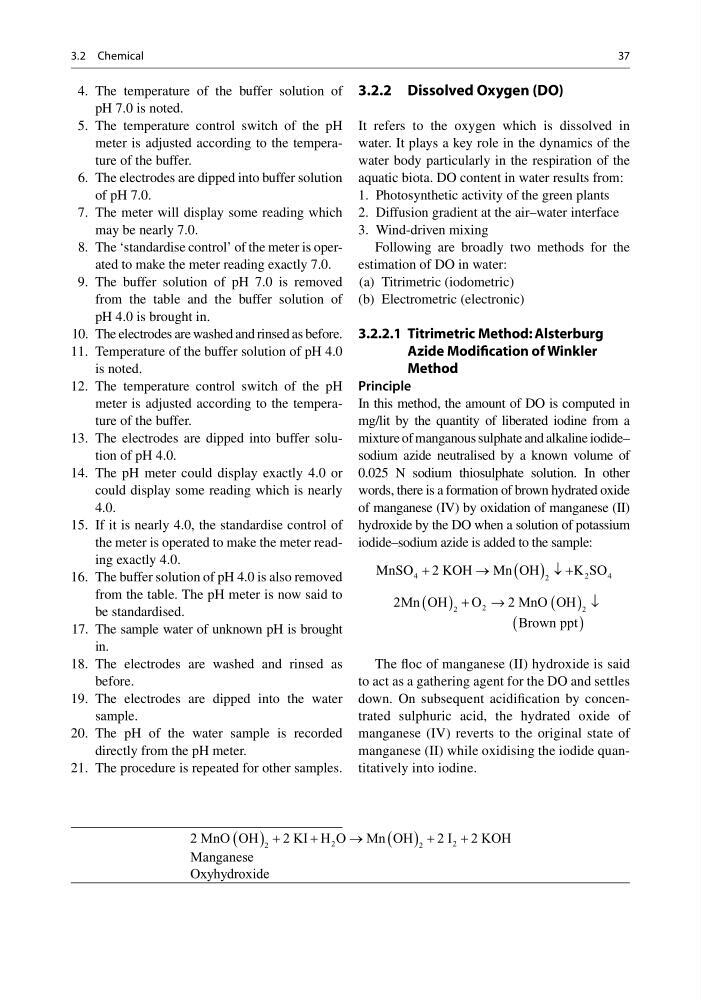
The floc of manganese (II) hydroxide is said
to act as a gathering agent for the DO and settles
down. On subsequent acidification by concentrated sulphuric acid, the hydrated oxide of
manganese (IV) reverts to the original state of
manganese (II) while oxidising the iodide quantitatively into iodine.
2
2
2
2
2
2
2
2
MnO OH
KI H O Mn OH
I
KOH
Manganese
Oxyhydroxide
( ) +
+
®
( ) + +
3.2 Chemical
4. The temperature of the buffer solution of
pH 7.0 is noted.
5. The temperature control switch of the pH
meter is adjusted according to the temperature of the buffer.
6. The electrodes are dipped into buffer solution
of pH 7.0.
7. The meter will display some reading which
may be nearly 7.0.
8. The ‘standardise control’ of the meter is operated to make the meter reading exactly 7.0.
9. The buffer solution of pH 7.0 is removed
from the table and the buffer solution of
pH 4.0 is brought in.
10. The electrodes are washed and rinsed as before.
11. Temperature of the buffer solution of pH 4.0
is noted.
12. The temperature control switch of the pH
meter is adjusted according to the temperature of the buffer.
13. The electrodes are dipped into buffer solution of pH 4.0.
14. The pH meter could display exactly 4.0 or
could display some reading which is nearly
4.0.
15. If it is nearly 4.0, the standardise control of
the meter is operated to make the meter reading exactly 4.0.
16. The buffer solution of pH 4.0 is also removed
from the table. The pH meter is now said to
be standardised.
17. The sample water of unknown pH is brought
in.
18. The electrodes are washed and rinsed as
before.
19. The electrodes are dipped into the water
sample.
20. The pH of the water sample is recorded
directly from the pH meter.
21. The procedure is repeated for other samples.
3.2.2 Dissolved Oxygen (DO)
It refers to the oxygen which is dissolved in
water. It plays a key role in the dynamics of the
water body particularly in the respiration of the
aquatic biota. DO content in water results from:
1. Photosynthetic activity of the green plants
2. Diffusion gradient at the air–water interface
3. Wind-driven mixing
Following are broadly two methods for the
estimation of DO in water:
(a) Titrimetric (iodometric)
(b) Electrometric (electronic)
3.2.2.1 Titrimetric Method: Alsterburg
Azide Modification of Winkler
Method
Principle
In this method, the amount of DO is computed in
mg/lit by the quantity of liberated iodine from a
mixture of manganous sulphate and alkaline iodide–
sodium azide neutralised by a known volume of
0.025 N sodium thiosulphate solution. In other
words, there is a formation of brown hydrated oxide
of manganese (IV) by oxidation of manganese (II)
hydroxide by the DO when a solution of potassium
iodide–sodium azide is added to the sample:
MnSO
KOH Mn OH
K SO
4
2
2
4
2
+
®
( ) ¯ +
2
2
2
2
2
Mn OH
O
MnO OH
Brown ppt
( ) + →
( )
(
)
↓
The floc of manganese (II) hydroxide is said
to act as a gathering agent for the DO and settles
down. On subsequent acidification by concentrated sulphuric acid, the hydrated oxide of
manganese (IV) reverts to the original state of
manganese (II) while oxidising the iodide quantitatively into iodine.
2
2
2
2
2
2
2
2
MnO OH
KI H O Mn OH
I
KOH
Manganese
Oxyhydroxide
( ) +
+
®
( ) + +
3.2 Chemical