

35
(iii) In a 100-ml volumetric flask, 5.0 ml of
Solution I is mixed with 5.0 ml of
Solution II. Allowed to stand for 24 h at
25 ± 3 °C. This be diluted to 100-ml
mark of the flask and shaken properly.
Turbidity of this suspension is 400
NTU.
NB: Stock solutions be prepared monthly.
(c) Standard Turbidity Suspension
Ten millilitre of Stock Turbidity Suspension
(as prepared above) be diluted to 100 ml with
turbidity-free water. The turbidity of this suspension is defined as 40 NTU. Such suspensions be
prepared weekly.
Procedure
(a) Turbiditimeter Calibration: Generally, these
meters are kept calibrated by the manufacturer before being sold out. Further, manufacturer’s operation manual could be useful
in calibration, if required.
(b) Measurement of Turbidities of <40 NTU:
The sample is thoroughly shaken. The air
bubbles are allowed to escape. The sample is
poured into the turbiditimeter tube and the
turbidity is read directly from the scale or
from the calibration curve.
(c) Measurement of Turbidity of >40 NTU: The
sample is diluted with turbidity-free water
until its turbidity falls between 30.0 and 40.0
NTU. Now, the turbidity of the original sample is computed from the turbidity of the
diluted sample and dilution factor. The Stock
Turbidity Suspension of 400 NTU be used
for continuous monitoring. High turbidities
determined by direct measurement are likely
to differ appreciably from those determined
by dilution technique
Calculation
NTU =
´ +
(
)
A B C
C
,
Where
A = NTU found in the diluted sample
B = Volume of the dilution water
C = Sample volume taken for dilution
Interpretation of Results
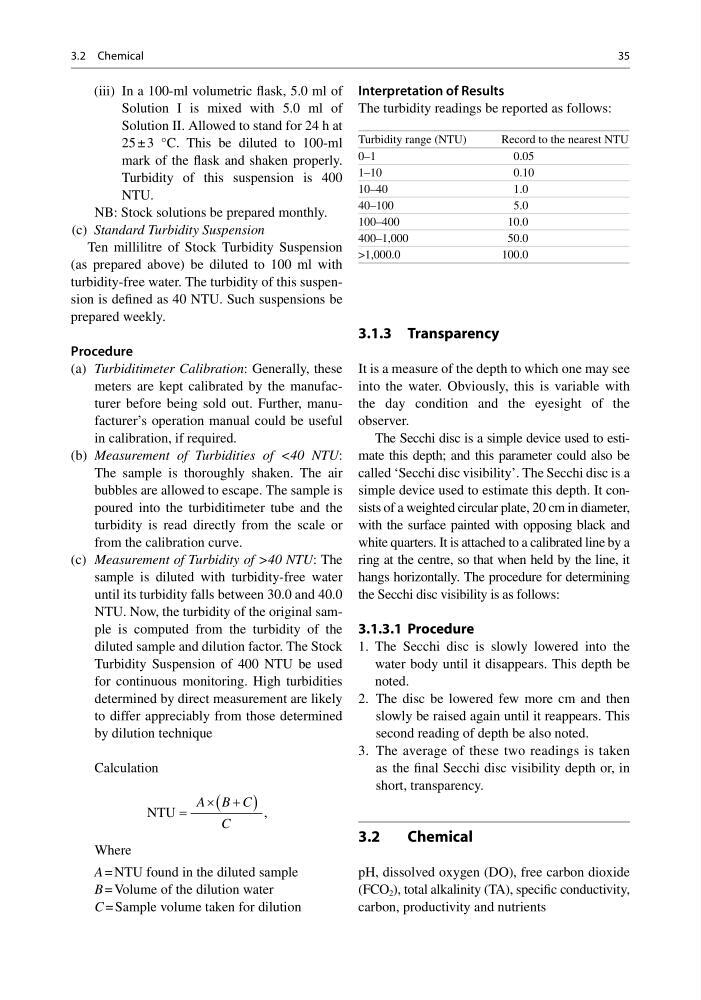
The turbidity readings be reported as follows:
Turbidity range (NTU)
Record to the nearest NTU
0–1
0.05
1–10
0.10
10–40
1.0
40–100
5.0
100–400
10.0
400–1,000
50.0
>1,000.0
100.0
3.1.3 Transparency
It is a measure of the depth to which one may see
into the water. Obviously, this is variable with
the day condition and the eyesight of the
observer.
The Secchi disc is a simple device used to estimate this depth; and this parameter could also be
called ‘Secchi disc visibility’. The Secchi disc is a
simple device used to estimate this depth. It consists of a weighted circular plate, 20 cm in diameter,
with the surface painted with opposing black and
white quarters. It is attached to a calibrated line by a
ring at the centre, so that when held by the line, it
hangs horizontally. The procedure for determining
the Secchi disc visibility is as follows:
3.1.3.1 Procedure
1. The Secchi disc is slowly lowered into the
water body until it disappears. This depth be
noted.
2. The disc be lowered few more cm and then
slowly be raised again until it reappears. This
second reading of depth be also noted.
3. The average of these two readings is taken
as the final Secchi disc visibility depth or, in
short, transparency.
3.2
Chemical
pH, dissolved oxygen (DO), free carbon dioxide
(FCO 2 ), total alkalinity (TA), specific conductivity,
carbon, productivity and nutrients
3.2 Chemical
(iii) In a 100-ml volumetric flask, 5.0 ml of
Solution I is mixed with 5.0 ml of
Solution II. Allowed to stand for 24 h at
25 ± 3 °C. This be diluted to 100-ml
mark of the flask and shaken properly.
Turbidity of this suspension is 400
NTU.
NB: Stock solutions be prepared monthly.
(c) Standard Turbidity Suspension
Ten millilitre of Stock Turbidity Suspension
(as prepared above) be diluted to 100 ml with
turbidity-free water. The turbidity of this suspension is defined as 40 NTU. Such suspensions be
prepared weekly.
Procedure
(a) Turbiditimeter Calibration: Generally, these
meters are kept calibrated by the manufacturer before being sold out. Further, manufacturer’s operation manual could be useful
in calibration, if required.
(b) Measurement of Turbidities of <40 NTU:
The sample is thoroughly shaken. The air
bubbles are allowed to escape. The sample is
poured into the turbiditimeter tube and the
turbidity is read directly from the scale or
from the calibration curve.
(c) Measurement of Turbidity of >40 NTU: The
sample is diluted with turbidity-free water
until its turbidity falls between 30.0 and 40.0
NTU. Now, the turbidity of the original sample is computed from the turbidity of the
diluted sample and dilution factor. The Stock
Turbidity Suspension of 400 NTU be used
for continuous monitoring. High turbidities
determined by direct measurement are likely
to differ appreciably from those determined
by dilution technique
Calculation
NTU =
´ +
(
)
A B C
C
,
Where
A = NTU found in the diluted sample
B = Volume of the dilution water
C = Sample volume taken for dilution
Interpretation of Results
The turbidity readings be reported as follows:
Turbidity range (NTU)
Record to the nearest NTU
0–1
0.05
1–10
0.10
10–40
1.0
40–100
5.0
100–400
10.0
400–1,000
50.0
>1,000.0
100.0
3.1.3 Transparency
It is a measure of the depth to which one may see
into the water. Obviously, this is variable with
the day condition and the eyesight of the
observer.
The Secchi disc is a simple device used to estimate this depth; and this parameter could also be
called ‘Secchi disc visibility’. The Secchi disc is a
simple device used to estimate this depth. It consists of a weighted circular plate, 20 cm in diameter,
with the surface painted with opposing black and
white quarters. It is attached to a calibrated line by a
ring at the centre, so that when held by the line, it
hangs horizontally. The procedure for determining
the Secchi disc visibility is as follows:
3.1.3.1 Procedure
1. The Secchi disc is slowly lowered into the
water body until it disappears. This depth be
noted.
2. The disc be lowered few more cm and then
slowly be raised again until it reappears. This
second reading of depth be also noted.
3. The average of these two readings is taken
as the final Secchi disc visibility depth or, in
short, transparency.
3.2
Chemical
pH, dissolved oxygen (DO), free carbon dioxide
(FCO 2 ), total alkalinity (TA), specific conductivity,
carbon, productivity and nutrients
3.2 Chemical