

670
by mechanical , chemical or biological means.
The mechanical means involve water - level
manipulation ; the chemical control includes
spraying or dusting of the water bodies with
herbicides , while the biological methods include
control by introducing the herbivorous fi shes .
There are various suggestions of ‘creative
approach’ of managing the aquatic vegetation by
considering the entire lentic body and its bays as
an ‘ aquascape ’ and to manage it by judicious
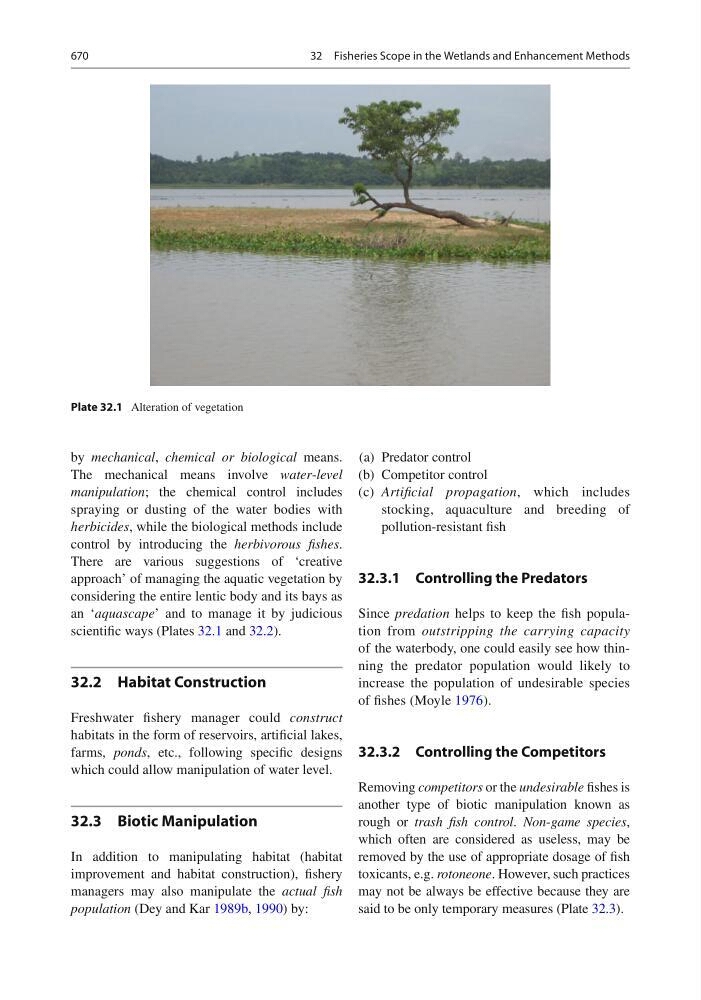
scientifi c ways (Plates 32.1 and 32.2 ).
32.2 Habitat Construction
Freshwater fi shery manager could construct
habitats in the form of reservoirs, artifi cial lakes,
farms, ponds , etc., following specifi c designs
which could allow manipulation of water level.
32.3 Biotic Manipulation
In addition to manipulating habitat (habitat
improvement and habitat construction), fi shery
managers may also manipulate the actual fi sh
population (Dey and Kar 1989b , 1990 ) by:
(a) Predator control
(b) Competitor control
(c) Artifi cial propagation , which includes
stocking, aquaculture and breeding of
pollution- resistant fi sh
32.3.1 Controlling the Predators
Since predation helps to keep the fi sh population from outstripping the carrying capacity
of the waterbody, one could easily see how thinning the predator population would likely to
increase the population of undesirable species
of fi shes (Moyle 1976 ).
32.3.2 Controlling the Competitors
Removing competitors or the undesirable fi shes is
another type of biotic manipulation known as
rough or trash fi sh control . Non - game species ,
which often are considered as useless, may be
removed by the use of appropriate dosage of fi sh
toxicants, e.g. rotoneone . However, such practices
may not be always be effective because they are
said to be only temporary measures (Plate 32.3 ).
Plate 32.1 Alteration of vegetation
32 Fisheries Scope in the Wetlands and Enhancement Methods