

637
degrading wetlands, legal–policy failures,
anthropogenic effects, etc.
12. Wetlands are globally becoming a threatened
landscape. As such, it is to be appreciated
that threat to wetlands is a threat to ecological balance.
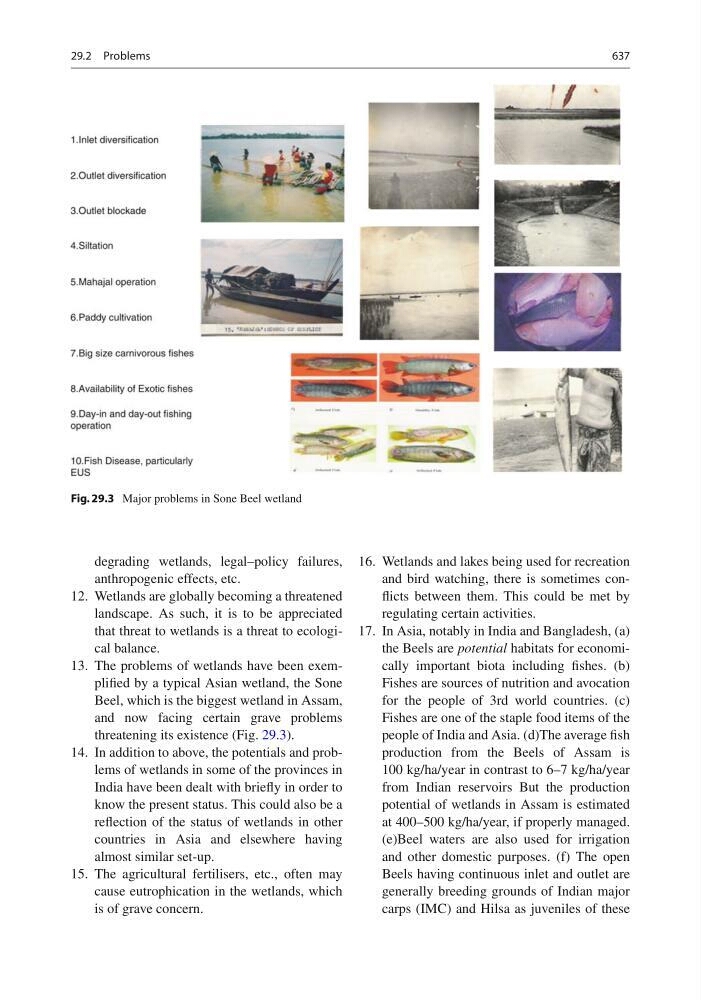
13. The problems of wetlands have been exemplifi ed by a typical Asian wetland, the Sone
Beel, which is the biggest wetland in Assam,
and now facing certain grave problems
threatening its existence (Fig. 29.3 ).
14. In addition to above, the potentials and problems of wetlands in some of the provinces in
India have been dealt with briefl y in order to
know the present status. This could also be a
refl ection of the status of wetlands in other
countries in Asia and elsewhere having
almost similar set-up.
15. The agricultural fertilisers, etc., often may
cause eutrophication in the wetlands, which
is of grave concern.
16. Wetlands and lakes being used for recreation
and bird watching, there is sometimes confl icts between them. This could be met by
regulating certain activities.
17. In Asia, notably in India and Bangladesh, (a)
the Beels are potential habitats for economically important biota including fi shes. (b)
Fishes are sources of nutrition and avocation
for the people of 3rd world countries. (c)
Fishes are one of the staple food items of the
people of India and Asia. (d)The average fi sh
production from the Beels of Assam is
100 kg/ha/year in contrast to 6–7 kg/ha/year
from Indian reservoirs But the production
potential of wetlands in Assam is estimated
at 400–500 kg/ha/year, if properly managed.
(e)Beel waters are also used for irrigation
and other domestic purposes. (f) The open
Beels having continuous inlet and outlet are
generally breeding grounds of Indian major
carps (IMC) and Hilsa as juveniles of these
Fig. 29.3 Major problems in Sone Beel wetland
29.2 Problems