

609
large, belong to the professional category of
fi shermen, while the Meiteis and Beharis mostly
belong to the part-time and occasional categories
of fi shermen.
Unlike in Sone Beel, there is not much diversity of fi shing gears in Chatla Haor. The Kaibartas
are generally seen to fi sh with Lar barshi, Dori,
Paran, Patan jal, Maha jal, Ghuran jal, Jhaki jal
and Dal jal. The Meiteis are seen to operate
mainly the Patan jal and the Jhaki jal, while the
Beharis generally operate the Jhaki jal. Further,
the Pelain (small trawl) is seen in operation in
Chatla Haor by all the three communities of
fi shermen. As in Sone Beel, the socio-economic
condition of the fi shermen in Chatla is also very
poor and needs upliftment.
28.3.7 In the Anuas
The ‘Anuas’, though not very enormous in dimension (as compared to Sone Beel and Chatla Haor),
are highly potential in fi sh production mainly
because of their great depth, having been part of
the course of River Barak once upon a time.
Fishermen belonging to different communities,
notably the Maimals, Patnis and Meiteis, live in
the villages around the Anuas. They operate
mainly the Lar barshi, Patan jal and the Jhaki
jal for fi shing in the Anuas. Socio-economically,
they are poor and most of them live hand to
mouth. However, the Anuas are generally leased
out by the government to fi sh traders who are rich
and employ the poor fi shermen as labourers in
fi shing without giving much benefi t to them.
28.3.7.1 Fishing Centres
In a lentic water body, fi shing generally goes on
in the entire water spread area. Similarly, in a
lotic system, fi sh catching usually goes on in the
entire stretch of the river. However, in both lentic
and lotic systems, there are certain interesting
spots, which are signifi cantly different from other
areas of the water bodies with regard to possibility
of fetching a richer catch. Such spots are more
apparent at the DSL of the water bodies and are
distinguished from others by certain features, like
increased depth and favourable physico-chemical
characteristics of water. Such ‘distinguished
spots’, where intense fi shing goes on at DSL, are
regarded as ‘fi shing centres’. On the other hand,
the fi sh markets on the shoreline of the Beels or
on the banks of rivers, where the captured fi shes
land for the fi rst time, are called the ‘fi sh landing
stations.’ From the fi sh landing stations, the fi shes
are marketed to other markets in the district and
province.
An account of the fi shing centres (FC), fi sh
landing stations (FLS) and Fish Marketing (FM)
is briefl y given below.
28.3.8 In Sone Beel in Assam
28.3.8.1 Fishing Centres
During the rainy season, the entire water spread
area of the Beel is used for intensive fi shing at
both domestic and commercial scales. However,
at DSL, when the water spread area of the Beel
shrinks, and the Beel becomes shallow, intense
fi shing activities are restricted mainly to eight
distinct deeper ‘fi shing centres’, which are locally
called ‘Bundhs’. Every year, at DSL of the Beel,
these ‘Bundhs’ are leased out principally to the
Kaibarta fi shermen living around the Beel, who
fi sh in the ‘Bundhs’ mostly during the period
from November to April. Such Bundhs, lying at
deeper portions of the Beel at DSL, are generally
kept encircled with bamboo mat (locally called
‘Khati bundh’) of height varying from 2.0 to
8.0 m; and fi shes are captured and marketed
regularly, as required, during the entire period of
operation.
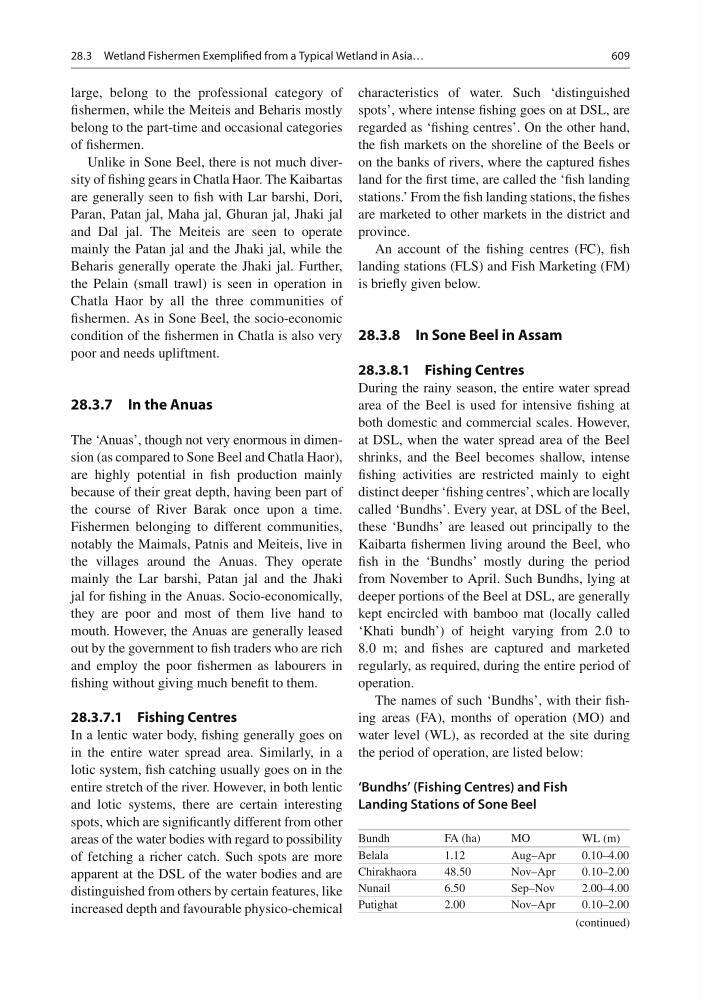
The names of such ‘Bundhs’, with their fi shing areas (FA), months of operation (MO) and
water level (WL), as recorded at the site during
the period of operation, are listed below:
‘Bundhs’ (Fishing Centres) and Fish
Landing Stations of Sone Beel
Bundh
FA (ha)
MO
WL (m)
Belala
1.12
Aug–Apr
0.10–4.00
Chirakhaora
48.50
Nov–Apr
0.10–2.00
Nunail
6.50
Sep–Nov
2.00–4.00
Putighat
2.00
Nov–Apr
0.10–2.00
(continued)
28.3 Wetland Fishermen Exemplifi ed from a Typical Wetland in Asia…