

596
varies in length from 30 to 40 m, height from 5.0
to 5.5 m and mesh size from 1.0 to 6.0 mm.
Ghuran jal is operated by three persons from a
RB boat. In operation, one person holds one end
of the head rope on the bank or after rowing to a
shallow area of c 1.0 m deep, while one person
gets down from the boat holding one end of the
head rope of the gear. The boat is rowed gradually to a deeper water of c 1.5 m, then the second
man, who holds the other extremity of the net,
also gets down from the boat. By this time, the
net has been cast from the coracle in a semicircular manner. While the area is being encircled and
the net is gradually being dragged towards the
shore, the second man gets into the boat to lift the
net, the fi rst man keeps the net under his feet and
the third man creates a mild current therein by
revolving the boat slowly. The fi sh moving along
the current are caught by the gear and brought
above water.
In Sone Beel, this kind of gear has been seen
in operation from April to December at a depth
range of 0.50–1.50 m for capturing mainly carps
and minnows.
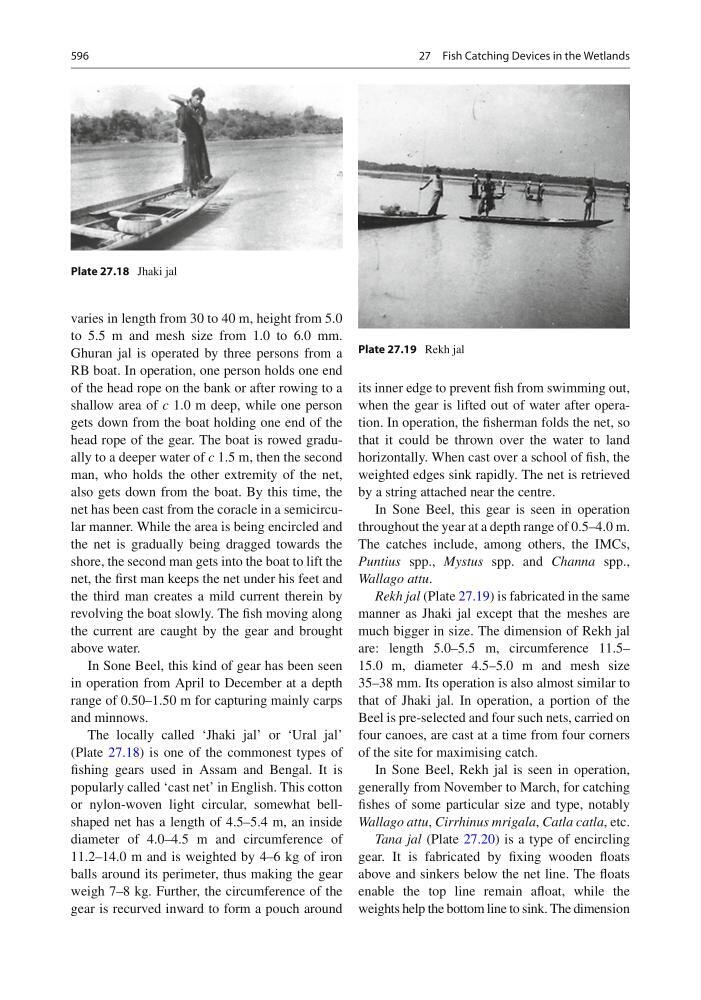
The locally called ‘Jhaki jal’ or ‘Ural jal’
(Plate 27.18 ) is one of the commonest types of
fi shing gears used in Assam and Bengal. It is
popularly called ‘cast net’ in English. This cotton
or nylon-woven light circular, somewhat bellshaped net has a length of 4.5–5.4 m, an inside
diameter of 4.0–4.5 m and circumference of
11.2–14.0 m and is weighted by 4–6 kg of iron
balls around its perimeter, thus making the gear
weigh 7–8 kg. Further, the circumference of the
gear is recurved inward to form a pouch around
its inner edge to prevent fi sh from swimming out,
when the gear is lifted out of water after operation. In operation, the fi sherman folds the net, so
that it could be thrown over the water to land
horizontally. When cast over a school of fi sh, the
weighted edges sink rapidly. The net is retrieved
by a string attached near the centre.
In Sone Beel, this gear is seen in operation
throughout the year at a depth range of 0.5–4.0 m.
The catches include, among others, the IMCs,
Puntius spp., Mystus spp. and Channa spp.,
Wallago attu .
Rekh jal (Plate 27.19 ) is fabricated in the same
manner as Jhaki jal except that the meshes are
much bigger in size. The dimension of Rekh jal
are: length 5.0–5.5 m, circumference 11.5–
15.0 m, diameter 4.5–5.0 m and mesh size
35–38 mm. Its operation is also almost similar to
that of Jhaki jal. In operation, a portion of the
Beel is pre-selected and four such nets, carried on
four canoes, are cast at a time from four corners
of the site for maximising catch.
In Sone Beel, Rekh jal is seen in operation,
generally from November to March, for catching
fi shes of some particular size and type, notably
Wallago attu , Cirrhinus mrigala , Catla catla , etc.
Tana jal (Plate 27.20 ) is a type of encircling
gear. It is fabricated by fi xing wooden fl oats
above and sinkers below the net line. The fl oats
enable the top line remain afl oat, while the
weights help the bottom line to sink. The dimension
Plate 27.18 Jhaki jal
Plate 27.19 Rekh jal
27 Fish Catching Devices in the Wetlands