

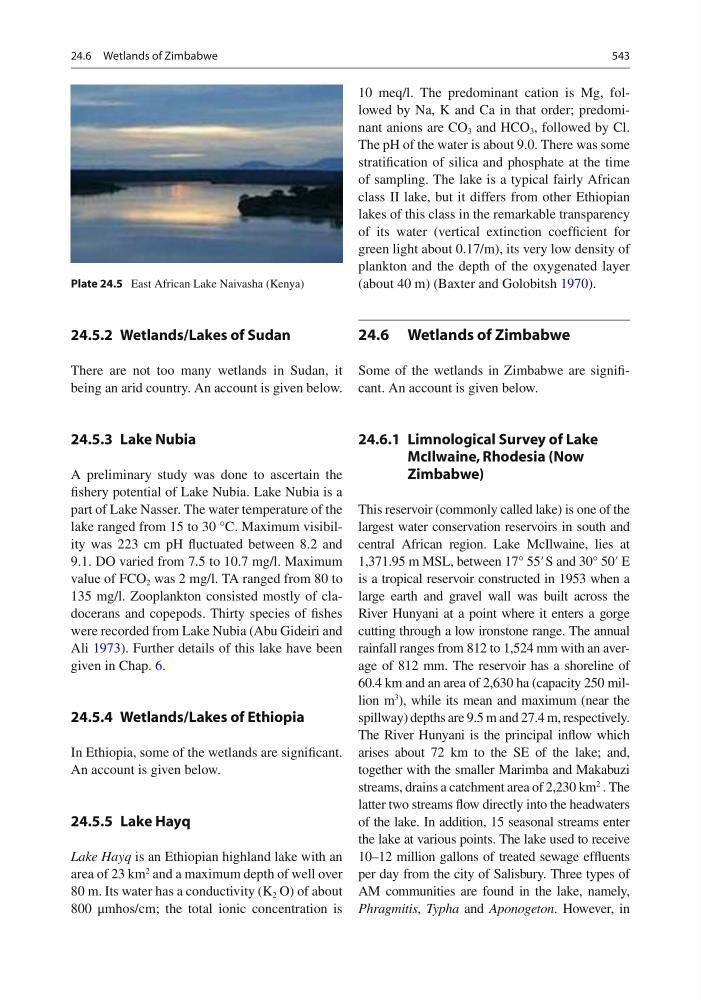
543
24.5.2 Wetlands/Lakes of Sudan
There are not too many wetlands in Sudan, it
being an arid country. An account is given below.
24.5.3 Lake Nubia
A preliminary study was done to ascertain the
fi shery potential of Lake Nubia. Lake Nubia is a
part of Lake Nasser. The water temperature of the
lake ranged from 15 to 30 °C. Maximum visibility was 223 cm pH fl uctuated between 8.2 and
9.1. DO varied from 7.5 to 10.7 mg/l. Maximum
value of FCO 2 was 2 mg/l. TA ranged from 80 to
135 mg/l. Zooplankton consisted mostly of cladocerans and copepods. Thirty species of fi shes
were recorded from Lake Nubia (Abu Gideiri and
Ali 1973 ). Further details of this lake have been
given in Chap. 6 .
24.5.4 Wetlands/Lakes of Ethiopia
In Ethiopia, some of the wetlands are signifi cant.
An account is given below.
24.5.5 Lake Hayq
Lake Hayq is an Ethiopian highland lake with an
area of 23 km
2 and a maximum depth of well over
80 m. Its water has a conductivity (K 2 O) of about
800 μmhos/cm; the total ionic concentration is
10 meq/l. The predominant cation is Mg, followed by Na, K and Ca in that order; predominant anions are CO 3 and HCO 3 , followed by Cl.
The pH of the water is about 9.0. There was some
stratifi cation of silica and phosphate at the time
of sampling. The lake is a typical fairly African
class II lake, but it differs from other Ethiopian
lakes of this class in the remarkable transparency
of its water (vertical extinction coeffi cient for
green light about 0.17/m), its very low density of
plankton and the depth of the oxygenated layer
(about 40 m) (Baxter and Golobitsh 1970 ).
24.6 Wetlands of Zimbabwe
Some of the wetlands in Zimbabwe are signifi -
cant. An account is given below.
24.6.1 Limnological Survey of Lake
McIlwaine, Rhodesia (Now
Zimbabwe)
This reservoir (commonly called lake) is one of the
largest water conservation reservoirs in south and
central African region. Lake McIlwaine, lies at
1,371.95 m MSL, between 17° 55′ S and 30° 50′ E
is a tropical reservoir constructed in 1953 when a
large earth and gravel wall was built across the
River Hunyani at a point where it enters a gorge
cutting through a low ironstone range. The annual
rainfall ranges from 812 to 1,524 mm with an average of 812 mm. The reservoir has a shoreline of
60.4 km and an area of 2,630 ha (capacity 250 million m
3
), while its mean and maximum (near the
spillway) depths are 9.5 m and 27.4 m, respectively.
The River Hunyani is the principal infl ow which
arises about 72 km to the SE of the lake; and,
together with the smaller Marimba and Makabuzi
streams, drains a catchment area of 2,230 km
2 . The
latter two streams fl ow directly into the headwaters
of the lake. In addition, 15 seasonal streams enter
the lake at various points. The lake used to receive
10–12 million gallons of treated sewage effl uents
per day from the city of Salisbury. Three types of
AM communities are found in the lake, namely,
Phragmitis , Typha and Aponogeton . However, in
Plate 24.5 East African Lake Naivasha (Kenya)
24.6 Wetlands of Zimbabwe