

526
or more. It is, therefore, possible to boat around
the canopy of the trees during the fl ood season.
Pastaza: The Largest Wetland Complex
in the Peruvian Amazon
One of the most distinctive features of the Amazon
biome is its abundance of water. This is evident in
the Pastaza River Wetland Complex, located in
Loreto. Here, the rivers and lakes extend through
fl ooded forests and aguaje palm swamps over >3.8
million hectares, turning this complex (which is
also called Abanico del Pastaza) into the largest
Ramsar site wetland of international importance
in the entire Amazon. This has also become one of
the most productive aquatic ecosystems, where
WWF works alongside local communities, promoting its conservation.
23.7.7.6 Wetlands as a Source
of Resources
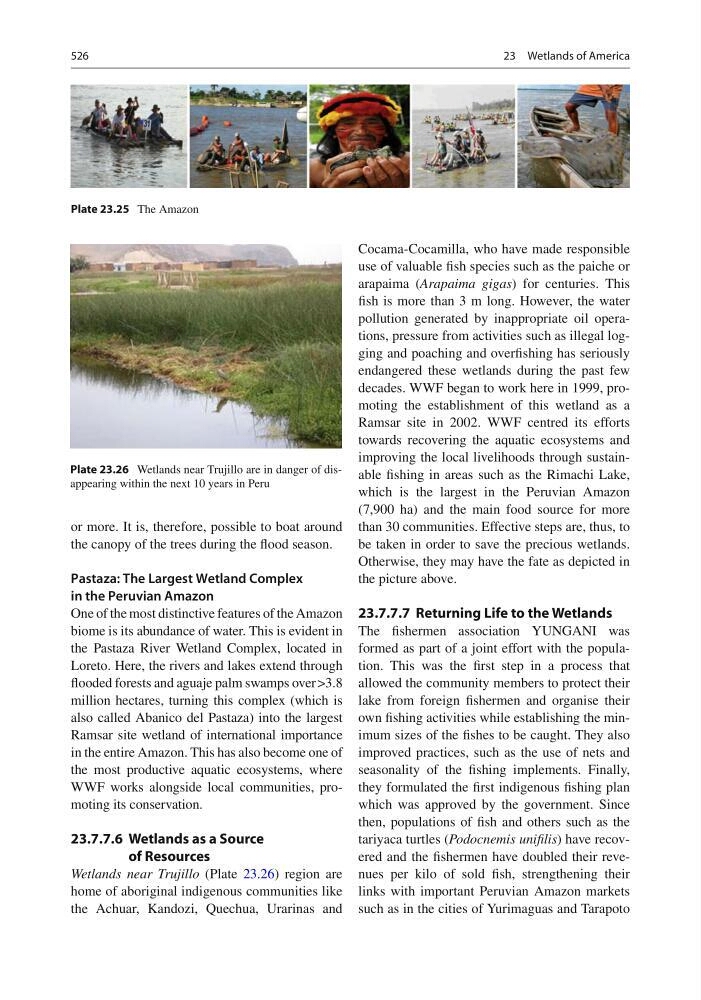
Wetlands near Trujillo (Plate 23.26 ) region are
home of aboriginal indigenous communities like
the Achuar, Kandozi, Quechua, Urarinas and
Cocama-Cocamilla, who have made responsible
use of valuable fi sh species such as the paiche or
arapaima ( Arapaima gigas ) for centuries. This
fi sh is more than 3 m long. However, the water
pollution generated by inappropriate oil operations, pressure from activities such as illegal logging and poaching and overfi shing has seriously
endangered these wetlands during the past few
decades. WWF began to work here in 1999, promoting the establishment of this wetland as a
Ramsar site in 2002. WWF centred its efforts
towards recovering the aquatic ecosystems and
improving the local livelihoods through sustainable fi shing in areas such as the Rimachi Lake,
which is the largest in the Peruvian Amazon
(7,900 ha) and the main food source for more
than 30 communities. Effective steps are, thus, to
be taken in order to save the precious wetlands.
Otherwise, they may have the fate as depicted in
the picture above.
23.7.7.7 Returning Life to the Wetlands
The fi shermen association YUNGANI was
formed as part of a joint effort with the population. This was the fi rst step in a process that
allowed the community members to protect their
lake from foreign fi shermen and organise their
own fi shing activities while establishing the minimum sizes of the fi shes to be caught. They also
improved practices, such as the use of nets and
seasonality of the fi shing implements. Finally,
they formulated the fi rst indigenous fi shing plan
which was approved by the government. Since
then, populations of fi sh and others such as the
tariyaca turtles ( Podocnemis unifi lis ) have recovered and the fi shermen have doubled their revenues per kilo of sold fi sh, strengthening their
links with important Peruvian Amazon markets
such as in the cities of Yurimaguas and Tarapoto
Plate 23.26 Wetlands near Trujillo are in danger of disappearing within the next 10 years in Peru
Plate 23.25 The Amazon
23 Wetlands of America
or more. It is, therefore, possible to boat around
the canopy of the trees during the fl ood season.
Pastaza: The Largest Wetland Complex
in the Peruvian Amazon
One of the most distinctive features of the Amazon
biome is its abundance of water. This is evident in
the Pastaza River Wetland Complex, located in
Loreto. Here, the rivers and lakes extend through
fl ooded forests and aguaje palm swamps over >3.8
million hectares, turning this complex (which is
also called Abanico del Pastaza) into the largest
Ramsar site wetland of international importance
in the entire Amazon. This has also become one of
the most productive aquatic ecosystems, where
WWF works alongside local communities, promoting its conservation.
23.7.7.6 Wetlands as a Source
of Resources
Wetlands near Trujillo (Plate 23.26 ) region are
home of aboriginal indigenous communities like
the Achuar, Kandozi, Quechua, Urarinas and
Cocama-Cocamilla, who have made responsible
use of valuable fi sh species such as the paiche or
arapaima ( Arapaima gigas ) for centuries. This
fi sh is more than 3 m long. However, the water
pollution generated by inappropriate oil operations, pressure from activities such as illegal logging and poaching and overfi shing has seriously
endangered these wetlands during the past few
decades. WWF began to work here in 1999, promoting the establishment of this wetland as a
Ramsar site in 2002. WWF centred its efforts
towards recovering the aquatic ecosystems and
improving the local livelihoods through sustainable fi shing in areas such as the Rimachi Lake,
which is the largest in the Peruvian Amazon
(7,900 ha) and the main food source for more
than 30 communities. Effective steps are, thus, to
be taken in order to save the precious wetlands.
Otherwise, they may have the fate as depicted in
the picture above.
23.7.7.7 Returning Life to the Wetlands
The fi shermen association YUNGANI was
formed as part of a joint effort with the population. This was the fi rst step in a process that
allowed the community members to protect their
lake from foreign fi shermen and organise their
own fi shing activities while establishing the minimum sizes of the fi shes to be caught. They also
improved practices, such as the use of nets and
seasonality of the fi shing implements. Finally,
they formulated the fi rst indigenous fi shing plan
which was approved by the government. Since
then, populations of fi sh and others such as the
tariyaca turtles ( Podocnemis unifi lis ) have recovered and the fi shermen have doubled their revenues per kilo of sold fi sh, strengthening their
links with important Peruvian Amazon markets
such as in the cities of Yurimaguas and Tarapoto
Plate 23.26 Wetlands near Trujillo are in danger of disappearing within the next 10 years in Peru
Plate 23.25 The Amazon
23 Wetlands of America