

505
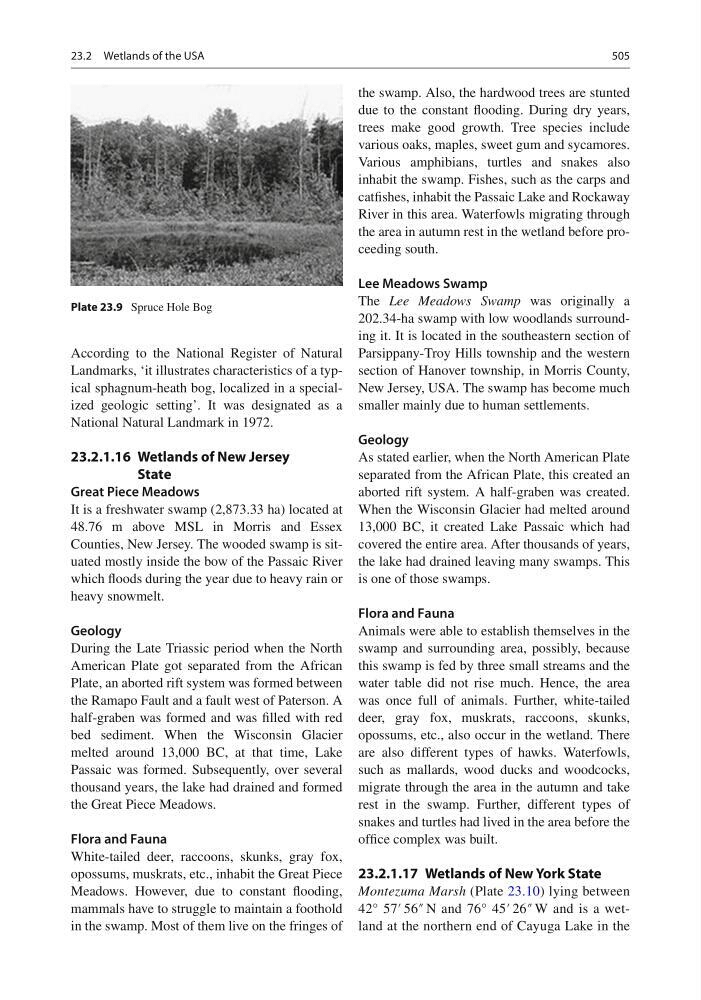
According to the National Register of Natural
Landmarks, ‘it illustrates characteristics of a typical sphagnum- heath bog, localized in a specialized geologic setting’. It was designated as a
National Natural Landmark in 1972.
23.2.1.16 Wetlands of New Jersey
State
Great Piece Meadows
It is a freshwater swamp (2,873.33 ha) located at
48.76 m above MSL in Morris and Essex
Counties, New Jersey. The wooded swamp is situated mostly inside the bow of the Passaic River
which fl oods during the year due to heavy rain or
heavy snowmelt.
Geology
During the Late Triassic period when the North
American Plate got separated from the African
Plate, an aborted rift system was formed between
the Ramapo Fault and a fault west of Paterson. A
half-graben was formed and was fi lled with red
bed sediment. When the Wisconsin Glacier
melted around 13,000 BC, at that time, Lake
Passaic was formed. Subsequently, over several
thousand years, the lake had drained and formed
the Great Piece Meadows.
Flora and Fauna
White-tailed deer, raccoons, skunks, gray fox,
opossums, muskrats, etc., inhabit the Great Piece
Meadows. However, due to constant fl ooding,
mammals have to struggle to maintain a foothold
in the swamp. Most of them live on the fringes of
the swamp. Also, the hardwood trees are stunted
due to the constant fl ooding. During dry years,
trees make good growth. Tree species include
various oaks, maples, sweet gum and sycamores.
Various amphibians, turtles and snakes also
inhabit the swamp. Fishes, such as the carps and
catfi shes, inhabit the Passaic Lake and Rockaway
River in this area. Waterfowls migrating through
the area in autumn rest in the wetland before proceeding south.
Lee Meadows Swamp
The Lee Meadows Swamp was originally a
202.34-ha swamp with low woodlands surrounding it. It is located in the southeastern section of
Parsippany-Troy Hills township and the western
section of Hanover township, in Morris County,
New Jersey, USA. The swamp has become much
smaller mainly due to human settlements.
Geology
As stated earlier, when the North American Plate
separated from the African Plate, this created an
aborted rift system. A half-graben was created.
When the Wisconsin Glacier had melted around
13,000 BC, it created Lake Passaic which had
covered the entire area. After thousands of years,
the lake had drained leaving many swamps. This
is one of those swamps.
Flora and Fauna
Animals were able to establish themselves in the
swamp and surrounding area, possibly, because
this swamp is fed by three small streams and the
water table did not rise much. Hence, the area
was once full of animals. Further, white-tailed
deer, gray fox, muskrats, raccoons, skunks,
opossums, etc., also occur in the wetland. There
are also different types of hawks. Waterfowls,
such as mallards, wood ducks and woodcocks,
migrate through the area in the autumn and take
rest in the swamp. Further, different types of
snakes and turtles had lived in the area before the
offi ce complex was built.
23.2.1.17 Wetlands of New York State
Montezuma Marsh (Plate 23.10 ) lying between
42° 57′ 56″ N and 76° 45′ 26″ W and is a wetland at the northern end of Cayuga Lake in the
Plate 23.9 Spruce Hole Bog
23.2 Wetlands of the USA
According to the National Register of Natural
Landmarks, ‘it illustrates characteristics of a typical sphagnum- heath bog, localized in a specialized geologic setting’. It was designated as a
National Natural Landmark in 1972.
23.2.1.16 Wetlands of New Jersey
State
Great Piece Meadows
It is a freshwater swamp (2,873.33 ha) located at
48.76 m above MSL in Morris and Essex
Counties, New Jersey. The wooded swamp is situated mostly inside the bow of the Passaic River
which fl oods during the year due to heavy rain or
heavy snowmelt.
Geology
During the Late Triassic period when the North
American Plate got separated from the African
Plate, an aborted rift system was formed between
the Ramapo Fault and a fault west of Paterson. A
half-graben was formed and was fi lled with red
bed sediment. When the Wisconsin Glacier
melted around 13,000 BC, at that time, Lake
Passaic was formed. Subsequently, over several
thousand years, the lake had drained and formed
the Great Piece Meadows.
Flora and Fauna
White-tailed deer, raccoons, skunks, gray fox,
opossums, muskrats, etc., inhabit the Great Piece
Meadows. However, due to constant fl ooding,
mammals have to struggle to maintain a foothold
in the swamp. Most of them live on the fringes of
the swamp. Also, the hardwood trees are stunted
due to the constant fl ooding. During dry years,
trees make good growth. Tree species include
various oaks, maples, sweet gum and sycamores.
Various amphibians, turtles and snakes also
inhabit the swamp. Fishes, such as the carps and
catfi shes, inhabit the Passaic Lake and Rockaway
River in this area. Waterfowls migrating through
the area in autumn rest in the wetland before proceeding south.
Lee Meadows Swamp
The Lee Meadows Swamp was originally a
202.34-ha swamp with low woodlands surrounding it. It is located in the southeastern section of
Parsippany-Troy Hills township and the western
section of Hanover township, in Morris County,
New Jersey, USA. The swamp has become much
smaller mainly due to human settlements.
Geology
As stated earlier, when the North American Plate
separated from the African Plate, this created an
aborted rift system. A half-graben was created.
When the Wisconsin Glacier had melted around
13,000 BC, it created Lake Passaic which had
covered the entire area. After thousands of years,
the lake had drained leaving many swamps. This
is one of those swamps.
Flora and Fauna
Animals were able to establish themselves in the
swamp and surrounding area, possibly, because
this swamp is fed by three small streams and the
water table did not rise much. Hence, the area
was once full of animals. Further, white-tailed
deer, gray fox, muskrats, raccoons, skunks,
opossums, etc., also occur in the wetland. There
are also different types of hawks. Waterfowls,
such as mallards, wood ducks and woodcocks,
migrate through the area in the autumn and take
rest in the swamp. Further, different types of
snakes and turtles had lived in the area before the
offi ce complex was built.
23.2.1.17 Wetlands of New York State
Montezuma Marsh (Plate 23.10 ) lying between
42° 57′ 56″ N and 76° 45′ 26″ W and is a wetland at the northern end of Cayuga Lake in the
Plate 23.9 Spruce Hole Bog
23.2 Wetlands of the USA