

487
than 5 % of their extent covered by some form of
wetland. This extent is considered signifi cant at
19 of the 23 sites. Amongst them, 8 sites are fi sh
ponds (Heath and Evans 2000).
22.13 Wetlands of Roumania
In Roumania, there are quite a large number of
wetlands. An account is briefl y given below.
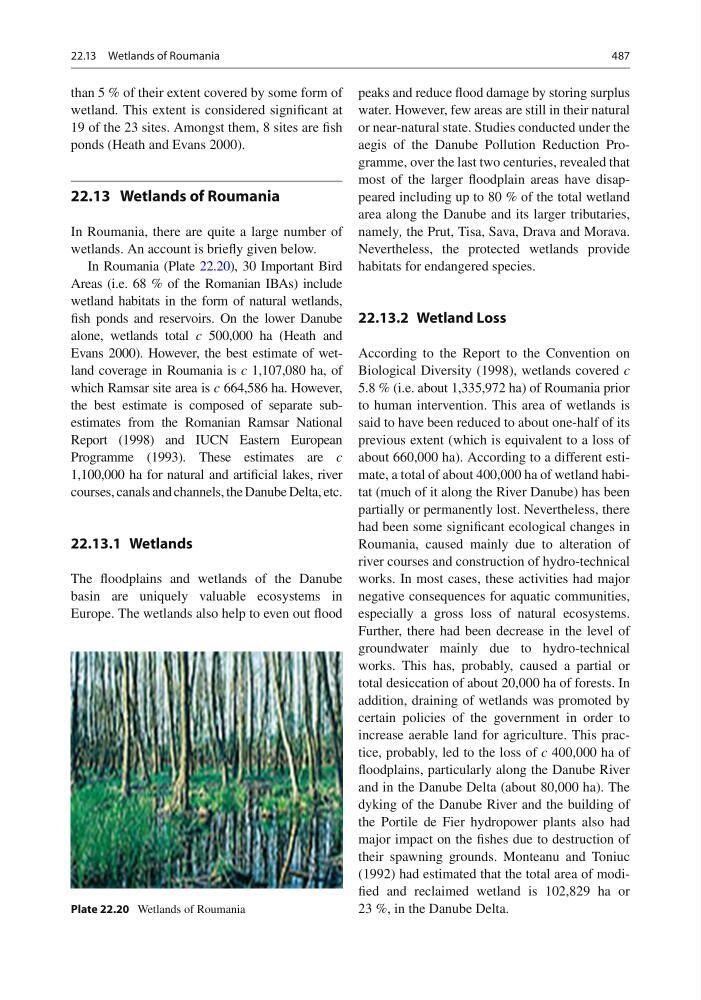
In Roumania (Plate 22.20 ), 30 Important Bird
Areas (i.e. 68 % of the Romanian IBAs) include
wetland habitats in the form of natural wetlands,
fi sh ponds and reservoirs. On the lower Danube
alone, wetlands total c 500,000 ha (Heath and
Evans 2000). However, the best estimate of wetland coverage in Roumania is c 1,107,080 ha, of
which Ramsar site area is c 664,586 ha. However,
the best estimate is composed of separate subestimates from the Romanian Ramsar National
Report (1998) and IUCN Eastern European
Programme (1993). These estimates are c
1,100,000 ha for natural and artifi cial lakes, river
courses, canals and channels, the Danube Delta, etc.
22.13.1 Wetlands
The fl oodplains and wetlands of the Danube
basin are uniquely valuable ecosystems in
Europe. The wetlands also help to even out fl ood
peaks and reduce fl ood damage by storing surplus
water. However, few areas are still in their natural
or near-natural state. Studies conducted under the
aegis of the Danube Pollution Reduction Programme, over the last two centuries, revealed that
most of the larger fl oodplain areas have disappeared including up to 80 % of the total wetland
area along the Danube and its larger tributaries,
namely , the Prut, Tisa, Sava, Drava and Morava.
Nevertheless, the protected wetlands provide
habitats for endangered species.
22.13.2 Wetland Loss
According to the Report to the Convention on
Biological Diversity (1998), wetlands covered c
5.8 % (i.e. about 1,335,972 ha ) of Roumania prior
to human intervention. This area of wetlands is
said to have been reduced to about one-half of its
previous extent (which is equivalent to a loss of
about 660,000 ha). According to a different estimate, a total of about 400,000 ha of wetland habitat (much of it along the River Danube) has been
partially or permanently lost. Nevertheless, there
had been some signifi cant ecological changes in
Roumania, caused mainly due to alteration of
river courses and construction of hydro-technical
works. In most cases, these activities had major
negative consequences for aquatic communities,
especially a gross loss of natural ecosystems.
Further, there had been decrease in the level of
groundwater mainly due to hydro-technical
works. This has, probably, caused a partial or
total desiccation of about 20,000 ha of forests. In
addition, draining of wetlands was promoted by
certain policies of the government in order to
increase aerable land for agriculture. This practice, probably, led to the loss of c 400,000 ha of
fl oodplains, particularly along the Danube River
and in the Danube Delta (about 80,000 ha). The
dyking of the Danube River and the building of
the Portile de Fier hydropower plants also had
major impact on the fi shes due to destruction of
their spawning grounds. Monteanu and Toniuc
(1992) had estimated that the total area of modifi ed and reclaimed wetland is 102,829 ha or
23 %, in the Danube Delta.
Plate 22.20 Wetlands of Roumania
22.13 Wetlands of Roumania
than 5 % of their extent covered by some form of
wetland. This extent is considered signifi cant at
19 of the 23 sites. Amongst them, 8 sites are fi sh
ponds (Heath and Evans 2000).
22.13 Wetlands of Roumania
In Roumania, there are quite a large number of
wetlands. An account is briefl y given below.
In Roumania (Plate 22.20 ), 30 Important Bird
Areas (i.e. 68 % of the Romanian IBAs) include
wetland habitats in the form of natural wetlands,
fi sh ponds and reservoirs. On the lower Danube
alone, wetlands total c 500,000 ha (Heath and
Evans 2000). However, the best estimate of wetland coverage in Roumania is c 1,107,080 ha, of
which Ramsar site area is c 664,586 ha. However,
the best estimate is composed of separate subestimates from the Romanian Ramsar National
Report (1998) and IUCN Eastern European
Programme (1993). These estimates are c
1,100,000 ha for natural and artifi cial lakes, river
courses, canals and channels, the Danube Delta, etc.
22.13.1 Wetlands
The fl oodplains and wetlands of the Danube
basin are uniquely valuable ecosystems in
Europe. The wetlands also help to even out fl ood
peaks and reduce fl ood damage by storing surplus
water. However, few areas are still in their natural
or near-natural state. Studies conducted under the
aegis of the Danube Pollution Reduction Programme, over the last two centuries, revealed that
most of the larger fl oodplain areas have disappeared including up to 80 % of the total wetland
area along the Danube and its larger tributaries,
namely , the Prut, Tisa, Sava, Drava and Morava.
Nevertheless, the protected wetlands provide
habitats for endangered species.
22.13.2 Wetland Loss
According to the Report to the Convention on
Biological Diversity (1998), wetlands covered c
5.8 % (i.e. about 1,335,972 ha ) of Roumania prior
to human intervention. This area of wetlands is
said to have been reduced to about one-half of its
previous extent (which is equivalent to a loss of
about 660,000 ha). According to a different estimate, a total of about 400,000 ha of wetland habitat (much of it along the River Danube) has been
partially or permanently lost. Nevertheless, there
had been some signifi cant ecological changes in
Roumania, caused mainly due to alteration of
river courses and construction of hydro-technical
works. In most cases, these activities had major
negative consequences for aquatic communities,
especially a gross loss of natural ecosystems.
Further, there had been decrease in the level of
groundwater mainly due to hydro-technical
works. This has, probably, caused a partial or
total desiccation of about 20,000 ha of forests. In
addition, draining of wetlands was promoted by
certain policies of the government in order to
increase aerable land for agriculture. This practice, probably, led to the loss of c 400,000 ha of
fl oodplains, particularly along the Danube River
and in the Danube Delta (about 80,000 ha). The
dyking of the Danube River and the building of
the Portile de Fier hydropower plants also had
major impact on the fi shes due to destruction of
their spawning grounds. Monteanu and Toniuc
(1992) had estimated that the total area of modifi ed and reclaimed wetland is 102,829 ha or
23 %, in the Danube Delta.
Plate 22.20 Wetlands of Roumania
22.13 Wetlands of Roumania