

476
agricultural degradation pressures. For example,
the great crested newt was found here prior to the
expansion of the town of Portlethen. Many acidloving vegetative species occur in Portlethen
Moss. A wide variety of sphagnum, carex, juncus
and other characteristic bog species inhabit this
moss. Sometimes insectivorous plants reside in
mosses, since the soils are generally nutrient
poor. The heath also serves as a food source for
area roe deer, while Corydalis is an attractive
host for numerous butterfl y larvae.
22.5.6.4 Relation to Other Mosses
There are numerous mosses or bog habitats in
Scotland. Many of them are situated also in
Aberdeenshire, including the Cookney Moss,
Leuchar Moss and Red Moss of Netherley. There
are also many other shires within Scotland that
contain mosses such as Fife, Angus, Morayshire
and Lanarkshire. Some of these are lowland bogs
and others, like Portlethen Moss, are raised bogs.
There are other similar acidic peat bogs in the
northern part of North America, Russia and
northern Europe. All these wetlands have both
similarities and differences.
22.5.6.5 Conservation Status
The habitat is monitored by the Scottish Wildlife
Trust, which also recognised it as a nature preserve with designation PLM076. However, there
is some ongoing loss of the moss habitat from
cattle grazing, but the most signifi cant threat is
the loss of almost half of the moss due to population expansion pressure and urban land development by the civic body of the town of Portlethen
during the period 1985 to 2005. Likewise, enrichment (addition of grazing animal manure) is not a
major issue due to the low density of animals.
However, trampling is considered as an insignifi cant
threat due to the small animal or human presence
in the existing nature reserve area. Nevertheless,
damage to the primordial moss is considered
extensive and widespread by the Scottish Wildlife
Trust. Further, the raised bog habitat of the
Portlethen Moss is also protected by the UK
Biodiversity Action Plan.
22.5.7 Yanal Bog
Yanal Bog (grid reference ST424607,
OSGRIDREF), situated between 51° 20′ 33″ N
and 2° 49′ 42″ W, is a 1.6-ha calcicolous lowland mire and a biological SSSI on the southern edge of the North Somerset Levels, just
north of the village of Sandford, North
Somerset. It was notifi ed as an SSSI in 1988.
Underlying the site are gravels and clay alluvium, above which sits a layer of peat. This
results in a high water table, creating a distinct
domed landscape feature.
22.5.7.1 Biological Interest
The fl ora of the mire are nationally rare in Britain.
Notably, it supports two species, namely , the
black bog rush ( Schoenus nigricans ) and bluntfl owered rush ( Juncus subnodulosus ), which have
restricted distributions in southwest England.
22.5.8 The North Kent Marshes
The North Kent Marshes (Plate 22.5 ), located
in the north of the county of Kent on the
Thames Estuary in southeast England, is one of
the 22 Environmentally Sensitive Areas (ESA)
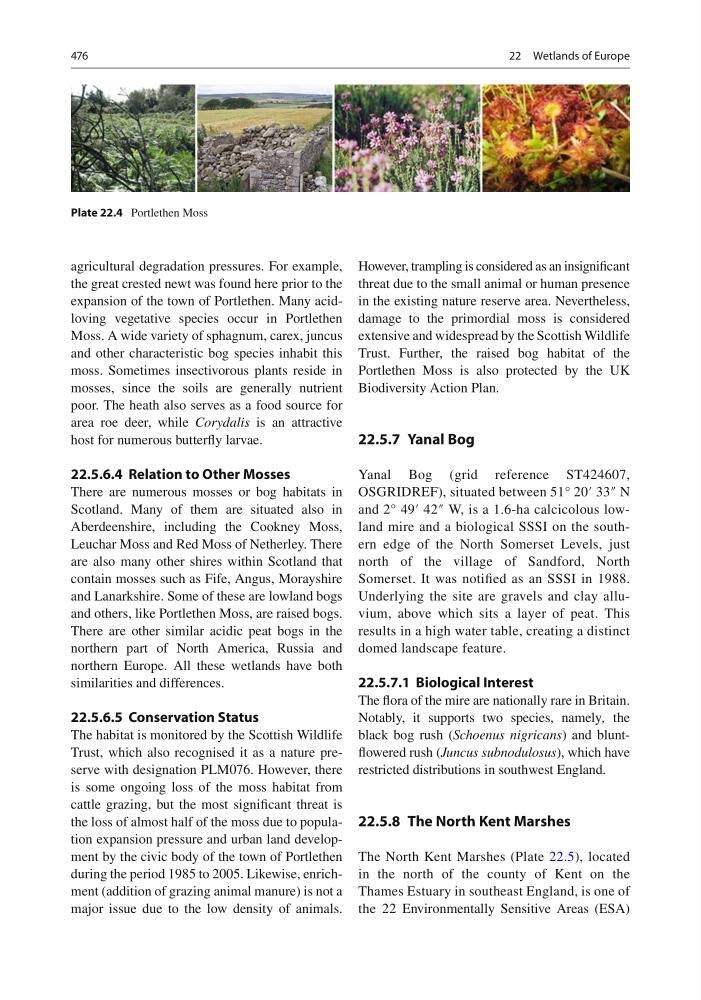
Plate 22.4 Portlethen Moss
22 Wetlands of Europe
agricultural degradation pressures. For example,
the great crested newt was found here prior to the
expansion of the town of Portlethen. Many acidloving vegetative species occur in Portlethen
Moss. A wide variety of sphagnum, carex, juncus
and other characteristic bog species inhabit this
moss. Sometimes insectivorous plants reside in
mosses, since the soils are generally nutrient
poor. The heath also serves as a food source for
area roe deer, while Corydalis is an attractive
host for numerous butterfl y larvae.
22.5.6.4 Relation to Other Mosses
There are numerous mosses or bog habitats in
Scotland. Many of them are situated also in
Aberdeenshire, including the Cookney Moss,
Leuchar Moss and Red Moss of Netherley. There
are also many other shires within Scotland that
contain mosses such as Fife, Angus, Morayshire
and Lanarkshire. Some of these are lowland bogs
and others, like Portlethen Moss, are raised bogs.
There are other similar acidic peat bogs in the
northern part of North America, Russia and
northern Europe. All these wetlands have both
similarities and differences.
22.5.6.5 Conservation Status
The habitat is monitored by the Scottish Wildlife
Trust, which also recognised it as a nature preserve with designation PLM076. However, there
is some ongoing loss of the moss habitat from
cattle grazing, but the most signifi cant threat is
the loss of almost half of the moss due to population expansion pressure and urban land development by the civic body of the town of Portlethen
during the period 1985 to 2005. Likewise, enrichment (addition of grazing animal manure) is not a
major issue due to the low density of animals.
However, trampling is considered as an insignifi cant
threat due to the small animal or human presence
in the existing nature reserve area. Nevertheless,
damage to the primordial moss is considered
extensive and widespread by the Scottish Wildlife
Trust. Further, the raised bog habitat of the
Portlethen Moss is also protected by the UK
Biodiversity Action Plan.
22.5.7 Yanal Bog
Yanal Bog (grid reference ST424607,
OSGRIDREF), situated between 51° 20′ 33″ N
and 2° 49′ 42″ W, is a 1.6-ha calcicolous lowland mire and a biological SSSI on the southern edge of the North Somerset Levels, just
north of the village of Sandford, North
Somerset. It was notifi ed as an SSSI in 1988.
Underlying the site are gravels and clay alluvium, above which sits a layer of peat. This
results in a high water table, creating a distinct
domed landscape feature.
22.5.7.1 Biological Interest
The fl ora of the mire are nationally rare in Britain.
Notably, it supports two species, namely , the
black bog rush ( Schoenus nigricans ) and bluntfl owered rush ( Juncus subnodulosus ), which have
restricted distributions in southwest England.
22.5.8 The North Kent Marshes
The North Kent Marshes (Plate 22.5 ), located
in the north of the county of Kent on the
Thames Estuary in southeast England, is one of
the 22 Environmentally Sensitive Areas (ESA)
Plate 22.4 Portlethen Moss
22 Wetlands of Europe