

474
Anglia. A number of wetland plants here, e.g.
the slender cotton grass and lesser water plantain, are rare in Britain.
The reserve is said to be a heaven for birds.
Predatory visitors like the hen harrier, buzzard,
hobby and the occasional marsh harrier visit the
site regularly. Further, the site provides refuge for
a range of wetland birds like the bittern, water
rail, sedge and reed warblers, bearded tit and grey
heron, which may often be seen here.
22.5.3 Matley Bog
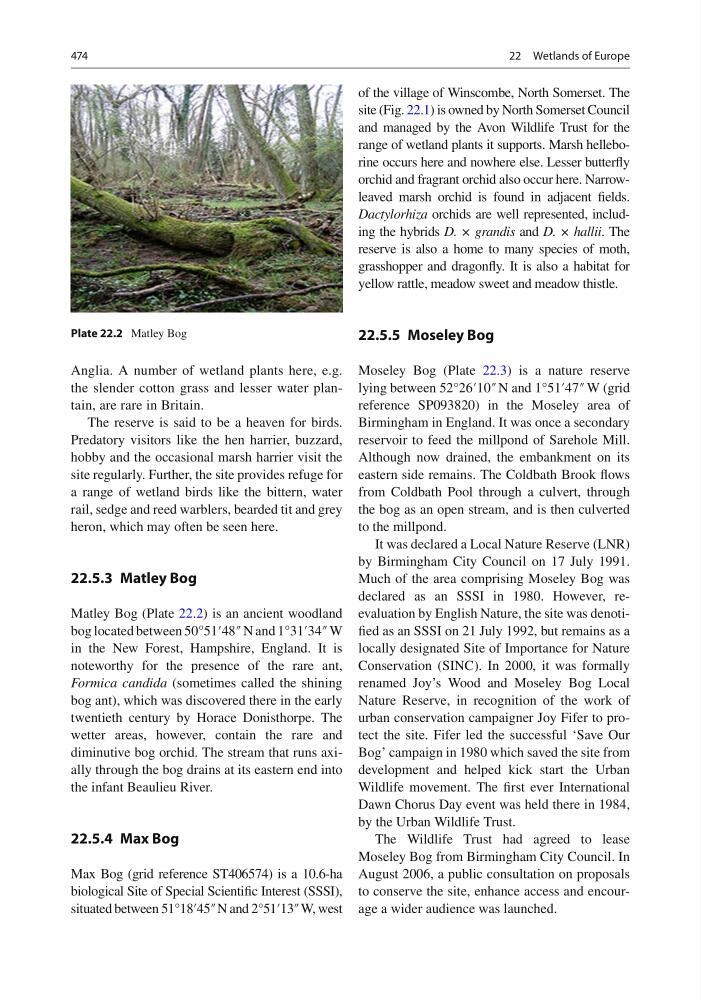
Matley Bog (Plate 22.2 ) is an ancient woodland
bog located between 50 ° 51′48″ N and 1 ° 31′34″ W
in the New Forest, Hampshire, England. It is
noteworthy for the presence of the rare ant,
Formica candida (sometimes called the shining
bog ant), which was discovered there in the early
twentieth century by Horace Donisthorpe. The
wetter areas, however, contain the rare and
diminutive bog orchid. The stream that runs axially through the bog drains at its eastern end into
the infant Beaulieu River.
22.5.4 Max Bog
Max Bog (grid reference ST406574) is a 10.6-ha
biological Site of Special Scientifi c Interest (SSSI),
situated between 51°18′45″ N and 2°51′13″ W, west
of the village of Winscombe, North Somerset. The
site (Fig. 22.1 ) is owned by North Somerset Council
and managed by the Avon Wildlife Trust for the
range of wetland plants it supports. Marsh helleborine occurs here and nowhere else. Lesser butterfl y
orchid and fragrant orchid also occur here. Narrowleaved marsh orchid is found in adjacent fi elds.
Dactylorhiza orchids are well represented, including the hybrids D. × grandis and D. × hallii . The
reserve is also a home to many species of moth,
grasshopper and dragonfl y. It is also a habitat for
yellow rattle, meadow sweet and meadow thistle.
22.5.5 Moseley Bog
Moseley Bog (Plate 22.3 ) is a nature reserve
lying between 52°26′10″ N and 1°51′47″ W (grid
reference SP093820) in the Moseley area of
Birmingham in England. It was once a secondary
reservoir to feed the millpond of Sarehole Mill.
Although now drained, the embankment on its
eastern side remains. The Coldbath Brook fl ows
from Coldbath Pool through a culvert, through
the bog as an open stream, and is then culverted
to the millpond.
It was declared a Local Nature Reserve (LNR)
by Birmingham City Council on 17 July 1991.
Much of the area comprising Moseley Bog was
declared as an SSSI in 1980. However, reevaluation by English Nature, the site was denotifi ed as an SSSI on 21 July 1992, but remains as a
locally designated Site of Importance for Nature
Conservation (SINC). In 2000, it was formally
renamed Joy’s Wood and Moseley Bog Local
Nature Reserve, in recognition of the work of
urban conservation campaigner Joy Fifer to protect the site. Fifer led the successful ‘Save Our
Bog’ campaign in 1980 which saved the site from
development and helped kick start the Urban
Wildlife movement. The fi rst ever International
Dawn Chorus Day event was held there in 1984,
by the Urban Wildlife Trust.
The Wildlife Trust had agreed to lease
Moseley Bog from Birmingham City Council. In
August 2006, a public consultation on proposals
to conserve the site, enhance access and encourage a wider audience was launched.
Plate 22.2 Matley Bog
22 Wetlands of Europe
Anglia. A number of wetland plants here, e.g.
the slender cotton grass and lesser water plantain, are rare in Britain.
The reserve is said to be a heaven for birds.
Predatory visitors like the hen harrier, buzzard,
hobby and the occasional marsh harrier visit the
site regularly. Further, the site provides refuge for
a range of wetland birds like the bittern, water
rail, sedge and reed warblers, bearded tit and grey
heron, which may often be seen here.
22.5.3 Matley Bog
Matley Bog (Plate 22.2 ) is an ancient woodland
bog located between 50 ° 51′48″ N and 1 ° 31′34″ W
in the New Forest, Hampshire, England. It is
noteworthy for the presence of the rare ant,
Formica candida (sometimes called the shining
bog ant), which was discovered there in the early
twentieth century by Horace Donisthorpe. The
wetter areas, however, contain the rare and
diminutive bog orchid. The stream that runs axially through the bog drains at its eastern end into
the infant Beaulieu River.
22.5.4 Max Bog
Max Bog (grid reference ST406574) is a 10.6-ha
biological Site of Special Scientifi c Interest (SSSI),
situated between 51°18′45″ N and 2°51′13″ W, west
of the village of Winscombe, North Somerset. The
site (Fig. 22.1 ) is owned by North Somerset Council
and managed by the Avon Wildlife Trust for the
range of wetland plants it supports. Marsh helleborine occurs here and nowhere else. Lesser butterfl y
orchid and fragrant orchid also occur here. Narrowleaved marsh orchid is found in adjacent fi elds.
Dactylorhiza orchids are well represented, including the hybrids D. × grandis and D. × hallii . The
reserve is also a home to many species of moth,
grasshopper and dragonfl y. It is also a habitat for
yellow rattle, meadow sweet and meadow thistle.
22.5.5 Moseley Bog
Moseley Bog (Plate 22.3 ) is a nature reserve
lying between 52°26′10″ N and 1°51′47″ W (grid
reference SP093820) in the Moseley area of
Birmingham in England. It was once a secondary
reservoir to feed the millpond of Sarehole Mill.
Although now drained, the embankment on its
eastern side remains. The Coldbath Brook fl ows
from Coldbath Pool through a culvert, through
the bog as an open stream, and is then culverted
to the millpond.
It was declared a Local Nature Reserve (LNR)
by Birmingham City Council on 17 July 1991.
Much of the area comprising Moseley Bog was
declared as an SSSI in 1980. However, reevaluation by English Nature, the site was denotifi ed as an SSSI on 21 July 1992, but remains as a
locally designated Site of Importance for Nature
Conservation (SINC). In 2000, it was formally
renamed Joy’s Wood and Moseley Bog Local
Nature Reserve, in recognition of the work of
urban conservation campaigner Joy Fifer to protect the site. Fifer led the successful ‘Save Our
Bog’ campaign in 1980 which saved the site from
development and helped kick start the Urban
Wildlife movement. The fi rst ever International
Dawn Chorus Day event was held there in 1984,
by the Urban Wildlife Trust.
The Wildlife Trust had agreed to lease
Moseley Bog from Birmingham City Council. In
August 2006, a public consultation on proposals
to conserve the site, enhance access and encourage a wider audience was launched.
Plate 22.2 Matley Bog
22 Wetlands of Europe