

472
22.2.1.1 Human History
The archaeological excavations revealed possible
relics of Bronze Age people in Kulyagash. Prior
to the fourteenth century, the area was populated
by Finno-Ugric people, but later, it was populated
by Volga Bulgars and other Turks. It was then
developed by the modern Tatars and Bashkirs.
Since the late sixteenth century, it is also a home
of the eastern Mari and Russians. In the nineteenth century, Derbeshkinsky settlement was
founded in the north of the wetland. There were
also dockyards for the Kama River ships.
22.2.1.2 Flora
Plants such as Andromeda polifolia, Scheuchzeria
palustris, Oxycoccus palustris, Eriophorum vaginatum, Salix myrtilloides (as mentioned in the local
Red Data Book) are found in this wetland. Also
other plants, like Najas major, Nymphaea alba,
Nuphar pumila, Leersia oryzoides, Calamagrostis
neglecta, C. phragmitoides, Ligularia sibirica ,
Betula humilis, inhabit the wetland.
22.2.2 Central Russian Bi-Ob’
River Valley
The Bi-Ob’ region of Central Russia is a large
fl oodplain on the Ob River between Kazakhstan
to the south and the Ob River’s estuary to the
north on the Kara Sea. This valley of channels,
fl oodplain lakes and river distributaries is actually an inland delta caused more by decreased sea
levels than by deposited sediments. The region
has been described as ‘the largest single breeding
area for waterfowls in Eurasia’ (Dugan 1993 ).
22.2.3 Volga River Delta
On the edge of the Caspian Sea, the Volga River
forms one of the world’s largest highly braided
inland deltas having an area of c 19,000 km
2 and a
length of >120 km. It spreads over c 200 km at the
edge of the sea. The most extensive wetland area
occurs in the delta of the Caspian Sea, as the sea
declines in water level creating extensive
Phragmites marshes and water lotus ( Nelumbo
nucifera ) beds (Finlayson and Volz 1994 ).
Notably, c 70 % of the world’s sturgeon comes
from the Caspian Sea. The delta is a wintering
ground in mild winters for waterbirds, including
raptors and passerine species. But a series of dams
had destroyed the river’s natural hydrology.
Extensive industrial and agricultural pollution as
well as sea-level decline in the Caspian Sea are
making impacts.
22.3 Wetlands of Estonia
There are different types of wetlands in Estonia.
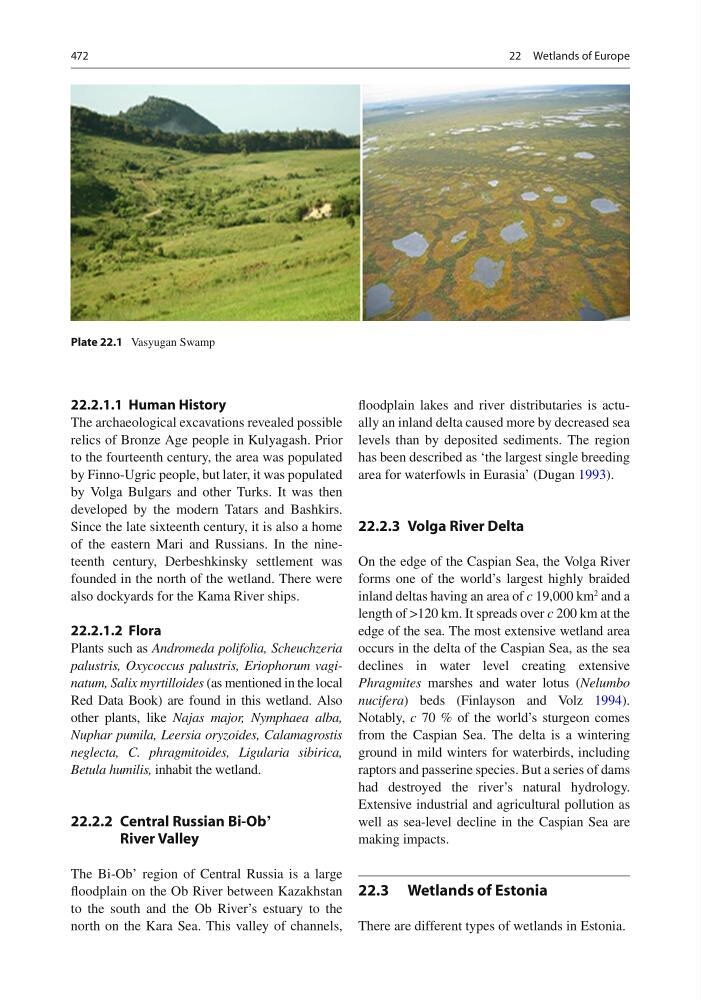
Plate 22.1 Vasyugan Swamp
22 Wetlands of Europe
22.2.1.1 Human History
The archaeological excavations revealed possible
relics of Bronze Age people in Kulyagash. Prior
to the fourteenth century, the area was populated
by Finno-Ugric people, but later, it was populated
by Volga Bulgars and other Turks. It was then
developed by the modern Tatars and Bashkirs.
Since the late sixteenth century, it is also a home
of the eastern Mari and Russians. In the nineteenth century, Derbeshkinsky settlement was
founded in the north of the wetland. There were
also dockyards for the Kama River ships.
22.2.1.2 Flora
Plants such as Andromeda polifolia, Scheuchzeria
palustris, Oxycoccus palustris, Eriophorum vaginatum, Salix myrtilloides (as mentioned in the local
Red Data Book) are found in this wetland. Also
other plants, like Najas major, Nymphaea alba,
Nuphar pumila, Leersia oryzoides, Calamagrostis
neglecta, C. phragmitoides, Ligularia sibirica ,
Betula humilis, inhabit the wetland.
22.2.2 Central Russian Bi-Ob’
River Valley
The Bi-Ob’ region of Central Russia is a large
fl oodplain on the Ob River between Kazakhstan
to the south and the Ob River’s estuary to the
north on the Kara Sea. This valley of channels,
fl oodplain lakes and river distributaries is actually an inland delta caused more by decreased sea
levels than by deposited sediments. The region
has been described as ‘the largest single breeding
area for waterfowls in Eurasia’ (Dugan 1993 ).
22.2.3 Volga River Delta
On the edge of the Caspian Sea, the Volga River
forms one of the world’s largest highly braided
inland deltas having an area of c 19,000 km
2 and a
length of >120 km. It spreads over c 200 km at the
edge of the sea. The most extensive wetland area
occurs in the delta of the Caspian Sea, as the sea
declines in water level creating extensive
Phragmites marshes and water lotus ( Nelumbo
nucifera ) beds (Finlayson and Volz 1994 ).
Notably, c 70 % of the world’s sturgeon comes
from the Caspian Sea. The delta is a wintering
ground in mild winters for waterbirds, including
raptors and passerine species. But a series of dams
had destroyed the river’s natural hydrology.
Extensive industrial and agricultural pollution as
well as sea-level decline in the Caspian Sea are
making impacts.
22.3 Wetlands of Estonia
There are different types of wetlands in Estonia.
Plate 22.1 Vasyugan Swamp
22 Wetlands of Europe