

467
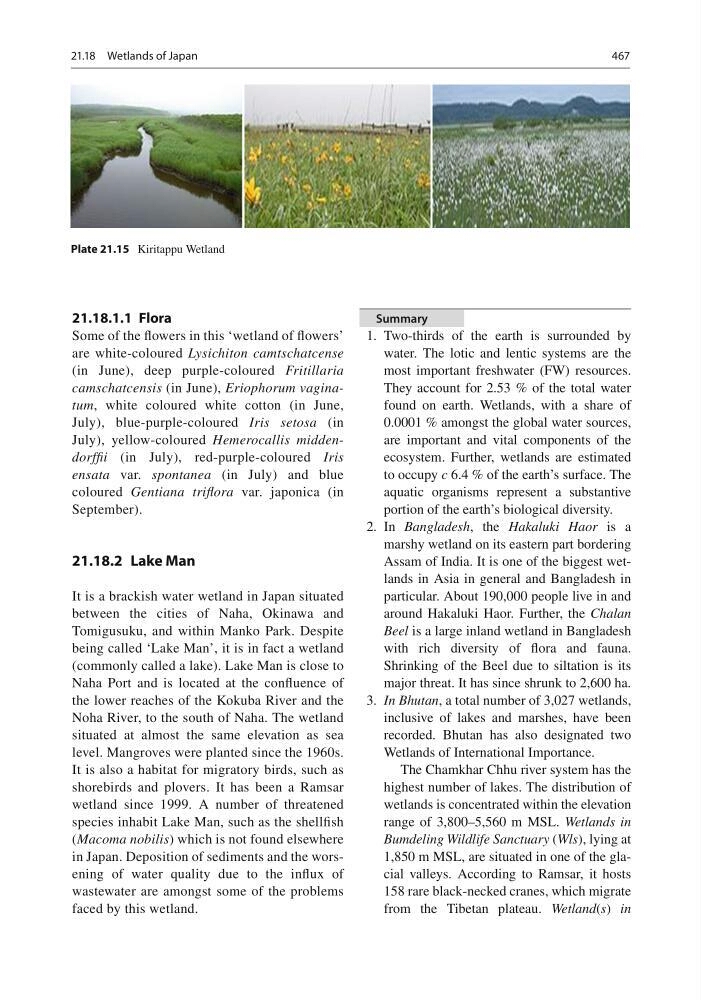
21.18.1.1 Flora
Some of the fl owers in this ‘wetland of fl owers’
are white-coloured Lysichiton camtschatcense
(in June), deep purple-coloured Fritillaria
camschatcensis (in June), Eriophorum vaginatum , white coloured white cotton (in June,
July), blue-purple- coloured Iris setosa (in
July), yellow- coloured Hemerocallis middendorffi i (in July), red-purple-coloured Iris
ensata var. spontanea (in July) and blue
coloured Gentiana trifl ora var. japonica (in
September).
21.18.2 Lake Man
It is a brackish water wetland in Japan situated
between the cities of Naha, Okinawa and
Tomigusuku, and within Manko Park. Despite
being called ‘Lake Man’, it is in fact a wetland
(commonly called a lake). Lake Man is close to
Naha Port and is located at the confl uence of
the lower reaches of the Kokuba River and the
Noha River, to the south of Naha. The wetland
situated at almost the same elevation as sea
level. Mangroves were planted since the 1960s.
It is also a habitat for migratory birds, such as
shorebirds and plovers. It has been a Ramsar
wetland since 1999. A number of threatened
species inhabit Lake Man, such as the shellfi sh
( Macoma nobilis ) which is not found elsewhere
in Japan. Deposition of sediments and the worsening of water quality due to the infl ux of
wastewater are amongst some of the problems
faced by this wetland.
Summary
1. Two-thirds of the earth is surrounded by
water. The lotic and lentic systems are the
most important freshwater (FW) resources.
They account for 2.53 % of the total water
found on earth. Wetlands, with a share of
0.0001 % amongst the global water sources,
are important and vital components of the
ecosystem. Further, wetlands are estimated
to occupy c 6.4 % of the earth’s surface. The
aquatic organisms represent a substantive
portion of the earth’s biological diversity.
2. In Bangladesh , the Hakaluki Haor is a
marshy wetland on its eastern part bordering
Assam of India. It is one of the biggest wetlands in Asia in general and Bangladesh in
particular. About 190,000 people live in and
around Hakaluki Haor. Further, the Chalan
Beel is a large inland wetland in Bangladesh
with rich diversity of fl ora and fauna.
Shrinking of the Beel due to siltation is its
major threat. It has since shrunk to 2,600 ha.
3. In Bhutan , a total number of 3,027 wetlands,
inclusive of lakes and marshes, have been
recorded. Bhutan has also designated two
Wetlands of International Importance.
The Chamkhar Chhu river system has the
highest number of lakes. The distribution of
wetlands is concentrated within the elevation
range of 3,800–5,560 m MSL. Wetlands in
Bumdeling Wildlife Sanctuary ( Wls ), lying at
1,850 m MSL, are situated in one of the glacial valleys. According to Ramsar, it hosts
158 rare black-necked cranes, which migrate
from the Tibetan plateau. Wetland ( s ) in
Plate 21.15 Kiritappu Wetland
21.18 Wetlands of Japan
21.18.1.1 Flora
Some of the fl owers in this ‘wetland of fl owers’
are white-coloured Lysichiton camtschatcense
(in June), deep purple-coloured Fritillaria
camschatcensis (in June), Eriophorum vaginatum , white coloured white cotton (in June,
July), blue-purple- coloured Iris setosa (in
July), yellow- coloured Hemerocallis middendorffi i (in July), red-purple-coloured Iris
ensata var. spontanea (in July) and blue
coloured Gentiana trifl ora var. japonica (in
September).
21.18.2 Lake Man
It is a brackish water wetland in Japan situated
between the cities of Naha, Okinawa and
Tomigusuku, and within Manko Park. Despite
being called ‘Lake Man’, it is in fact a wetland
(commonly called a lake). Lake Man is close to
Naha Port and is located at the confl uence of
the lower reaches of the Kokuba River and the
Noha River, to the south of Naha. The wetland
situated at almost the same elevation as sea
level. Mangroves were planted since the 1960s.
It is also a habitat for migratory birds, such as
shorebirds and plovers. It has been a Ramsar
wetland since 1999. A number of threatened
species inhabit Lake Man, such as the shellfi sh
( Macoma nobilis ) which is not found elsewhere
in Japan. Deposition of sediments and the worsening of water quality due to the infl ux of
wastewater are amongst some of the problems
faced by this wetland.
Summary
1. Two-thirds of the earth is surrounded by
water. The lotic and lentic systems are the
most important freshwater (FW) resources.
They account for 2.53 % of the total water
found on earth. Wetlands, with a share of
0.0001 % amongst the global water sources,
are important and vital components of the
ecosystem. Further, wetlands are estimated
to occupy c 6.4 % of the earth’s surface. The
aquatic organisms represent a substantive
portion of the earth’s biological diversity.
2. In Bangladesh , the Hakaluki Haor is a
marshy wetland on its eastern part bordering
Assam of India. It is one of the biggest wetlands in Asia in general and Bangladesh in
particular. About 190,000 people live in and
around Hakaluki Haor. Further, the Chalan
Beel is a large inland wetland in Bangladesh
with rich diversity of fl ora and fauna.
Shrinking of the Beel due to siltation is its
major threat. It has since shrunk to 2,600 ha.
3. In Bhutan , a total number of 3,027 wetlands,
inclusive of lakes and marshes, have been
recorded. Bhutan has also designated two
Wetlands of International Importance.
The Chamkhar Chhu river system has the
highest number of lakes. The distribution of
wetlands is concentrated within the elevation
range of 3,800–5,560 m MSL. Wetlands in
Bumdeling Wildlife Sanctuary ( Wls ), lying at
1,850 m MSL, are situated in one of the glacial valleys. According to Ramsar, it hosts
158 rare black-necked cranes, which migrate
from the Tibetan plateau. Wetland ( s ) in
Plate 21.15 Kiritappu Wetland
21.18 Wetlands of Japan