

455
Many of them have either been converted into
rice paddies or into fi sh ponds. Further, in many
cases, the wetlands and reed ( Phragmites ) fi elds
are connected hydrologically with fi sh ponds and
rice paddies to enhance food and fi bre production
(Ma et al. 1993 ). In addition, there are also extensive inland wetlands associated with the Yangtze
River. This is particularly in the Jianghan–
Dongting Plain in the middle of the river valley
near Wuhan in Hubei Province. This former
region of marshes and lakes had an area of c
10,000 km
2 . And it had been extensively drained
and dyked. But still, it consistently faces crop
damage due to excessive water. It is, probably,
impossible to integrate these backwater areas
with the Yangtze River as they were believed to
be once. Nevertheless, conversion of wet areas
from rice and other crops to wetland crops, such
as lotus ( Nelumbo nucifera ) and wild rice stem
( Zizania latifolia ), has been suggested as a viable
‘ecological’ approach (Bruins et al. 1998 ).
Notwithstanding the above, it may be noted
here that many of coastal marshes of China are of
more recent origin in contrast to the marshes
found on the European and eastern North
American coastlines (Chung 1994 ). It may be
noted here that Spartina anglica and S . alternifolia have been introduced in China in an effort to
restore the eastern coastline. Approximately
40,000 ha had been restored by Professor ChungHsin Chung and his colleagues at Nanjing
University for accretion for agricultural use, for
mitigation of saline soils, as a source of green
manure and animal fodder, and for seashore stabilisation (Qin et al. 1998).
In addition to the above, there are several
inland wetland areas in the western mountain
and desert regions of China as part of the
>250,000 km
2 of wetlands in the country.
Further, the sources of several major rivers can
also be found in the Qinghai–Tibetan Plateau,
namely, the Yellow, the Yangtze, the Indus and
the Ganges, along with high altitude lakes and
bogs. Most of the larger lakes of the plateau are
saline. The Qinghai Hu Lake (area 458,000 ha)
is, perhaps, the largest lake in the region. The
lakes in this region have been shrinking most
recently at 12 cm/year in depth, because this
whole area has been experiencing desiccation.
However, these wetlands are habitat for millions of resident and migratory birds comprising >160 species (Lu 1990 ). Notably, the
brackish water wetland, called the Lake Issyk
Kul, is situated in a basin of the Tian Shan
mountain chain along the China–Kazakhstan
border. It is considered as one of the biggest
mountain lakes in the world. Some of these
wetlands are important havens for migratory
waterfowl. They are also important for regional
fi sheries and for supplying reeds used in the
manufacture of paper (Lu 1990 ).
21.10.1 Wetlands of China
Concomitant to the general account given above,
an account of the lentic bodies in China is given
below. The lentic bodies of China have been further dealt with in Chap. 6 .
21.10.1.1 Khanka Lake
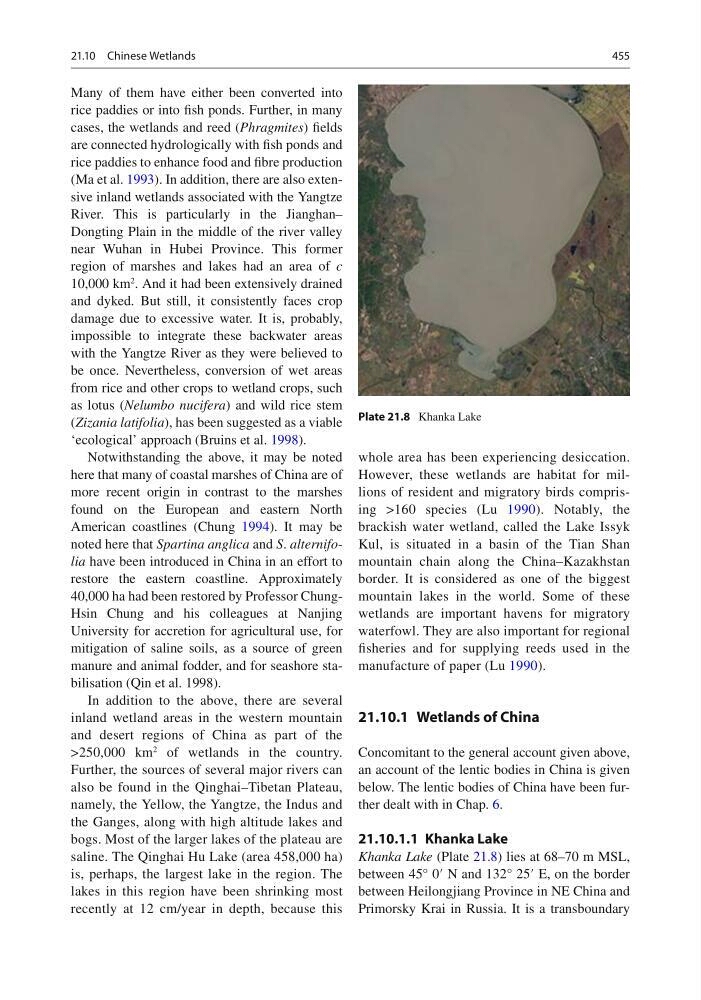
Khanka Lake (Plate 21.8 ) lies at 68–70 m MSL,
between 45° 0′ N and 132° 25′ E, on the border
between Heilongjiang Province in NE China and
Primorsky Krai in Russia. It is a transboundary
Plate 21.8 Khanka Lake
21.10 Chinese Wetlands
Many of them have either been converted into
rice paddies or into fi sh ponds. Further, in many
cases, the wetlands and reed ( Phragmites ) fi elds
are connected hydrologically with fi sh ponds and
rice paddies to enhance food and fi bre production
(Ma et al. 1993 ). In addition, there are also extensive inland wetlands associated with the Yangtze
River. This is particularly in the Jianghan–
Dongting Plain in the middle of the river valley
near Wuhan in Hubei Province. This former
region of marshes and lakes had an area of c
10,000 km
2 . And it had been extensively drained
and dyked. But still, it consistently faces crop
damage due to excessive water. It is, probably,
impossible to integrate these backwater areas
with the Yangtze River as they were believed to
be once. Nevertheless, conversion of wet areas
from rice and other crops to wetland crops, such
as lotus ( Nelumbo nucifera ) and wild rice stem
( Zizania latifolia ), has been suggested as a viable
‘ecological’ approach (Bruins et al. 1998 ).
Notwithstanding the above, it may be noted
here that many of coastal marshes of China are of
more recent origin in contrast to the marshes
found on the European and eastern North
American coastlines (Chung 1994 ). It may be
noted here that Spartina anglica and S . alternifolia have been introduced in China in an effort to
restore the eastern coastline. Approximately
40,000 ha had been restored by Professor ChungHsin Chung and his colleagues at Nanjing
University for accretion for agricultural use, for
mitigation of saline soils, as a source of green
manure and animal fodder, and for seashore stabilisation (Qin et al. 1998).
In addition to the above, there are several
inland wetland areas in the western mountain
and desert regions of China as part of the
>250,000 km
2 of wetlands in the country.
Further, the sources of several major rivers can
also be found in the Qinghai–Tibetan Plateau,
namely, the Yellow, the Yangtze, the Indus and
the Ganges, along with high altitude lakes and
bogs. Most of the larger lakes of the plateau are
saline. The Qinghai Hu Lake (area 458,000 ha)
is, perhaps, the largest lake in the region. The
lakes in this region have been shrinking most
recently at 12 cm/year in depth, because this
whole area has been experiencing desiccation.
However, these wetlands are habitat for millions of resident and migratory birds comprising >160 species (Lu 1990 ). Notably, the
brackish water wetland, called the Lake Issyk
Kul, is situated in a basin of the Tian Shan
mountain chain along the China–Kazakhstan
border. It is considered as one of the biggest
mountain lakes in the world. Some of these
wetlands are important havens for migratory
waterfowl. They are also important for regional
fi sheries and for supplying reeds used in the
manufacture of paper (Lu 1990 ).
21.10.1 Wetlands of China
Concomitant to the general account given above,
an account of the lentic bodies in China is given
below. The lentic bodies of China have been further dealt with in Chap. 6 .
21.10.1.1 Khanka Lake
Khanka Lake (Plate 21.8 ) lies at 68–70 m MSL,
between 45° 0′ N and 132° 25′ E, on the border
between Heilongjiang Province in NE China and
Primorsky Krai in Russia. It is a transboundary
Plate 21.8 Khanka Lake
21.10 Chinese Wetlands