

453
It also gave the site its Thai name. The site has the
largest population of this shell species, which is
endemic to the northern Gulf of Thailand. Also,
18 species of birds and 42 species of invertebrates
have been recorded at the mudfl ats and the
adjoining coastal mangrove forests. Notably, the
mudfl at Don Nai is located directly at the coast
and accessible by car. At Chu Chi village, several
sea food restaurants offer the local shells. Also,
the highly revered shrine of Prince Chumphon
Khet-Udomsak attracts Thai visitors. The site
had been designated as Ramsar site (number
1099) on 5 July 2001.
21.9 Wetlands of Lao PDR
Concomitant to above, there are many wetlands
in Lao PDR. In spite of this, many communities
in Lao PDR have limited access to freshwater,
health clinics and education. Fishery resources
are decreasing, land for river bank agriculture is
scarce and unsafe chemical fertilisers are being
used. An account of the scenario in Lao PDR is
briefl y given below.
The Upper Mekong of Lao PDR is an area
undergoing rapid changes, e.g. the opening of
river navigation to commercial vessels, the development of roads and the construction of hydropower dams. Rural communities whose
livelihoods remain largely based on agriculture
and the use of natural resources are the ones most
affected by development. Attempts had been
made to improve the situation. The IUCN Water
and Nature Initiative (WANI) project site in Lao
covers three low-lying districts of Attapeu:
Samakhixai, Xaysetha and Sanamxai. Until
recently, Attapeu was just a remote province with
poor communications. However, Attapeu
Province is rich in natural resources including
fi sheries and forests and has a rich ethnic diversity. In addition to the lowlands and ricefi elds,
there are a wide variety of wetland types, including lava fi elds and the fl oodplains associated with
Sekong and Sepian rivers. While poverty rates
are high, agricultural productivity is still very
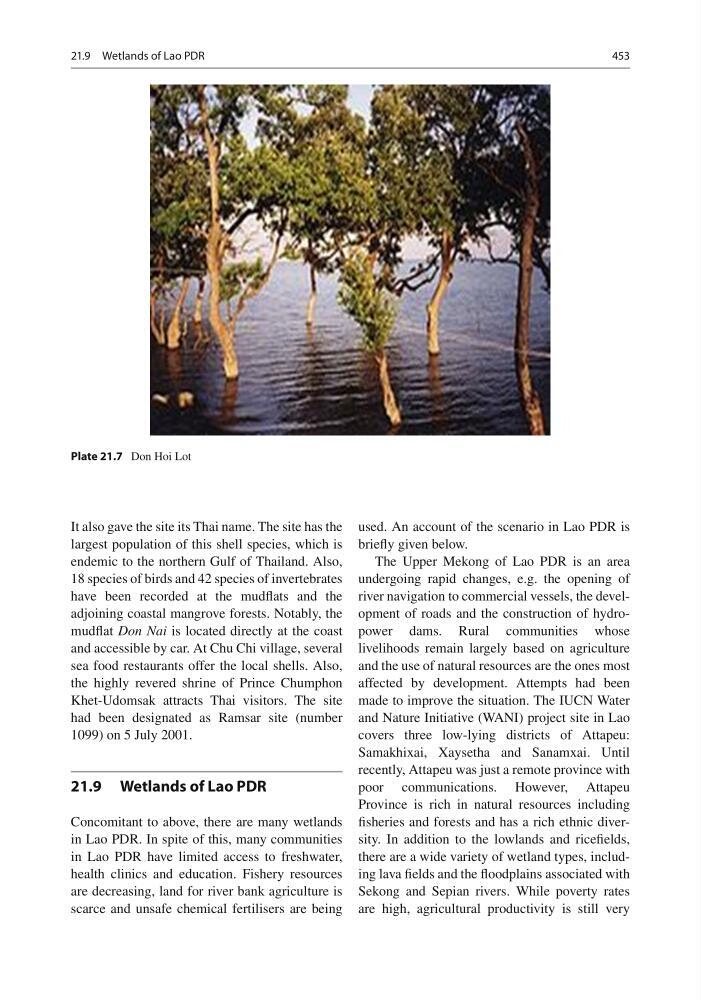
Plate 21.7 Don Hoi Lot
21.9 Wetlands of Lao PDR
It also gave the site its Thai name. The site has the
largest population of this shell species, which is
endemic to the northern Gulf of Thailand. Also,
18 species of birds and 42 species of invertebrates
have been recorded at the mudfl ats and the
adjoining coastal mangrove forests. Notably, the
mudfl at Don Nai is located directly at the coast
and accessible by car. At Chu Chi village, several
sea food restaurants offer the local shells. Also,
the highly revered shrine of Prince Chumphon
Khet-Udomsak attracts Thai visitors. The site
had been designated as Ramsar site (number
1099) on 5 July 2001.
21.9 Wetlands of Lao PDR
Concomitant to above, there are many wetlands
in Lao PDR. In spite of this, many communities
in Lao PDR have limited access to freshwater,
health clinics and education. Fishery resources
are decreasing, land for river bank agriculture is
scarce and unsafe chemical fertilisers are being
used. An account of the scenario in Lao PDR is
briefl y given below.
The Upper Mekong of Lao PDR is an area
undergoing rapid changes, e.g. the opening of
river navigation to commercial vessels, the development of roads and the construction of hydropower dams. Rural communities whose
livelihoods remain largely based on agriculture
and the use of natural resources are the ones most
affected by development. Attempts had been
made to improve the situation. The IUCN Water
and Nature Initiative (WANI) project site in Lao
covers three low-lying districts of Attapeu:
Samakhixai, Xaysetha and Sanamxai. Until
recently, Attapeu was just a remote province with
poor communications. However, Attapeu
Province is rich in natural resources including
fi sheries and forests and has a rich ethnic diversity. In addition to the lowlands and ricefi elds,
there are a wide variety of wetland types, including lava fi elds and the fl oodplains associated with
Sekong and Sepian rivers. While poverty rates
are high, agricultural productivity is still very
Plate 21.7 Don Hoi Lot
21.9 Wetlands of Lao PDR