

440
is a tropical lake with depth generally ranging
from 109.3 to 261.5 cm. The marginal slope of
the lake was not at all regular as both steep and
gradual slopes were encountered throughout.
The lake basin was uneven with loamy (occasionally sandy) basin soil. The temperature of
the lake water usually varies between 12.3 and
34.5 °C. The wetland did not show any thermal
stratifi cation. Water transparency was related to
volume of water. The ranges of other characteristics of water were pH 6.3–8.8, DO 4.3–
9.9 mg/l, FCO 2 2.6–2.7 mg/l and T.A.
36.5–91.0 mg/l. The bottom soil depicted
pH 6.4–6.6, available phosphorus 10.0–
13.3 mg/100 g, available nitrite nitrogen 2.3–
2.5 mg/100 g and available potassium
9.0–9.2 mg/100 g. The wetland seemed to be
fairly productive as per its water and soil characteristics (Dewan 1973 ). In addition to above,
26 species of AM belonging to 12 families were
recorded in the wetland. Moreover, 46 genera of
phytoplankton belonging to Chlorophyceae (22
genera), Bacillariophyceae (12 genera), Euglenophyceae (5 genera) and Myxophyceae (7 genera) had been recorded in the wetland. Also, 7
groups of zooplankton belonging to Protozoa (3
genera), Rotifera (12 genera), Cladocera (6 genera) and Copepoda (3 genera) were recorded in
the lake. The zoobenthos consisted of 5 groups
of animals, namely, Annelida, Crustacea,
Insecta, Mollusca and Pisces (mainly the trash
fi shes). Further, 20 species of fi shes belonging
to 10 families have been recorded in this wetland. Study of length–weight (LW) relationship
and condition of 4 species of fi shes indicated ‘n’
ranging from 2.18404 in Anabas testudineus to
3.7718 in Esomus danricus . The relative condition factor of the fi shes varied from 0.907 to
1.053. If properly managed, this wetland could
yield large quantity of fi shes.
21.2 Wetlands of Bhutan
In Bhutan, a total number of 3,027 wetlands,
inclusive of lakes and marshes, have been
recorded and about 52 % of the total wetlands are
found in Drangme Chu Basin, which is primarily
contributed by Mangde Chu and Chamkhar Chhu
river systems. Further, Bhutan has also designated two Wetlands of International Importance.
The Chamkhar Chhu river system has the
highest number of lakes. The distribution of wetlands is concentrated within the elevation range
of 3,800 to 5,560 m MSL.
Any wetland situated at an altitude of
>3,000 m could be regarded as a high altitude
(HA) wetland. In Bhutan, the HA wetlands
account for c 43 % (16,610 km
2 ) of the total
land. Further, Bhutan has 16 watersheds that
have HA wetlands. The watershed includes
seven river systems of the four major basins:
Amo Chu, Wang Chu, PunatsangChu and
Drangme Chhu . Its tributaries , two small independent basins of Neyra Ama Chu and
Jomotsangkha Chu and the headwater sources
of Shaar Chu, fl ow into Arunachal Pradesh.
21.2.1 Wetland(s) in Bumdeling
Wildlife Sanctuary (Wls)
Wetlands in Bumdeling Wls , lying at 1,850 m
MSL, are situated in one of the glacial valleys.
According to Ramsar, it hosts 158 rare blacknecked cranes, which migrate from the Tibetan
plateau. The site was offi cially declared as a conservation area in 1998. The Bumdeling Wls in
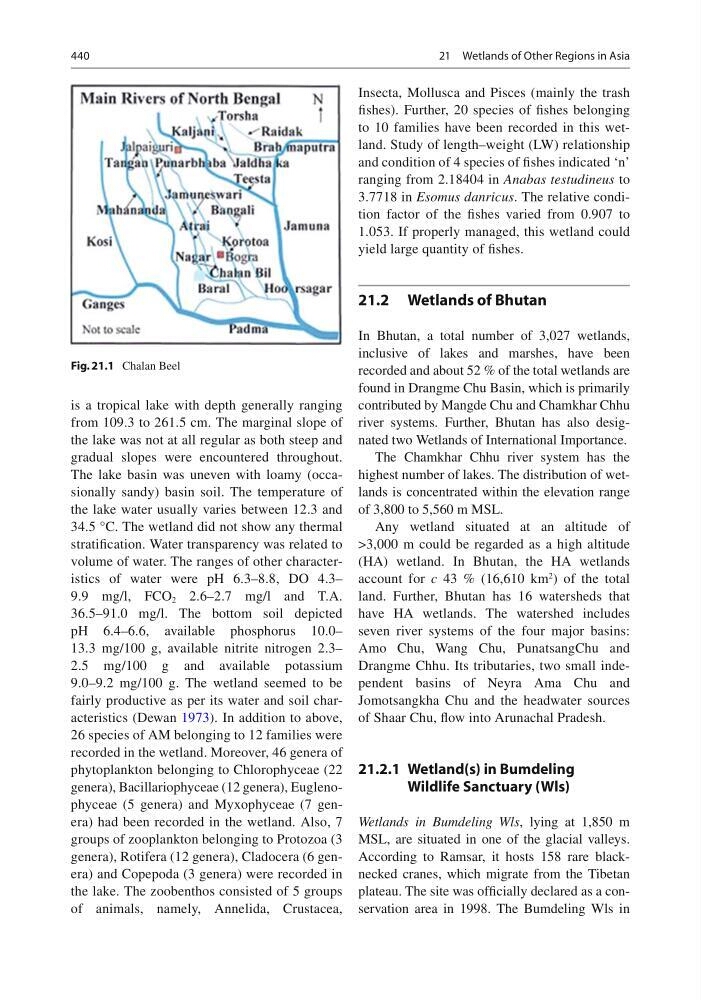
Fig. 21.1 Chalan Beel
21 Wetlands of Other Regions in Asia
is a tropical lake with depth generally ranging
from 109.3 to 261.5 cm. The marginal slope of
the lake was not at all regular as both steep and
gradual slopes were encountered throughout.
The lake basin was uneven with loamy (occasionally sandy) basin soil. The temperature of
the lake water usually varies between 12.3 and
34.5 °C. The wetland did not show any thermal
stratifi cation. Water transparency was related to
volume of water. The ranges of other characteristics of water were pH 6.3–8.8, DO 4.3–
9.9 mg/l, FCO 2 2.6–2.7 mg/l and T.A.
36.5–91.0 mg/l. The bottom soil depicted
pH 6.4–6.6, available phosphorus 10.0–
13.3 mg/100 g, available nitrite nitrogen 2.3–
2.5 mg/100 g and available potassium
9.0–9.2 mg/100 g. The wetland seemed to be
fairly productive as per its water and soil characteristics (Dewan 1973 ). In addition to above,
26 species of AM belonging to 12 families were
recorded in the wetland. Moreover, 46 genera of
phytoplankton belonging to Chlorophyceae (22
genera), Bacillariophyceae (12 genera), Euglenophyceae (5 genera) and Myxophyceae (7 genera) had been recorded in the wetland. Also, 7
groups of zooplankton belonging to Protozoa (3
genera), Rotifera (12 genera), Cladocera (6 genera) and Copepoda (3 genera) were recorded in
the lake. The zoobenthos consisted of 5 groups
of animals, namely, Annelida, Crustacea,
Insecta, Mollusca and Pisces (mainly the trash
fi shes). Further, 20 species of fi shes belonging
to 10 families have been recorded in this wetland. Study of length–weight (LW) relationship
and condition of 4 species of fi shes indicated ‘n’
ranging from 2.18404 in Anabas testudineus to
3.7718 in Esomus danricus . The relative condition factor of the fi shes varied from 0.907 to
1.053. If properly managed, this wetland could
yield large quantity of fi shes.
21.2 Wetlands of Bhutan
In Bhutan, a total number of 3,027 wetlands,
inclusive of lakes and marshes, have been
recorded and about 52 % of the total wetlands are
found in Drangme Chu Basin, which is primarily
contributed by Mangde Chu and Chamkhar Chhu
river systems. Further, Bhutan has also designated two Wetlands of International Importance.
The Chamkhar Chhu river system has the
highest number of lakes. The distribution of wetlands is concentrated within the elevation range
of 3,800 to 5,560 m MSL.
Any wetland situated at an altitude of
>3,000 m could be regarded as a high altitude
(HA) wetland. In Bhutan, the HA wetlands
account for c 43 % (16,610 km
2 ) of the total
land. Further, Bhutan has 16 watersheds that
have HA wetlands. The watershed includes
seven river systems of the four major basins:
Amo Chu, Wang Chu, PunatsangChu and
Drangme Chhu . Its tributaries , two small independent basins of Neyra Ama Chu and
Jomotsangkha Chu and the headwater sources
of Shaar Chu, fl ow into Arunachal Pradesh.
21.2.1 Wetland(s) in Bumdeling
Wildlife Sanctuary (Wls)
Wetlands in Bumdeling Wls , lying at 1,850 m
MSL, are situated in one of the glacial valleys.
According to Ramsar, it hosts 158 rare blacknecked cranes, which migrate from the Tibetan
plateau. The site was offi cially declared as a conservation area in 1998. The Bumdeling Wls in
Fig. 21.1 Chalan Beel
21 Wetlands of Other Regions in Asia