

414
large whistling teal, pintail, mallard and shoveller.
The principal mammals of Kanjli are the Indian
civet, mongoose, Indian porcupine, squirrel, the
common Indian hare, etc.
Problems
Some of the problems (threats) of Kanjli wetland
are (a) extensive infestation by water hyacinth;
(b) encroachments; (c) eutrophication; (d) urbanisation, agriculture, etc., within the wetland; (e)
unlawful and indiscriminate fi shing; (f) disturbance to birds; etc.
Conservation Measures
Some of the management and conservation measures are (a) detailed study for notifying the
Kanjli wetland as protected area under the
Environment Protection Act, 1986; (b) weed control by various means, like mechanical (by conveyor belt system) or biological (by releasing two
weevil species, namely, Neochetina bruchi and
N. eichorniae , which have been found to be effective worldwide and introduced in the downstream
in the Harike Wetland ecosystem, or by releasing
of the moth, namely , Sameodes albiguittal ); (c)
introduction of more native fi sh species into the
wetland; (d) afforestation in and around Kanjli
wetland mainly to prevent soil erosion, siltation
and diminution of the area of the wetland; (e)
fencing of the wetland to prevent excess grazing
and encroachments; (f) monitoring of the water
quality; (g) education; (h) regular scientifi c
research on the Kanjli wetland; etc.
20.3.12.3 Ropar Wetland
Ropar Wetland (commonly called Ropar Lake )
lies at 350 m MSL, between 30° 55′ and 30° 58′
N and 76° 26′ and 76° 28′ E, in the Shivalik foothills of the Lower Himalayas close to the
Rupnagar City, 45 km northwest of Chandigarh
City, in Rupnagar (Ropar) and Nawanshahr districts in the Punjab province of India. Ropar
(Plate 20.80 ) is a man-made freshwater wetland
constructed in 1882 and extended in 1952 on the
Sutlej River by building a head regulator to store
and divert water for benefi cial uses of irrigation,
drinking and industrial water supply. The climate
is semi-arid with an annual average rainfall of
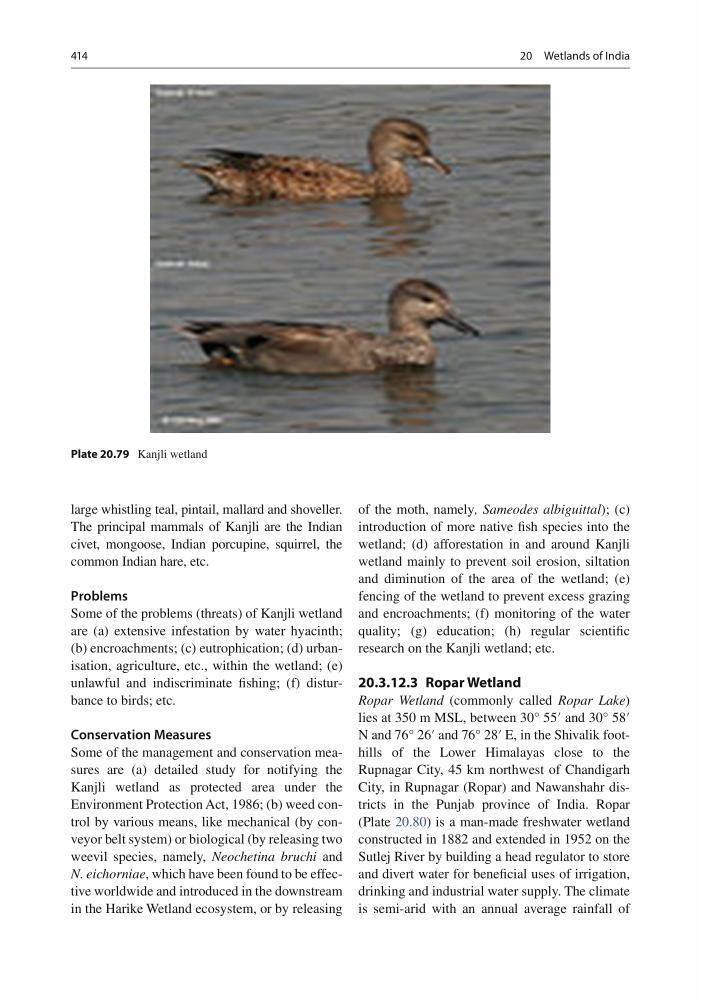
Plate 20.79 Kanjli wetland
20 Wetlands of India
large whistling teal, pintail, mallard and shoveller.
The principal mammals of Kanjli are the Indian
civet, mongoose, Indian porcupine, squirrel, the
common Indian hare, etc.
Problems
Some of the problems (threats) of Kanjli wetland
are (a) extensive infestation by water hyacinth;
(b) encroachments; (c) eutrophication; (d) urbanisation, agriculture, etc., within the wetland; (e)
unlawful and indiscriminate fi shing; (f) disturbance to birds; etc.
Conservation Measures
Some of the management and conservation measures are (a) detailed study for notifying the
Kanjli wetland as protected area under the
Environment Protection Act, 1986; (b) weed control by various means, like mechanical (by conveyor belt system) or biological (by releasing two
weevil species, namely, Neochetina bruchi and
N. eichorniae , which have been found to be effective worldwide and introduced in the downstream
in the Harike Wetland ecosystem, or by releasing
of the moth, namely , Sameodes albiguittal ); (c)
introduction of more native fi sh species into the
wetland; (d) afforestation in and around Kanjli
wetland mainly to prevent soil erosion, siltation
and diminution of the area of the wetland; (e)
fencing of the wetland to prevent excess grazing
and encroachments; (f) monitoring of the water
quality; (g) education; (h) regular scientifi c
research on the Kanjli wetland; etc.
20.3.12.3 Ropar Wetland
Ropar Wetland (commonly called Ropar Lake )
lies at 350 m MSL, between 30° 55′ and 30° 58′
N and 76° 26′ and 76° 28′ E, in the Shivalik foothills of the Lower Himalayas close to the
Rupnagar City, 45 km northwest of Chandigarh
City, in Rupnagar (Ropar) and Nawanshahr districts in the Punjab province of India. Ropar
(Plate 20.80 ) is a man-made freshwater wetland
constructed in 1882 and extended in 1952 on the
Sutlej River by building a head regulator to store
and divert water for benefi cial uses of irrigation,
drinking and industrial water supply. The climate
is semi-arid with an annual average rainfall of
Plate 20.79 Kanjli wetland
20 Wetlands of India