

412
Punjab province of India. It has a surface area of
4,100 ha. The wetland has a maximum depth of
2 m. There are 33 islands in the wetland. The
wetland and the lake were formed (in 1953) by
constructing the head works across the Sutlej
River in 1953. The rivers Beas and Sutlej are the
primary infl ows of the wetland. The rich biodiversity maintains the hydrological balance in the
catchment with vast concentration of migratory
waterfowls including a number of globally threatened species. This has paved the way for the recognition accorded to this wetland, in 1990, as one
of the Ramsar sites in India.
Hydrology
Harike is under the infl uence of tropical monsoon
climate. Makku feeder canals, with total carrying
capacity of 29,000 cusecs, supply the command
areas located in the States of Punjab and
Rajasthan. The grand Indira Gandhi Canal in
Rajasthan is fed from this source. The periphery
is surrounded by agricultural land, and the wetland is reported to be rich in groundwater
resources. The water quality of the wetland is
said to be largely good.
Biodiversity
The Harike has a rich and unique biodiversity
with several species of AM, fi shes, birds, turtles,
snakes, amphibians, fi shes and invertebrates.
Some of the AM are Eichhornia crassipes
(available in c 50 % of the area), Azolla
sp., Nelumbo nucifera, Ipomoea aquatica, Najas,
Hydrilla, Ceratophyllum, Potamogeton, Vallisneria ,
etc. Typha sp. is the dominant emergent marsh
vegetation. Tiny fl oating islets are formed by
Eichhornia crassipes and other grass species in
the mud and root zone all over the wetland.
Twenty-six species of fi shes have been
recorded in Harike. Some of the fi shes are Labeo
rohita , Catla catla , Puntius spp., Cirrhinus sp.,
Channa spp. , Mystus spp., Notopterus sp.,
Cyprinus sp ., Parambassis ranga, etc.
Approx. 200 species of birds visit the wetland
during winter. Some of the birds are cotton
pygmy goose ( Nettapus ), tufted duck ( Aythya
fuligula ), yellow-crowned woodpecker ( Dendrocopos mahrattensis ), yellow-eyed pigeon or
pale-backed pigeon, water cock ( Gallicrex cinerea ), etc. The wetland was declared as a bird
sanctuary in 1982 and named as Harike Pattan
Bird Sanctuary with an extended area of
8,600 ha.
Further, endangered (IUCN Red List) testudine turtles, smooth Indian otter, etc., are found
in this wetland.
Some of the invertebrates recorded are molluscs (39 taxa), insects (32 taxa), crustaceans (27
taxa), annelids (7 taxa), nematodes (7taxa), rotifers (59 taxa) and protozoans (21 taxa).
Indus Dolphins
Sighting of a family of half a dozen of IUCN Red
Data Book critically endangered Indus dolphin
( Platanista gangetica minor ) at two different
places along the 25-km stretch upstream of the
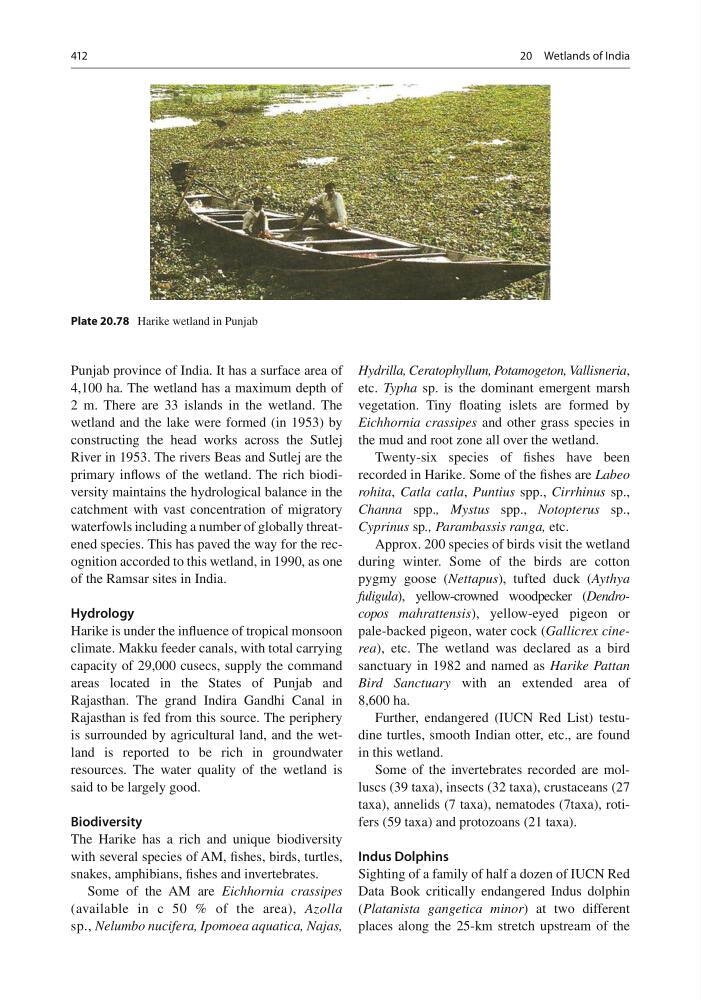
Plate 20.78 Harike wetland in Punjab
20 Wetlands of India
Punjab province of India. It has a surface area of
4,100 ha. The wetland has a maximum depth of
2 m. There are 33 islands in the wetland. The
wetland and the lake were formed (in 1953) by
constructing the head works across the Sutlej
River in 1953. The rivers Beas and Sutlej are the
primary infl ows of the wetland. The rich biodiversity maintains the hydrological balance in the
catchment with vast concentration of migratory
waterfowls including a number of globally threatened species. This has paved the way for the recognition accorded to this wetland, in 1990, as one
of the Ramsar sites in India.
Hydrology
Harike is under the infl uence of tropical monsoon
climate. Makku feeder canals, with total carrying
capacity of 29,000 cusecs, supply the command
areas located in the States of Punjab and
Rajasthan. The grand Indira Gandhi Canal in
Rajasthan is fed from this source. The periphery
is surrounded by agricultural land, and the wetland is reported to be rich in groundwater
resources. The water quality of the wetland is
said to be largely good.
Biodiversity
The Harike has a rich and unique biodiversity
with several species of AM, fi shes, birds, turtles,
snakes, amphibians, fi shes and invertebrates.
Some of the AM are Eichhornia crassipes
(available in c 50 % of the area), Azolla
sp., Nelumbo nucifera, Ipomoea aquatica, Najas,
Hydrilla, Ceratophyllum, Potamogeton, Vallisneria ,
etc. Typha sp. is the dominant emergent marsh
vegetation. Tiny fl oating islets are formed by
Eichhornia crassipes and other grass species in
the mud and root zone all over the wetland.
Twenty-six species of fi shes have been
recorded in Harike. Some of the fi shes are Labeo
rohita , Catla catla , Puntius spp., Cirrhinus sp.,
Channa spp. , Mystus spp., Notopterus sp.,
Cyprinus sp ., Parambassis ranga, etc.
Approx. 200 species of birds visit the wetland
during winter. Some of the birds are cotton
pygmy goose ( Nettapus ), tufted duck ( Aythya
fuligula ), yellow-crowned woodpecker ( Dendrocopos mahrattensis ), yellow-eyed pigeon or
pale-backed pigeon, water cock ( Gallicrex cinerea ), etc. The wetland was declared as a bird
sanctuary in 1982 and named as Harike Pattan
Bird Sanctuary with an extended area of
8,600 ha.
Further, endangered (IUCN Red List) testudine turtles, smooth Indian otter, etc., are found
in this wetland.
Some of the invertebrates recorded are molluscs (39 taxa), insects (32 taxa), crustaceans (27
taxa), annelids (7 taxa), nematodes (7taxa), rotifers (59 taxa) and protozoans (21 taxa).
Indus Dolphins
Sighting of a family of half a dozen of IUCN Red
Data Book critically endangered Indus dolphin
( Platanista gangetica minor ) at two different
places along the 25-km stretch upstream of the
Plate 20.78 Harike wetland in Punjab
20 Wetlands of India