

397
Ca 7.01 μg/l; Na 4.33 μg/l; Fe 41.57μg/l and
Mn 12.11 μg/l
(b) Interstitial water : pH 7.20; PO 4 , phosphorus
1.11 μg/l; Fe 59.1 μg/l and Mn 49.00 μg/l
(c) Sediments : organic carbon (OC) 8.95 %; PO 4 ,
phosphorus 1,690.00 μg/l; Fe 17,724.27 μg/l
and Mn 86.36 μg/l
Flora
The vegetation mainly includes the insectivorous
Drosera sp. (on the eastern shore); the plantation
crops, like cashew nut, tapioca and plantain; and
paddy, grown on the banks of the wetland.
Aqua Fauna
Some of the aquatic fauna noted in the wetland
are, (a) 27 species of freshwater fi shes, notably
Etroplus suratensis , catfi shes (particularly
Wallago attu ), 21 species of herrings and sardines
and so on. Also two genera of prawns are found;
(b) the common teal or dabbling duck is the
smallest migratory bird found in the wetland.
Further, some of the vulnerable, endangered
and critically endangered fi sh species in the wetland are (a) Puntius punctatus (day) (critically
endangered), (b) Horabagrus brachysoma
(Gunther) (endangered) and (c) Parambassis
thomassi (day) (vulnerable).
Other Fauna
Resident troupes of monkeys (which are part of
the Sasthamkotta temple), 13 species of insects (9
butterfl ies, 2 odonates and 2 hymenopterans), etc.
Deterioration in Wetland Environment
The wetland environment is affected due to (a)
increase in anthropogenic pressure, (b) encroachment of parts of wetland, (c) domestic and agrochemical wastes, etc.
Conservation and Management
The Management Action Plan (MAP) of the Kerala
State Government with expected funds from
Central Government under the National Lake
Conservation Plan (NLCP), for the lake’s sustainable utilisation and conservation, envisages the following activities: (a) agroforestry in the catchment,
(b) proper sanitation and drainage, (c) abatement of
pollution, (d) limited desilting, (e) weed control, (f)
conservation of indigenous fl ora and fauna, (g)
fi shery development, (h) awareness campaigns
amongst the local inhabitants and so on.
20.3.8.3 Kerala Backwaters
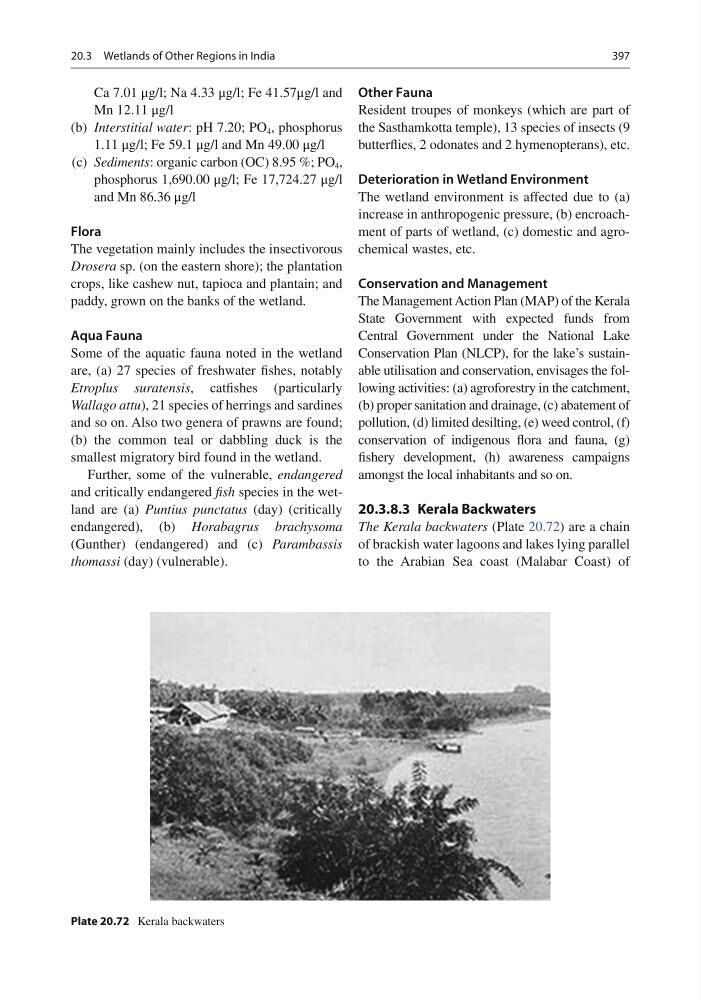
The Kerala backwaters (Plate 20.72 ) are a chain
of brackish water lagoons and lakes lying parallel
to the Arabian Sea coast (Malabar Coast) of
Plate 20.72 Kerala backwaters
20.3 Wetlands of Other Regions in India
Ca 7.01 μg/l; Na 4.33 μg/l; Fe 41.57μg/l and
Mn 12.11 μg/l
(b) Interstitial water : pH 7.20; PO 4 , phosphorus
1.11 μg/l; Fe 59.1 μg/l and Mn 49.00 μg/l
(c) Sediments : organic carbon (OC) 8.95 %; PO 4 ,
phosphorus 1,690.00 μg/l; Fe 17,724.27 μg/l
and Mn 86.36 μg/l
Flora
The vegetation mainly includes the insectivorous
Drosera sp. (on the eastern shore); the plantation
crops, like cashew nut, tapioca and plantain; and
paddy, grown on the banks of the wetland.
Aqua Fauna
Some of the aquatic fauna noted in the wetland
are, (a) 27 species of freshwater fi shes, notably
Etroplus suratensis , catfi shes (particularly
Wallago attu ), 21 species of herrings and sardines
and so on. Also two genera of prawns are found;
(b) the common teal or dabbling duck is the
smallest migratory bird found in the wetland.
Further, some of the vulnerable, endangered
and critically endangered fi sh species in the wetland are (a) Puntius punctatus (day) (critically
endangered), (b) Horabagrus brachysoma
(Gunther) (endangered) and (c) Parambassis
thomassi (day) (vulnerable).
Other Fauna
Resident troupes of monkeys (which are part of
the Sasthamkotta temple), 13 species of insects (9
butterfl ies, 2 odonates and 2 hymenopterans), etc.
Deterioration in Wetland Environment
The wetland environment is affected due to (a)
increase in anthropogenic pressure, (b) encroachment of parts of wetland, (c) domestic and agrochemical wastes, etc.
Conservation and Management
The Management Action Plan (MAP) of the Kerala
State Government with expected funds from
Central Government under the National Lake
Conservation Plan (NLCP), for the lake’s sustainable utilisation and conservation, envisages the following activities: (a) agroforestry in the catchment,
(b) proper sanitation and drainage, (c) abatement of
pollution, (d) limited desilting, (e) weed control, (f)
conservation of indigenous fl ora and fauna, (g)
fi shery development, (h) awareness campaigns
amongst the local inhabitants and so on.
20.3.8.3 Kerala Backwaters
The Kerala backwaters (Plate 20.72 ) are a chain
of brackish water lagoons and lakes lying parallel
to the Arabian Sea coast (Malabar Coast) of
Plate 20.72 Kerala backwaters
20.3 Wetlands of Other Regions in India