

395
20.3.8.2 Sasthamkotta Lake
Sasthamkotta wetland (commonly called lake )
lies at 33 m MSL, between 9° 02′ N and 76° 38′
E, and is one of the biggest freshwater lakes in
Kerala province of India. The lake (Plate 20.71 )
is named after the ancient Sastha temple (a pilgrimage centre) located on its bank. The lake is
located at a distance of 29 km from Quilon
City. Karunagapally, at a distance of 2 km, is
the closest town to the lake. The wetland has a
catchment area of 12.69 km
2 and a water surface area of 373 ha. The maximum and average
depths are 15.2 m and 6.53 m, respectively,
while the water volume is 22.4 million m
3
(mm
3 ). Karunagapally and Sasthamkotta are
the settlements of the wetland. It meets the
drinking water needs of half a million people of
the Quilon District, while the fi shes provide
livelihood to the people. The potability of the
wetland water is attributed to the presence of
large population of larva called Cavaborus
which consume bacteria in the wetland water. It
is a Ramsar wetland since November 2002. A
large part of the lake is reported to have been
occupied for agriculture.
Geology
Rocks are mainly Archaean with intrusions of
charnockite, biotite gneiss and dolerite dyke
rocks. The tertiary Varkala formations are
observed along the coastal beds. In the valley
portion, sand and silt deposits are recorded.
Geomorphological divisions of the basin area of
the lake comprise (a) the undulating uplands
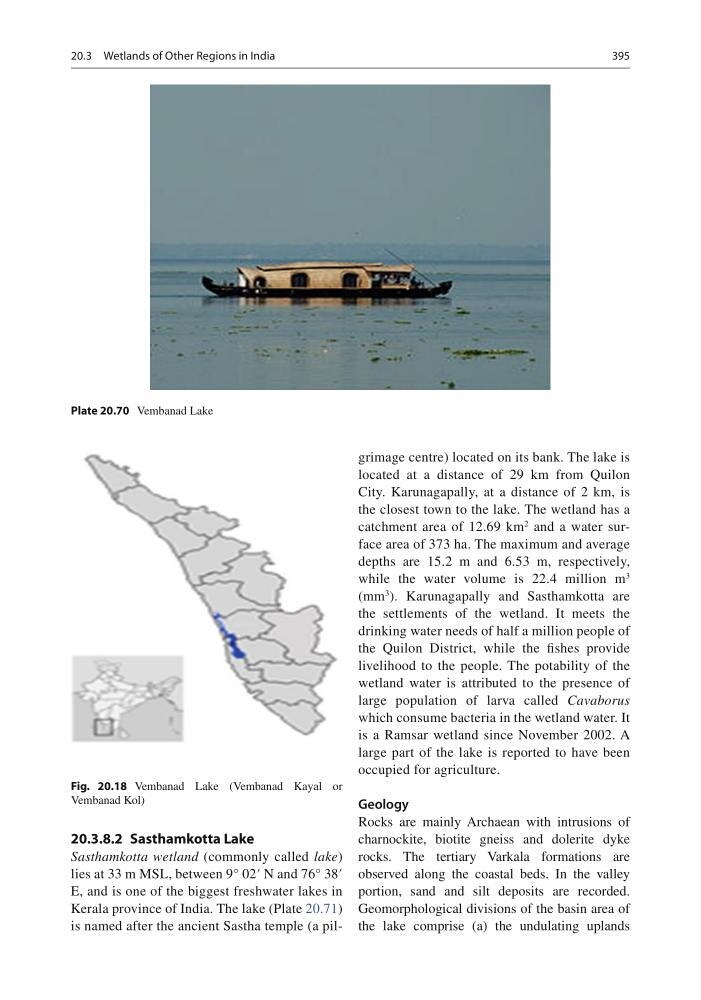
Plate 20.70 Vembanad Lake
Fig. 20.18 Vembanad Lake (Vembanad Kayal or
Vembanad Kol)
20.3 Wetlands of Other Regions in India
20.3.8.2 Sasthamkotta Lake
Sasthamkotta wetland (commonly called lake )
lies at 33 m MSL, between 9° 02′ N and 76° 38′
E, and is one of the biggest freshwater lakes in
Kerala province of India. The lake (Plate 20.71 )
is named after the ancient Sastha temple (a pilgrimage centre) located on its bank. The lake is
located at a distance of 29 km from Quilon
City. Karunagapally, at a distance of 2 km, is
the closest town to the lake. The wetland has a
catchment area of 12.69 km
2 and a water surface area of 373 ha. The maximum and average
depths are 15.2 m and 6.53 m, respectively,
while the water volume is 22.4 million m
3
(mm
3 ). Karunagapally and Sasthamkotta are
the settlements of the wetland. It meets the
drinking water needs of half a million people of
the Quilon District, while the fi shes provide
livelihood to the people. The potability of the
wetland water is attributed to the presence of
large population of larva called Cavaborus
which consume bacteria in the wetland water. It
is a Ramsar wetland since November 2002. A
large part of the lake is reported to have been
occupied for agriculture.
Geology
Rocks are mainly Archaean with intrusions of
charnockite, biotite gneiss and dolerite dyke
rocks. The tertiary Varkala formations are
observed along the coastal beds. In the valley
portion, sand and silt deposits are recorded.
Geomorphological divisions of the basin area of
the lake comprise (a) the undulating uplands
Plate 20.70 Vembanad Lake
Fig. 20.18 Vembanad Lake (Vembanad Kayal or
Vembanad Kol)
20.3 Wetlands of Other Regions in India