

361
Both sides of the Beel are covered by bamboo
plantation. Local people fi sh in the Beel. A BDC
now takes care of the Beel. IMC has been introduced into the Beel.
Some of the suggested measures are as follows:
(a) The Beel could be developed for aquaculture.
(b) The Beel be desilted for increasing its depth.
(c) Detrimental gears to be banned.
20.2.6.20 Param Beel
This oxbow wetland (Beel) is situated between
94° 17′ E and 26° 59′ N in Jorhat District of
Assam. It was a big swamp. The area of the Beel
is 9.30 ha, while its maximum and minimum
depths are 2.0 m and 1.5 m, respectively. It is a
muddy, rainfed and closed Beel with no river
connection and not much weed infestation.
There is cultivation and grazing along the periphery of the wetland. Anabas is an abundant fi sh in
the Beel.
Some of the suggested measures are as follows:
(a) Deweeding and desiltation
(b) Aquaculture in the Beel
(c) Restricted agriculture in the Beel mainly
through organic farming
20.2.7 Some Ancient Tanks in Sibsagar
There are many ancient temple tanks in Sibsagar
District of Assam. Preliminary studies in 20 such
tanks, ranging from 0.4 to 62 ha in area, revealed
that they are slightly acidic with low alkalinity.
They are potentially rich with essential nutrient
elements. However, their productivity could be
substantially enhanced through proper manuring
and stocking (Bhuyan 1970 ).
20.2.8 Hafl ong Lake
It is a small lentic body situated at Hafl ong town
in Dima Hasao (earlier North Cachar Hills) hill
District of Assam. The lake has typical ecobiological characteristics with moderate DO, TA,
electrical conductivity and plankton population.
Some of the fi shes of the lake are Puntius,
Amblypharyngodon, Devario, etc.
20.2.9 Some Wetlands in Different
Landscapes in Assam
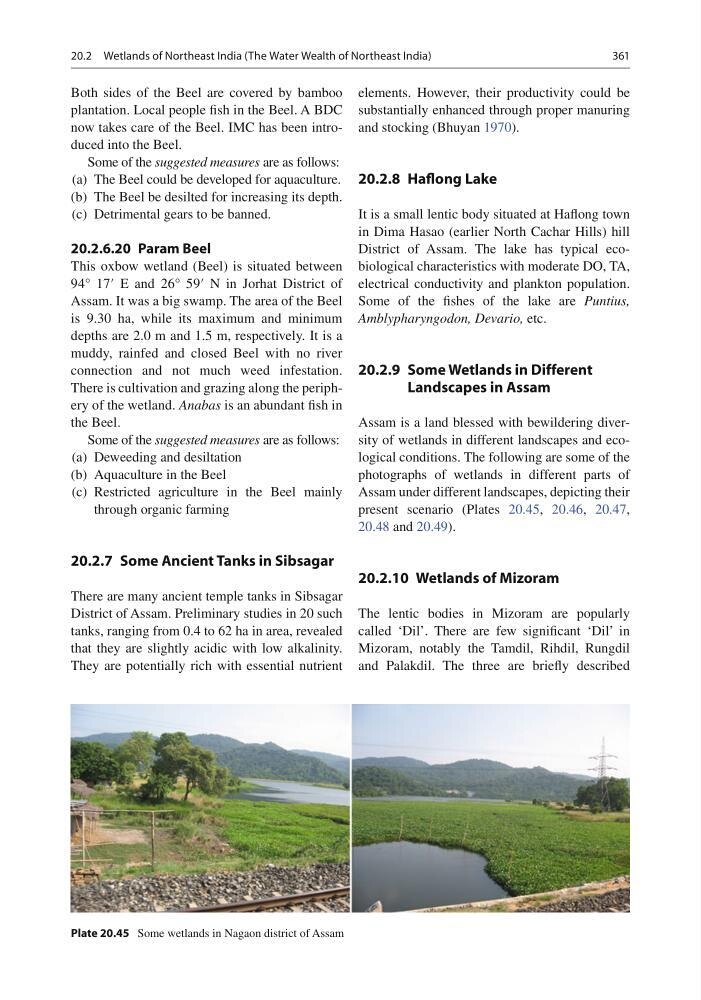
Assam is a land blessed with bewildering diversity of wetlands in different landscapes and ecological conditions. The following are some of the
photographs of wetlands in different parts of
Assam under different landscapes, depicting their
present scenario (Plates 20.45 , 20.46 , 20.47 ,
20.48 and 20.49 ).
20.2.10 Wetlands of Mizoram
The lentic bodies in Mizoram are popularly
called ‘Dil’. There are few signifi cant ‘Dil’ in
Mizoram, notably the Tamdil, Rihdil, Rungdil
and Palakdil. The three are briefl y described
Plate 20.45 Some wetlands in Nagaon district of Assam
20.2 Wetlands of Northeast India (The Water Wealth of Northeast India)
Both sides of the Beel are covered by bamboo
plantation. Local people fi sh in the Beel. A BDC
now takes care of the Beel. IMC has been introduced into the Beel.
Some of the suggested measures are as follows:
(a) The Beel could be developed for aquaculture.
(b) The Beel be desilted for increasing its depth.
(c) Detrimental gears to be banned.
20.2.6.20 Param Beel
This oxbow wetland (Beel) is situated between
94° 17′ E and 26° 59′ N in Jorhat District of
Assam. It was a big swamp. The area of the Beel
is 9.30 ha, while its maximum and minimum
depths are 2.0 m and 1.5 m, respectively. It is a
muddy, rainfed and closed Beel with no river
connection and not much weed infestation.
There is cultivation and grazing along the periphery of the wetland. Anabas is an abundant fi sh in
the Beel.
Some of the suggested measures are as follows:
(a) Deweeding and desiltation
(b) Aquaculture in the Beel
(c) Restricted agriculture in the Beel mainly
through organic farming
20.2.7 Some Ancient Tanks in Sibsagar
There are many ancient temple tanks in Sibsagar
District of Assam. Preliminary studies in 20 such
tanks, ranging from 0.4 to 62 ha in area, revealed
that they are slightly acidic with low alkalinity.
They are potentially rich with essential nutrient
elements. However, their productivity could be
substantially enhanced through proper manuring
and stocking (Bhuyan 1970 ).
20.2.8 Hafl ong Lake
It is a small lentic body situated at Hafl ong town
in Dima Hasao (earlier North Cachar Hills) hill
District of Assam. The lake has typical ecobiological characteristics with moderate DO, TA,
electrical conductivity and plankton population.
Some of the fi shes of the lake are Puntius,
Amblypharyngodon, Devario, etc.
20.2.9 Some Wetlands in Different
Landscapes in Assam
Assam is a land blessed with bewildering diversity of wetlands in different landscapes and ecological conditions. The following are some of the
photographs of wetlands in different parts of
Assam under different landscapes, depicting their
present scenario (Plates 20.45 , 20.46 , 20.47 ,
20.48 and 20.49 ).
20.2.10 Wetlands of Mizoram
The lentic bodies in Mizoram are popularly
called ‘Dil’. There are few signifi cant ‘Dil’ in
Mizoram, notably the Tamdil, Rihdil, Rungdil
and Palakdil. The three are briefl y described
Plate 20.45 Some wetlands in Nagaon district of Assam
20.2 Wetlands of Northeast India (The Water Wealth of Northeast India)