

351
AM
Cynodon dactylon, Eichhornia crassipes, Oryza
sativa, Salvinia cucullata, Trapa bispinosa,
Polygonum fl accidum, Nymphoides indicum and
Justicia repens.
Plankton
Microcystis aeruginosa, Synedra sp ., Pinnularia
sp ., Navicula sp., Arcella sp ., Brachionus sp ., Alona
sp ., Pleuroxus sp., Bosmina sp . and Cyclops sp.
Fish Diversity
Amblypharyngodon mola , Puntius ticto ,
Lepidocephalichthys guntea, Mystus vittatus ,
Channa punctatus, Parambassis sp., Chanda
nama, Glossogobius giuris, Anabas testudineus,
Trichogaster sp., Macrognathus aral and
Macrognathus pancalus.
FY
Parambassis shows the highest yield (55 %)
followed by Puntius, Mystus, etc.
General Inference on Fish Yield
The above account indicates that the Anuas are
potential oxbow wetlands having, in general, rich
population of Gudusia chapra and Salmophasia
bacaila, both of which constitute c 45 % of the
total fi sh yield from these oxbow wetlands on
average. On the other hand, a comparative study
of a fl oodplain wetland (Puneer Haor) and an
oxbow wetland (Sibnarayanpur Anua) revealed
orderwise distribution of ichthyospecies as follows: Osteoglossiformes, 1 and nil species;
Clupeiformes, nil and 1; Cypriniformes, 7 and 11;
Siluriformes, 6 and 4; Synbranchiformes, 1 and
3; Beloniformes, 1 and 1; Cyprinodontiformes, 1
and nil; and Perciformes, 7 and 2 (Kar et al. 2002 ).
In wetlands, like Hathichhara Beel, Doloo Beel,
Dubria Beel, Karkari Beel, Jonamara Beel,
Sushka Beel, Tapang Beel, Angang Beel, Sagar
Beel, Rani-Meghna Beel and Deochhara Beel,
the small trash fi shes constitute, on the average, c
83 % of the total yield from the wetland. However,
in Rata Beel, which is situated adjacent to Sone
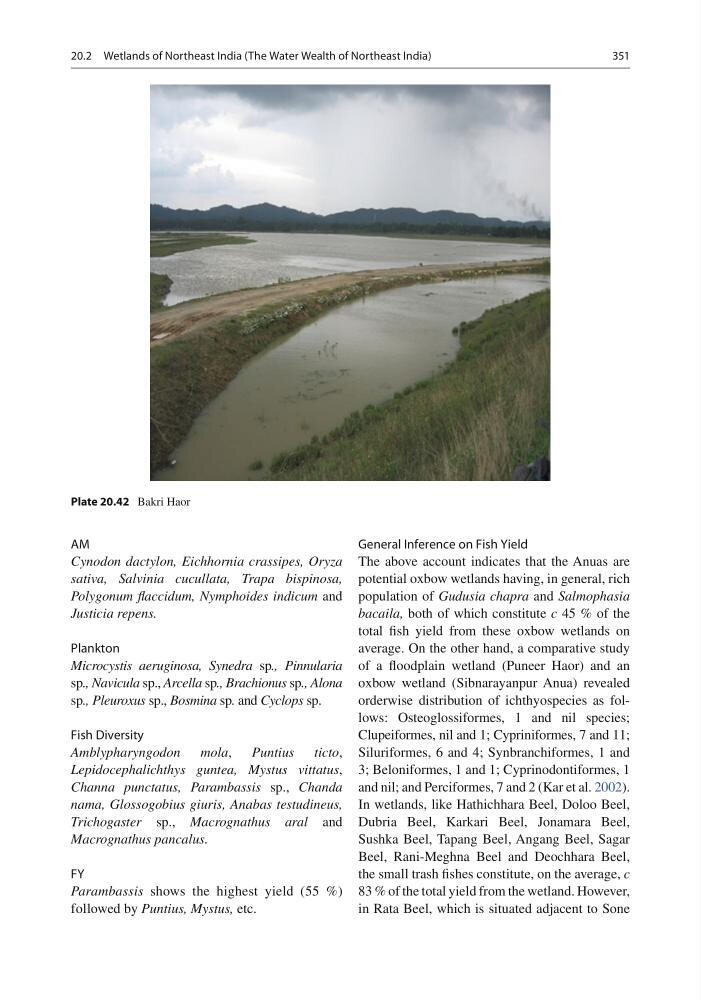
Plate 20.42 Bakri Haor
20.2 Wetlands of Northeast India (The Water Wealth of Northeast India)
AM
Cynodon dactylon, Eichhornia crassipes, Oryza
sativa, Salvinia cucullata, Trapa bispinosa,
Polygonum fl accidum, Nymphoides indicum and
Justicia repens.
Plankton
Microcystis aeruginosa, Synedra sp ., Pinnularia
sp ., Navicula sp., Arcella sp ., Brachionus sp ., Alona
sp ., Pleuroxus sp., Bosmina sp . and Cyclops sp.
Fish Diversity
Amblypharyngodon mola , Puntius ticto ,
Lepidocephalichthys guntea, Mystus vittatus ,
Channa punctatus, Parambassis sp., Chanda
nama, Glossogobius giuris, Anabas testudineus,
Trichogaster sp., Macrognathus aral and
Macrognathus pancalus.
FY
Parambassis shows the highest yield (55 %)
followed by Puntius, Mystus, etc.
General Inference on Fish Yield
The above account indicates that the Anuas are
potential oxbow wetlands having, in general, rich
population of Gudusia chapra and Salmophasia
bacaila, both of which constitute c 45 % of the
total fi sh yield from these oxbow wetlands on
average. On the other hand, a comparative study
of a fl oodplain wetland (Puneer Haor) and an
oxbow wetland (Sibnarayanpur Anua) revealed
orderwise distribution of ichthyospecies as follows: Osteoglossiformes, 1 and nil species;
Clupeiformes, nil and 1; Cypriniformes, 7 and 11;
Siluriformes, 6 and 4; Synbranchiformes, 1 and
3; Beloniformes, 1 and 1; Cyprinodontiformes, 1
and nil; and Perciformes, 7 and 2 (Kar et al. 2002 ).
In wetlands, like Hathichhara Beel, Doloo Beel,
Dubria Beel, Karkari Beel, Jonamara Beel,
Sushka Beel, Tapang Beel, Angang Beel, Sagar
Beel, Rani-Meghna Beel and Deochhara Beel,
the small trash fi shes constitute, on the average, c
83 % of the total yield from the wetland. However,
in Rata Beel, which is situated adjacent to Sone
Plate 20.42 Bakri Haor
20.2 Wetlands of Northeast India (The Water Wealth of Northeast India)