

337
Volvox sp . Ceratium sp ., Fragilaria sp .,
Gyrosigma sp ., Synedra sp ., Pinnularia sp . and
Navicula sp.
Fish Diversity
Gudusia chapra, Amblypharyngodon mola,
Mystus bleekeri , Esomus danricus, Labeo gonius ,
Puntius chola , Puntius ticto, Salmophasia
bacaila, Botia dario, Lepidocephalichthys guntea, Mystus bleekeri , Mystus cavasius, Mystus
tengara, Clarias batrachus, Heteropneustes fossilis, Xenentodon cancila, Channa punctata,
Channa striata , Monopterus cuchia, Parambassis
sp. , Parambassis ranga, Chanda nama, Badis
badis, Oreochromis mossambicus , Glossogobius
giuris, Anabas testudineus, Trichogaster fasciata, Trichogaster sp., Macrognathus aral,
Macrognathus pancalus and Mastacembelus
armatus.
FY
Amblypharyngodon mola usually shows the
highest yield (64 %) followed by Puntius,
Trichogaster, etc.
Puneer Haor
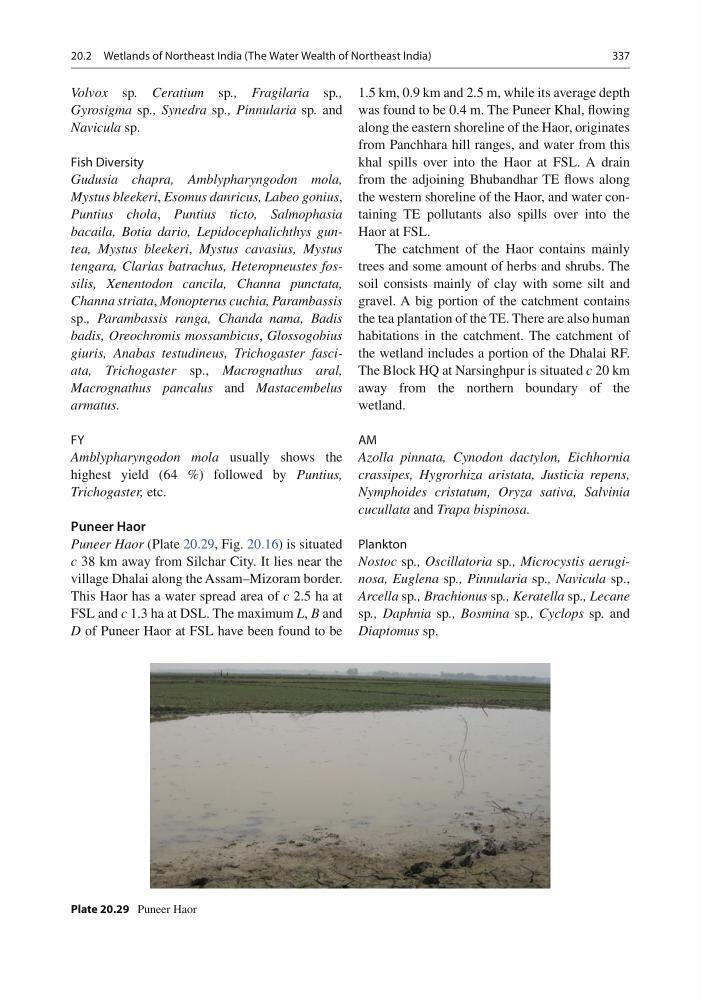
Puneer Haor (Plate 20.29 , Fig. 20.16 ) is situated
c 38 km away from Silchar City. It lies near the
village Dhalai along the Assam–Mizoram border.
This Haor has a water spread area of c 2.5 ha at
FSL and c 1.3 ha at DSL. The maximum L , B and
D of Puneer Haor at FSL have been found to be
1.5 km, 0.9 km and 2.5 m, while its average depth
was found to be 0.4 m. The Puneer Khal, fl owing
along the eastern shoreline of the Haor, originates
from Panchhara hill ranges, and water from this
khal spills over into the Haor at FSL. A drain
from the adjoining Bhubandhar TE fl ows along
the western shoreline of the Haor, and water containing TE pollutants also spills over into the
Haor at FSL.
The catchment of the Haor contains mainly
trees and some amount of herbs and shrubs. The
soil consists mainly of clay with some silt and
gravel. A big portion of the catchment contains
the tea plantation of the TE. There are also human
habitations in the catchment. The catchment of
the wetland includes a portion of the Dhalai RF.
The Block HQ at Narsinghpur is situated c 20 km
away from the northern boundary of the
wetland.
AM
Azolla pinnata, Cynodon dactylon, Eichhornia
crassipes, Hygrorhiza aristata, Justicia repens,
Nymphoides cristatum, Oryza sativa, Salvinia
cucullata and Trapa bispinosa.
Plankton
Nostoc sp ., Oscillatoria sp ., Microcystis aeruginosa, Euglena sp ., Pinnularia sp ., Navicula sp.,
Arcella sp ., Brachionus sp ., Keratella sp ., Lecane
sp ., Daphnia sp ., Bosmina sp ., Cyclops sp . and
Diaptomus sp.
Plate 20.29 Puneer Haor
20.2 Wetlands of Northeast India (The Water Wealth of Northeast India)
Volvox sp . Ceratium sp ., Fragilaria sp .,
Gyrosigma sp ., Synedra sp ., Pinnularia sp . and
Navicula sp.
Fish Diversity
Gudusia chapra, Amblypharyngodon mola,
Mystus bleekeri , Esomus danricus, Labeo gonius ,
Puntius chola , Puntius ticto, Salmophasia
bacaila, Botia dario, Lepidocephalichthys guntea, Mystus bleekeri , Mystus cavasius, Mystus
tengara, Clarias batrachus, Heteropneustes fossilis, Xenentodon cancila, Channa punctata,
Channa striata , Monopterus cuchia, Parambassis
sp. , Parambassis ranga, Chanda nama, Badis
badis, Oreochromis mossambicus , Glossogobius
giuris, Anabas testudineus, Trichogaster fasciata, Trichogaster sp., Macrognathus aral,
Macrognathus pancalus and Mastacembelus
armatus.
FY
Amblypharyngodon mola usually shows the
highest yield (64 %) followed by Puntius,
Trichogaster, etc.
Puneer Haor
Puneer Haor (Plate 20.29 , Fig. 20.16 ) is situated
c 38 km away from Silchar City. It lies near the
village Dhalai along the Assam–Mizoram border.
This Haor has a water spread area of c 2.5 ha at
FSL and c 1.3 ha at DSL. The maximum L , B and
D of Puneer Haor at FSL have been found to be
1.5 km, 0.9 km and 2.5 m, while its average depth
was found to be 0.4 m. The Puneer Khal, fl owing
along the eastern shoreline of the Haor, originates
from Panchhara hill ranges, and water from this
khal spills over into the Haor at FSL. A drain
from the adjoining Bhubandhar TE fl ows along
the western shoreline of the Haor, and water containing TE pollutants also spills over into the
Haor at FSL.
The catchment of the Haor contains mainly
trees and some amount of herbs and shrubs. The
soil consists mainly of clay with some silt and
gravel. A big portion of the catchment contains
the tea plantation of the TE. There are also human
habitations in the catchment. The catchment of
the wetland includes a portion of the Dhalai RF.
The Block HQ at Narsinghpur is situated c 20 km
away from the northern boundary of the
wetland.
AM
Azolla pinnata, Cynodon dactylon, Eichhornia
crassipes, Hygrorhiza aristata, Justicia repens,
Nymphoides cristatum, Oryza sativa, Salvinia
cucullata and Trapa bispinosa.
Plankton
Nostoc sp ., Oscillatoria sp ., Microcystis aeruginosa, Euglena sp ., Pinnularia sp ., Navicula sp.,
Arcella sp ., Brachionus sp ., Keratella sp ., Lecane
sp ., Daphnia sp ., Bosmina sp ., Cyclops sp . and
Diaptomus sp.
Plate 20.29 Puneer Haor
20.2 Wetlands of Northeast India (The Water Wealth of Northeast India)