

294
of the total lentic area (0.12 × 10
6 ha) in Assam.
These lentic systems are generally shallow and
open, ranging in size from 35 to 3,458.12 ha and
with depth ranging from 0.25 to 3.0 m (in some,
however, the maximum depth may exceed 6.0 m)
at FSL. Further, in Assam, there are c 1,392 wetlands having a total of c 22,896 fi sheries of different categories, out of which, the number of
registered wetlands is only 394 (30.38 %) covering an area of c 70,000 ha. Out of this, c 19,000 ha
is in good condition, c 15,000 ha is in semiderelict
condition and c 35,000 ha is in derelict condition
(Govt. of Assam 2006 ). In view of the above,
0.20 lakh tonnes of fi sh is imported to NE India
annually to meet the demands in the domestic
markets.
A brief resume of the fi sh production in different
provinces in NE India is given below (NEC 2010 ):
20.2.2 Satewise Data on Fish
Production in Northeast India
(a) Assam
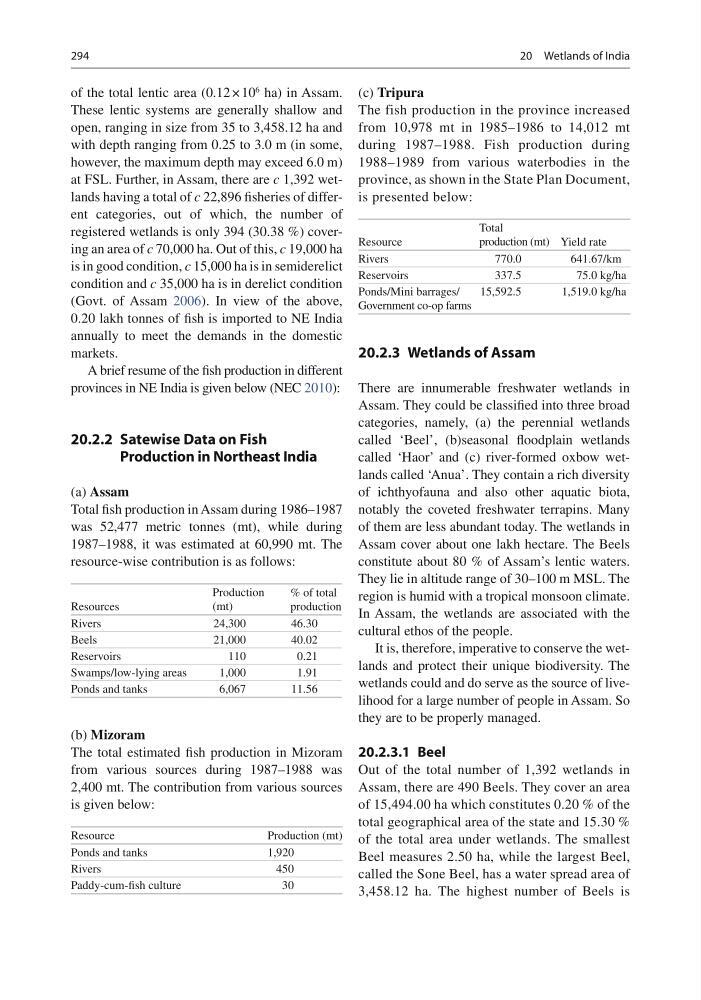
Total fi sh production in Assam during 1986–1987
was 52,477 metric tonnes (mt), while during
1987–1988, it was estimated at 60,990 mt. The
resource-wise contribution is as follows:
Resources
Production
(mt)
% of total
production
Rivers
24,300
46.30
Beels
21,000
40.02
Reservoirs
110
0.21
Swamps/low-lying areas
1,000
1.91
Ponds and tanks
6,067
11.56
(b) Mizoram
The total estimated fi sh production in Mizoram
from various sources during 1987–1988 was
2,400 mt. The contribution from various sources
is given below:
Resource
Production (mt)
Ponds and tanks
1,920
Rivers
450
Paddy-cum-fi sh culture
30
(c) Tripura
The fish production in the province increased
from 10,978 mt in 1985–1986 to 14,012 mt
during 1987–1988. Fish production during
1988–1989 from various waterbodies in the
province, as shown in the State Plan Document,
is presented below:
Resource
Total
production (mt) Yield rate
Rivers
770.0
641.67/km
Reservoirs
337.5
75.0 kg/ha
Ponds/Mini barrages/
Government co-op farms
15,592.5
1,519.0 kg/ha
20.2.3 Wetlands of Assam
There are innumerable freshwater wetlands in
Assam. They could be classifi ed into three broad
categories, namely, (a) the perennial wetlands
called ‘Beel’, (b)seasonal fl oodplain wetlands
called ‘Haor’ and (c) river-formed oxbow wetlands called ‘Anua’. They contain a rich diversity
of ichthyofauna and also other aquatic biota,
notably the coveted freshwater terrapins. Many
of them are less abundant today. The wetlands in
Assam cover about one lakh hectare. The Beels
constitute about 80 % of Assam’s lentic waters.
They lie in altitude range of 30–100 m MSL. The
region is humid with a tropical monsoon climate.
In Assam, the wetlands are associated with the
cultural ethos of the people.
It is, therefore, imperative to conserve the wetlands and protect their unique biodiversity. The
wetlands could and do serve as the source of livelihood for a large number of people in Assam. So
they are to be properly managed.
20.2.3.1 Beel
Out of the total number of 1,392 wetlands in
Assam, there are 490 Beels. They cover an area
of 15,494.00 ha which constitutes 0.20 % of the
total geographical area of the state and 15.30 %
of the total area under wetlands. The smallest
Beel measures 2.50 ha, while the largest Beel,
called the Sone Beel, has a water spread area of
3,458.12 ha. The highest number of Beels is
20 Wetlands of India
of the total lentic area (0.12 × 10
6 ha) in Assam.
These lentic systems are generally shallow and
open, ranging in size from 35 to 3,458.12 ha and
with depth ranging from 0.25 to 3.0 m (in some,
however, the maximum depth may exceed 6.0 m)
at FSL. Further, in Assam, there are c 1,392 wetlands having a total of c 22,896 fi sheries of different categories, out of which, the number of
registered wetlands is only 394 (30.38 %) covering an area of c 70,000 ha. Out of this, c 19,000 ha
is in good condition, c 15,000 ha is in semiderelict
condition and c 35,000 ha is in derelict condition
(Govt. of Assam 2006 ). In view of the above,
0.20 lakh tonnes of fi sh is imported to NE India
annually to meet the demands in the domestic
markets.
A brief resume of the fi sh production in different
provinces in NE India is given below (NEC 2010 ):
20.2.2 Satewise Data on Fish
Production in Northeast India
(a) Assam
Total fi sh production in Assam during 1986–1987
was 52,477 metric tonnes (mt), while during
1987–1988, it was estimated at 60,990 mt. The
resource-wise contribution is as follows:
Resources
Production
(mt)
% of total
production
Rivers
24,300
46.30
Beels
21,000
40.02
Reservoirs
110
0.21
Swamps/low-lying areas
1,000
1.91
Ponds and tanks
6,067
11.56
(b) Mizoram
The total estimated fi sh production in Mizoram
from various sources during 1987–1988 was
2,400 mt. The contribution from various sources
is given below:
Resource
Production (mt)
Ponds and tanks
1,920
Rivers
450
Paddy-cum-fi sh culture
30
(c) Tripura
The fish production in the province increased
from 10,978 mt in 1985–1986 to 14,012 mt
during 1987–1988. Fish production during
1988–1989 from various waterbodies in the
province, as shown in the State Plan Document,
is presented below:
Resource
Total
production (mt) Yield rate
Rivers
770.0
641.67/km
Reservoirs
337.5
75.0 kg/ha
Ponds/Mini barrages/
Government co-op farms
15,592.5
1,519.0 kg/ha
20.2.3 Wetlands of Assam
There are innumerable freshwater wetlands in
Assam. They could be classifi ed into three broad
categories, namely, (a) the perennial wetlands
called ‘Beel’, (b)seasonal fl oodplain wetlands
called ‘Haor’ and (c) river-formed oxbow wetlands called ‘Anua’. They contain a rich diversity
of ichthyofauna and also other aquatic biota,
notably the coveted freshwater terrapins. Many
of them are less abundant today. The wetlands in
Assam cover about one lakh hectare. The Beels
constitute about 80 % of Assam’s lentic waters.
They lie in altitude range of 30–100 m MSL. The
region is humid with a tropical monsoon climate.
In Assam, the wetlands are associated with the
cultural ethos of the people.
It is, therefore, imperative to conserve the wetlands and protect their unique biodiversity. The
wetlands could and do serve as the source of livelihood for a large number of people in Assam. So
they are to be properly managed.
20.2.3.1 Beel
Out of the total number of 1,392 wetlands in
Assam, there are 490 Beels. They cover an area
of 15,494.00 ha which constitutes 0.20 % of the
total geographical area of the state and 15.30 %
of the total area under wetlands. The smallest
Beel measures 2.50 ha, while the largest Beel,
called the Sone Beel, has a water spread area of
3,458.12 ha. The highest number of Beels is
20 Wetlands of India