

284
swamps, (d) non-forested swamps and (e) alluvial
formations. They, further, estimated that about half
of the world’s natural wetlands are situated in the
boreal region between 50° and 70° N; 90 % of the
wetlands in this region was defi ned by them as
‘bogs’ (Matthews 1990 ). Conversely, Aselmann
and Crutzen ( 1989 , 1990 ) had categorised wetlands
in a different way, namely , (a) bogs, (b) fens, (c)
swamps, (d) marshes and (e) fl oodplains. Out of
these, the bogs and fens had accounted for about
60 % of world’s wetlands (3.35 million km
2
). This
estimate is quite close to the 3.46 million km
2 of
northern boreal and subarctic peatlands given by
Gorham ( 1991 ). Further, Aselmann and Crutzen
( 1989 ) had described the bogs and fens as also
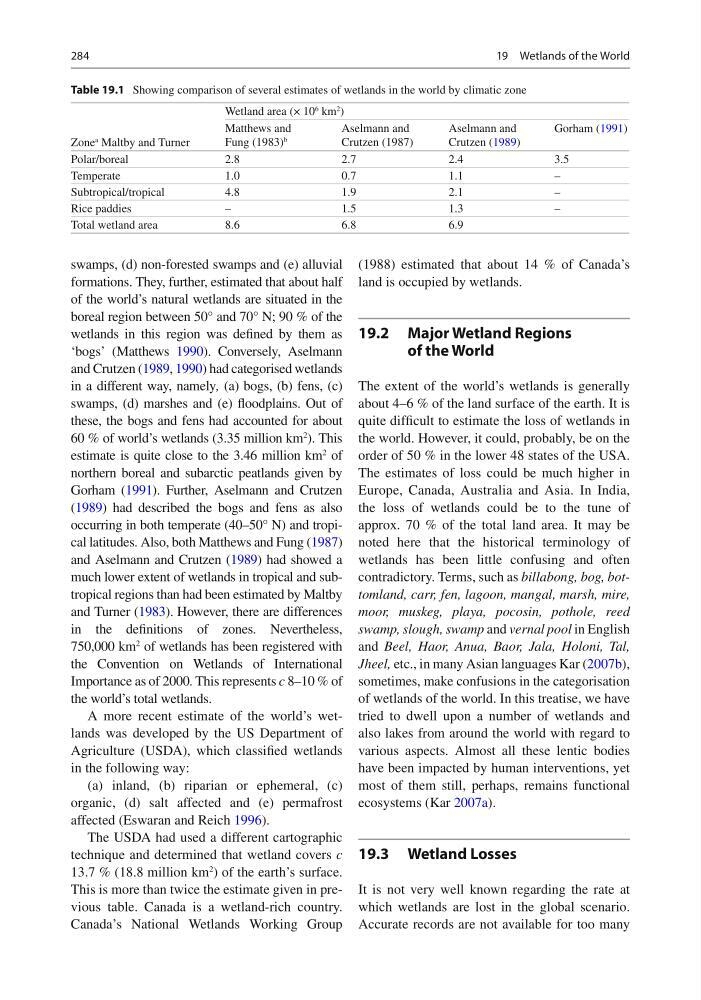
occurring in both temperate (40–50° N) and tropical latitudes. Also, both Matthews and Fung ( 1987 )
and Aselmann and Crutzen ( 1989 ) had showed a
much lower extent of wetlands in tropical and subtropical regions than had been estimated by Maltby
and Turner ( 1983 ). However, there are differences
in the defi nitions of zones. Nevertheless,
750,000 km
2 of wetlands has been registered with
the Convention on Wetlands of International
Importance as of 2000. This represents c 8–10 % of
the world’s total wetlands.
A more recent estimate of the world’s wetlands was developed by the US Department of
Agriculture (USDA), which classifi ed wetlands
in the following way:
(a) inland, (b) riparian or ephemeral, (c)
organic, (d) salt affected and (e) permafrost
affected (Eswaran and Reich 1996 ).
The USDA had used a different cartographic
technique and determined that wetland covers c
13.7 % (18.8 million km
2 ) of the earth’s surface.
This is more than twice the estimate given in previous table. Canada is a wetland-rich country.
Canada’s National Wetlands Working Group
(1988) estimated that about 14 % of Canada’s
land is occupied by wetlands.
19.2 Major Wetland Regions
of the World
The extent of the world’s wetlands is generally
about 4–6 % of the land surface of the earth. It is
quite diffi cult to estimate the loss of wetlands in
the world. However, it could, probably, be on the
order of 50 % in the lower 48 states of the USA.
The estimates of loss could be much higher in
Europe, Canada, Australia and Asia. In India,
the loss of wetlands could be to the tune of
approx. 70 % of the total land area. It may be
noted here that the historical terminology of
wetlands has been little confusing and often
contradictory. Terms, such as billabong, bog, bottomland, carr, fen, lagoon, mangal, marsh, mire,
moor, muskeg, playa, pocosin, pothole, reed
swamp, slough, swamp and vernal pool in English
and Beel, Haor, Anua, Baor, Jala, Holoni, Tal,
Jheel, etc., in many Asian languages Kar ( 2007b ),
sometimes, make confusions in the categorisation
of wetlands of the world. In this treatise, we have
tried to dwell upon a number of wetlands and
also lakes from around the world with regard to
various aspects. Almost all these lentic bodies
have been impacted by human interventions, yet
most of them still, perhaps, remains functional
ecosystems (Kar 2007a ).
19.3 Wetland Losses
It is not very well known regarding the rate at
which wetlands are lost in the global scenario.
Accurate records are not available for too many
Table 19.1 Showing comparison of several estimates of wetlands in the world by climatic zone
Wetland area (× 10
6 km
2 )
Zone
a Maltby and Turner
Matthews and
Fung (1983)
b
Aselmann and
Crutzen (1987)
Aselmann and
Crutzen ( 1989 )
Gorham ( 1991 )
Polar/boreal
2.8
2.7
2.4
3.5
Temperate
1.0
0.7
1.1
–
Subtropical/tropical
4.8
1.9
2.1
–
Rice paddies
–
1.5
1.3
–
Total wetland area
8.6
6.8
6.9
19 Wetlands of the World
swamps, (d) non-forested swamps and (e) alluvial
formations. They, further, estimated that about half
of the world’s natural wetlands are situated in the
boreal region between 50° and 70° N; 90 % of the
wetlands in this region was defi ned by them as
‘bogs’ (Matthews 1990 ). Conversely, Aselmann
and Crutzen ( 1989 , 1990 ) had categorised wetlands
in a different way, namely , (a) bogs, (b) fens, (c)
swamps, (d) marshes and (e) fl oodplains. Out of
these, the bogs and fens had accounted for about
60 % of world’s wetlands (3.35 million km
2
). This
estimate is quite close to the 3.46 million km
2 of
northern boreal and subarctic peatlands given by
Gorham ( 1991 ). Further, Aselmann and Crutzen
( 1989 ) had described the bogs and fens as also
occurring in both temperate (40–50° N) and tropical latitudes. Also, both Matthews and Fung ( 1987 )
and Aselmann and Crutzen ( 1989 ) had showed a
much lower extent of wetlands in tropical and subtropical regions than had been estimated by Maltby
and Turner ( 1983 ). However, there are differences
in the defi nitions of zones. Nevertheless,
750,000 km
2 of wetlands has been registered with
the Convention on Wetlands of International
Importance as of 2000. This represents c 8–10 % of
the world’s total wetlands.
A more recent estimate of the world’s wetlands was developed by the US Department of
Agriculture (USDA), which classifi ed wetlands
in the following way:
(a) inland, (b) riparian or ephemeral, (c)
organic, (d) salt affected and (e) permafrost
affected (Eswaran and Reich 1996 ).
The USDA had used a different cartographic
technique and determined that wetland covers c
13.7 % (18.8 million km
2 ) of the earth’s surface.
This is more than twice the estimate given in previous table. Canada is a wetland-rich country.
Canada’s National Wetlands Working Group
(1988) estimated that about 14 % of Canada’s
land is occupied by wetlands.
19.2 Major Wetland Regions
of the World
The extent of the world’s wetlands is generally
about 4–6 % of the land surface of the earth. It is
quite diffi cult to estimate the loss of wetlands in
the world. However, it could, probably, be on the
order of 50 % in the lower 48 states of the USA.
The estimates of loss could be much higher in
Europe, Canada, Australia and Asia. In India,
the loss of wetlands could be to the tune of
approx. 70 % of the total land area. It may be
noted here that the historical terminology of
wetlands has been little confusing and often
contradictory. Terms, such as billabong, bog, bottomland, carr, fen, lagoon, mangal, marsh, mire,
moor, muskeg, playa, pocosin, pothole, reed
swamp, slough, swamp and vernal pool in English
and Beel, Haor, Anua, Baor, Jala, Holoni, Tal,
Jheel, etc., in many Asian languages Kar ( 2007b ),
sometimes, make confusions in the categorisation
of wetlands of the world. In this treatise, we have
tried to dwell upon a number of wetlands and
also lakes from around the world with regard to
various aspects. Almost all these lentic bodies
have been impacted by human interventions, yet
most of them still, perhaps, remains functional
ecosystems (Kar 2007a ).
19.3 Wetland Losses
It is not very well known regarding the rate at
which wetlands are lost in the global scenario.
Accurate records are not available for too many
Table 19.1 Showing comparison of several estimates of wetlands in the world by climatic zone
Wetland area (× 10
6 km
2 )
Zone
a Maltby and Turner
Matthews and
Fung (1983)
b
Aselmann and
Crutzen (1987)
Aselmann and
Crutzen ( 1989 )
Gorham ( 1991 )
Polar/boreal
2.8
2.7
2.4
3.5
Temperate
1.0
0.7
1.1
–
Subtropical/tropical
4.8
1.9
2.1
–
Rice paddies
–
1.5
1.3
–
Total wetland area
8.6
6.8
6.9
19 Wetlands of the World